Vacuum lifting & industrial handlingVacuum lifting equipment
EN

Search Easytech

Try a material or application

Case studies

Vacuum lifting case studies

Explore vacuum lifting projects for bags, cartons, glass, sheet metal, doors and pails: real equipment, drawings, site constraints and selection decisions.

17 cases

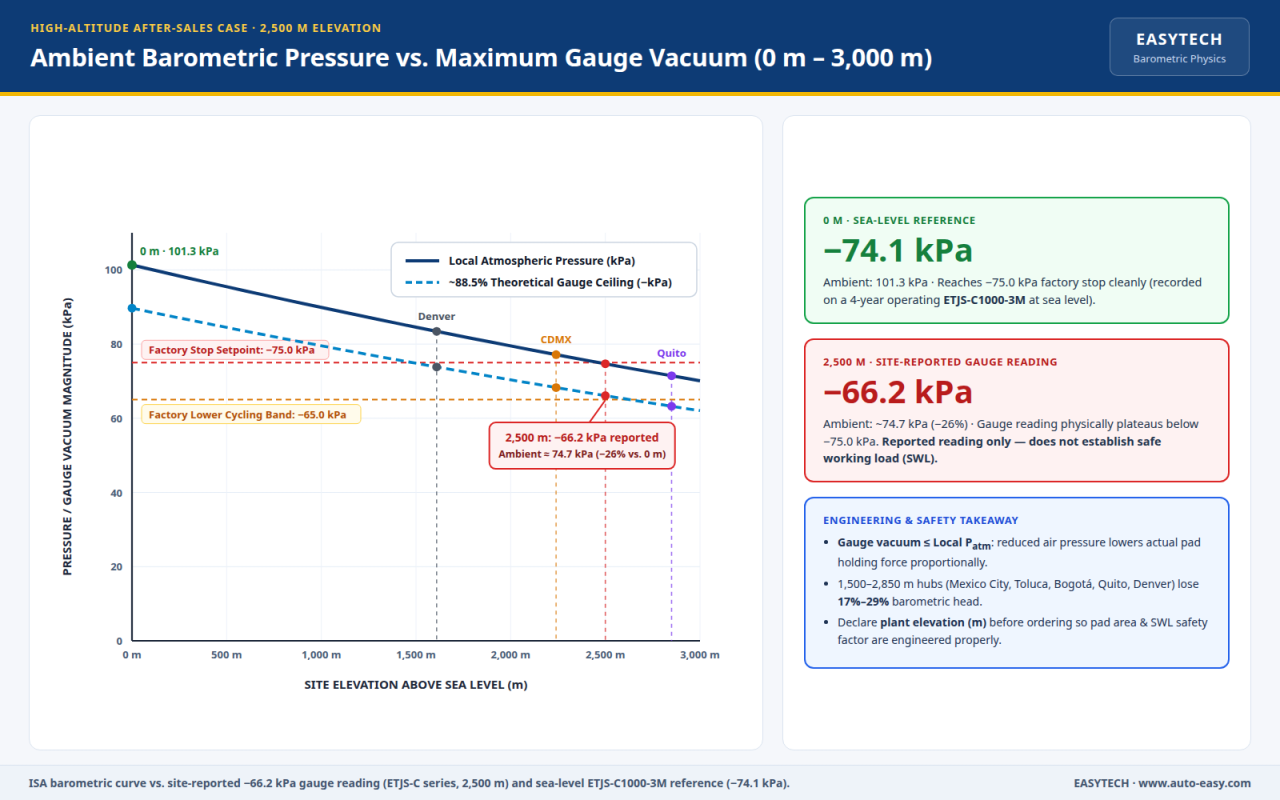
ISA barometric pressure curve from sea level (101.3 kPa, −74.1 kPa reference on ETJS-C1000-3M) to 2,500 m (~74.7 kPa ambient, −66.2 kPa site-reported gauge reading on ETJS-C series; gauge reading alone does not establish safe working load).

On-site handling

Why a sheet-metal vacuum lifter only reached −66 kPa at 2,500 m elevation: real after-sales diagnosis

A metalworking plant at 2,500 m elevation reported its ETJS-C series vacuum lifter reached only −66.2 kPa instead of the factory −75.0 kPa stop setpoint. After structured unloaded checks ruled out seal leaks and voltage drop, Easytech traced the gauge ceiling to local barometric pressure (~74.7 kPa, about 26% below sea level)—and explains why −66.2 kPa cannot establish safe working load on its own.

Reported site reading
−66.2 kPa gauge readingSite-reported digital switch reading against −75.0 kPa factory stop setpoint; does not establish safe working load (SWL)
Field & reference units
ETJS-C series (site) / ETJS-C1000-3M (0 m)ETJS-C heavy-duty sheet-metal vacuum lifter at 2,500 m compared with a 4-year ETJS-C1000-3M at sea level
Plant elevation
2,500 m above sea levelAmbient barometric pressure drops to ~74.7 kPa (~26% below 101.3 kPa sea level)
Explore this case
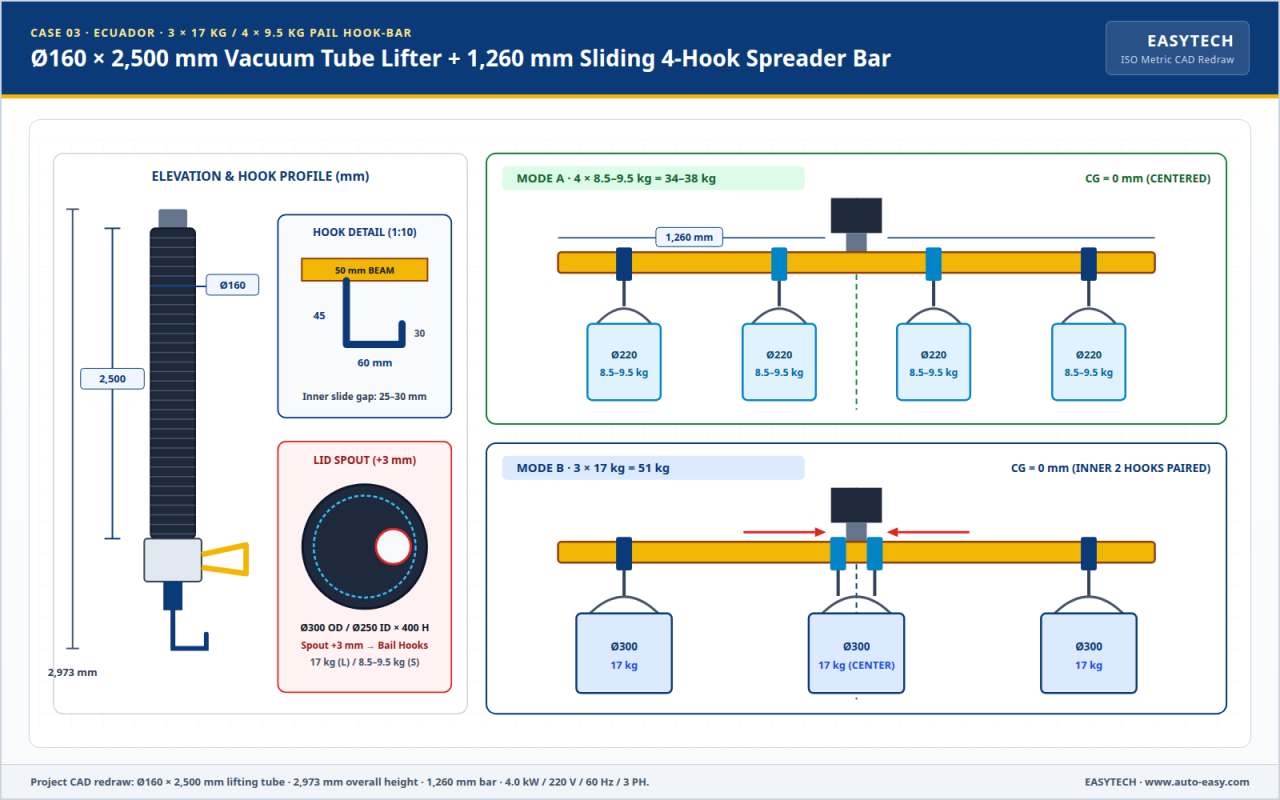
ISO metric engineering CAD redraw of an Easytech 160 by 2,500 mm vacuum tube lifter with a 1,260 mm sliding four-hook spreader bar comparing 4 small pails (34 to 38 kg) and 3 large pails (51 kg) with paired inner hooks keeping center of gravity centered.

Sample test

Lifting 3 large or 4 small paint pails at once without suction cups: Ecuador hook-bar tube lifter

A fast-moving paint plant in Ecuador needed to palletize either three 17 kg pails or four 8.5–9.5 kg pails in a single lift, but rejected vacuum suction cups because of raised pouring spouts and bail-handle workflow. Easytech paired a Ø160 × 2,500 mm vacuum tube lifter with a 1,260 mm four-hook spreader bar whose two middle hooks slide together to keep the center of gravity centered.

Large pail lift
3 × 17 kg = 51 kgØ30 cm OD / Ø25 cm ID × 40 cm H spouted pail (~3 mm raised lid spout); middle 2 hooks paired at center
Small pail lift
4 × 8.5–9.5 kg = 34–38 kgØ22 cm ID × 40 cm H spouted pail (~3 mm raised lid spout); all 4 hooks spread evenly
Hook spreader bar
1,260 mm span, 4 hooksCustom CAD assembly (45 mm drop × 60 mm tip × 30 mm throat); 2 outer hooks + 2 sliding inner hooks
Explore this case
After-sales workshop photograph showing a torn lower corrugated vacuum lifting tube and detached internal spring above the rectangular sponge suction head and yellow two-hand extended control handle.

On-site handling

Energy storage battery packs and two lifting-tube failures: what broke, how it was fixed, and 4 years of stable operation

A battery energy-storage plant replaced manual pack lifting with a vacuum tube lifter under a 3.6 m fire-pipe ceiling, then suffered two identical lifting-tube tears within its first four months. Here is what actually failed, why vacuum differential—not the internal spring—carries the load, how damaged tube ends are remediated, and what produced four trouble-free years afterward.

Workpiece loads
42–50 kg (initial) to 80 kg packs2021 commissioning spec covered 50 kg cartons (610 × 530 × 310 mm; bare pack 512 × 442 × 222 mm); peak factory production handled 80 kg storage packs
Peak plant volume
6–10 containers / monthHigh-season shipping volume driving shift from manual crews to tube-lifter palletizing
Ceiling & jib layout
3.6 m fire pipe / 3 m jib arm3,350 mm under-beam clearance, 270° slewing with wall limit stop, 1,700 mm vertical stroke
Explore this case
Easytech 300 kg battery-powered forklift sheet-metal vacuum lifter gripping a steel plate during factory pre-shipment inspection with green warning tower light illuminated, twin fork pockets and adjustable standing feet.

Sample test

Forklift-mounted battery vacuum lifters from 300 kg to 1,000 kg: remote control, fork lock and pre-shipment checks

Handling flat steel plates where no overhead crane reaches requires rethinking power, operator controls and load retention from the forklift cab. This project series grew out of one customer's forklift requirement into 300 kg to 1,000 kg battery-powered vacuum attachments verified in both manual and wireless remote modes before dispatch.

Series capacity range
300 / 600 / 800 / 1,000 kgStandardized series developed from forklift handling demand; catalog models ET-AT-METAL-300 and ET-AT-METAL-600 plus custom 800–1,000 kg builds
Inspected 300 kg unit
12 V DC, 80 W, 8 padsFactory pre-shipment inspection on ETJS-J300-2M with steel test plate
Inspected 1,000 kg unit
10 suction pads, twin fork pocketsFactory load-test build with top crane lifting eye for dual forklift/crane use
Explore this case
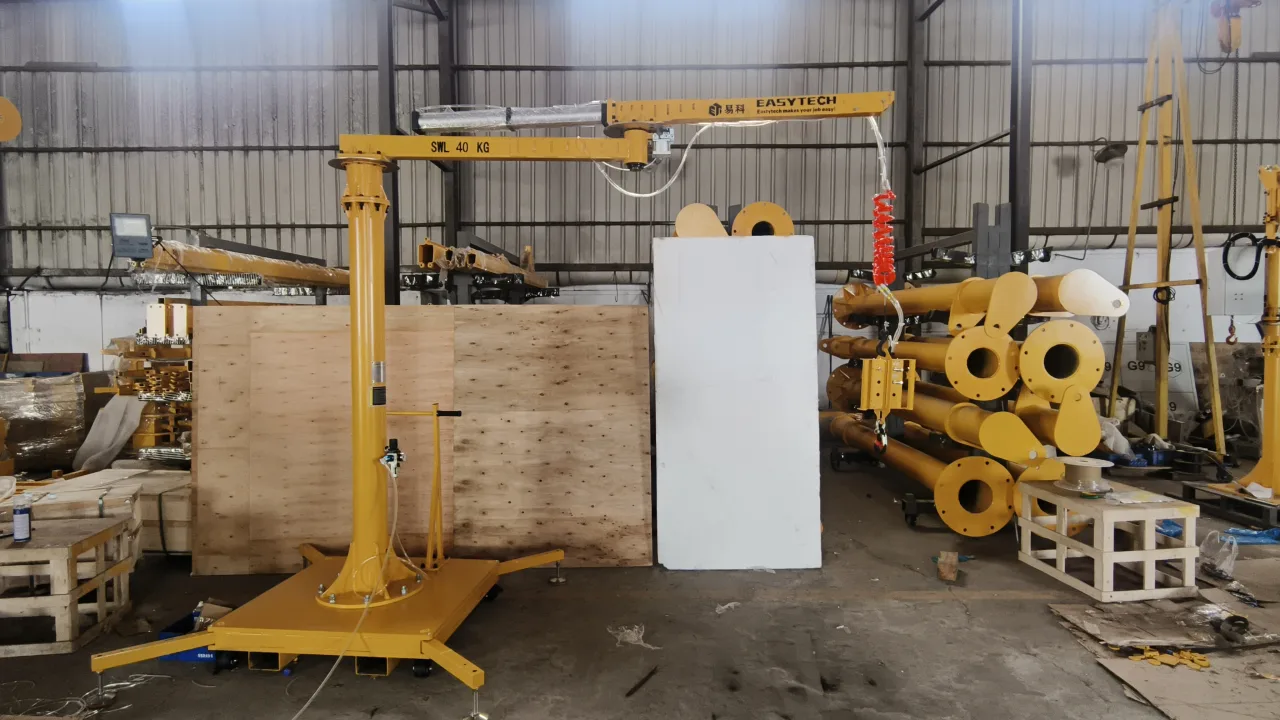
The assembled pneumatic wire-rope manipulator, folding arm and supported mobile base at the factory.

Design study

Moving pails with a pneumatic wire-rope manipulator: grip, reach and placement

A full pail is not only heavy. Its handle changes the pickup height, its body needs space beside the machine, and the final task may be placing it—or emptying it. This project uses a pneumatic wire-rope manipulator with a hook for pail handling, so the attachment, operator position and receiving point need to be considered together.

Machine capacity
40 kgETJSB-Q100 wire-rope manipulator
Air pressure
0.5–0.6 MPaMachine nameplate
Load connection
HookThe pail lifting point must suit the filled container
Explore this case
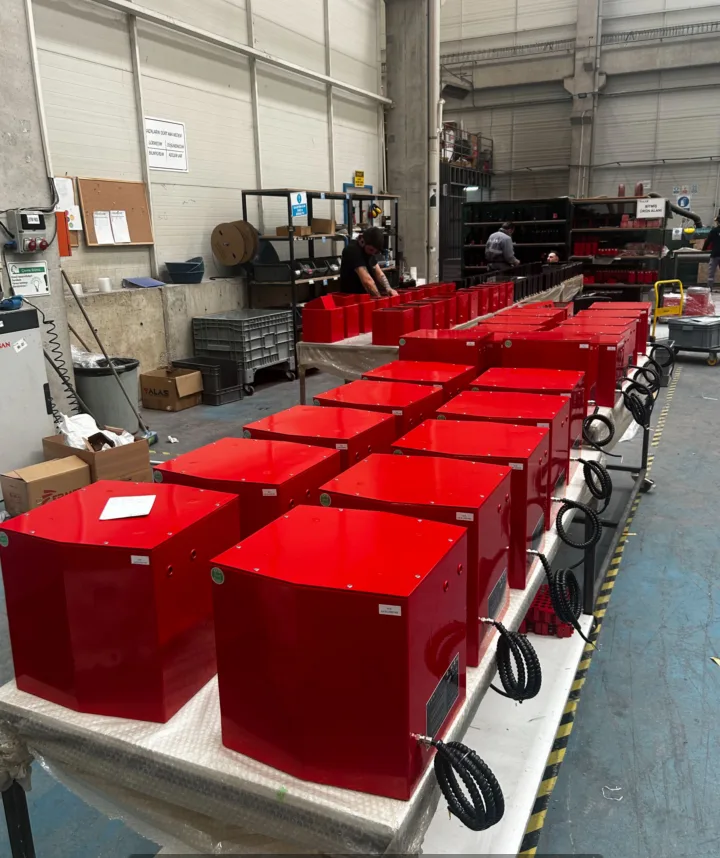
The formed red metal parts considered for the project, with raised edges and different contact surfaces.

Design study

Lifting formed sheet-metal housings: choosing the grip before the lifting device

A folded metal housing may have plenty of surface area but very little usable space for a suction pad. This project study starts with that distinction: where can the part be gripped, how will it hang, and what must happen between pickup and placement?

Proposed capacity
45 kgCustom project configuration; not a generic model rating
Suction pads
2 × 85 × 200 mmRectangular pads on a 350 mm beam
Lifting tube
Ø120 mm × 2,550 mmLater tube-lifter proposal
Explore this case
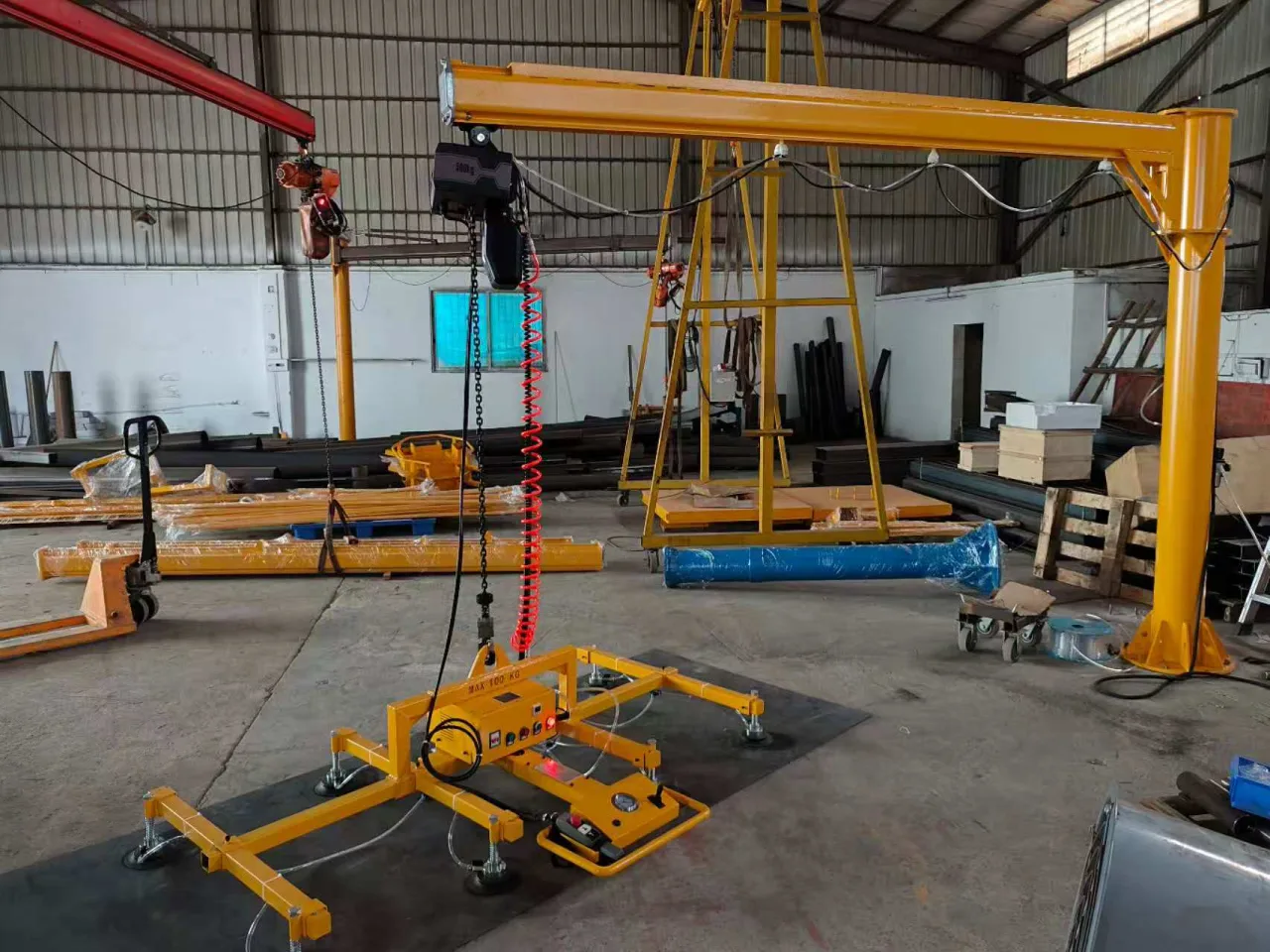
Factory assembly of the jib, electric chain hoist and vacuum lifting frame for the door-panel project.

Design study

Loading door panels onto a gluing machine: pad access and usable lifting height

A door panel has to arrive at the gluing machine in the right position, with its usable surfaces accessible and enough clearance to lower it onto the bed. This project combines a jib crane, electric chain hoist and vacuum frame, with different pad shapes for the required panel surfaces.

Vacuum-frame marking
Maximum 100 kgA higher-rated hoist does not increase this limit
Pad tooling
Round and ovalMatch the permitted gripping zones
Proposed lifting-face height
1,270 mmLayout calculation: 2,600 − 250 − 530 − 550 mm
Explore this case
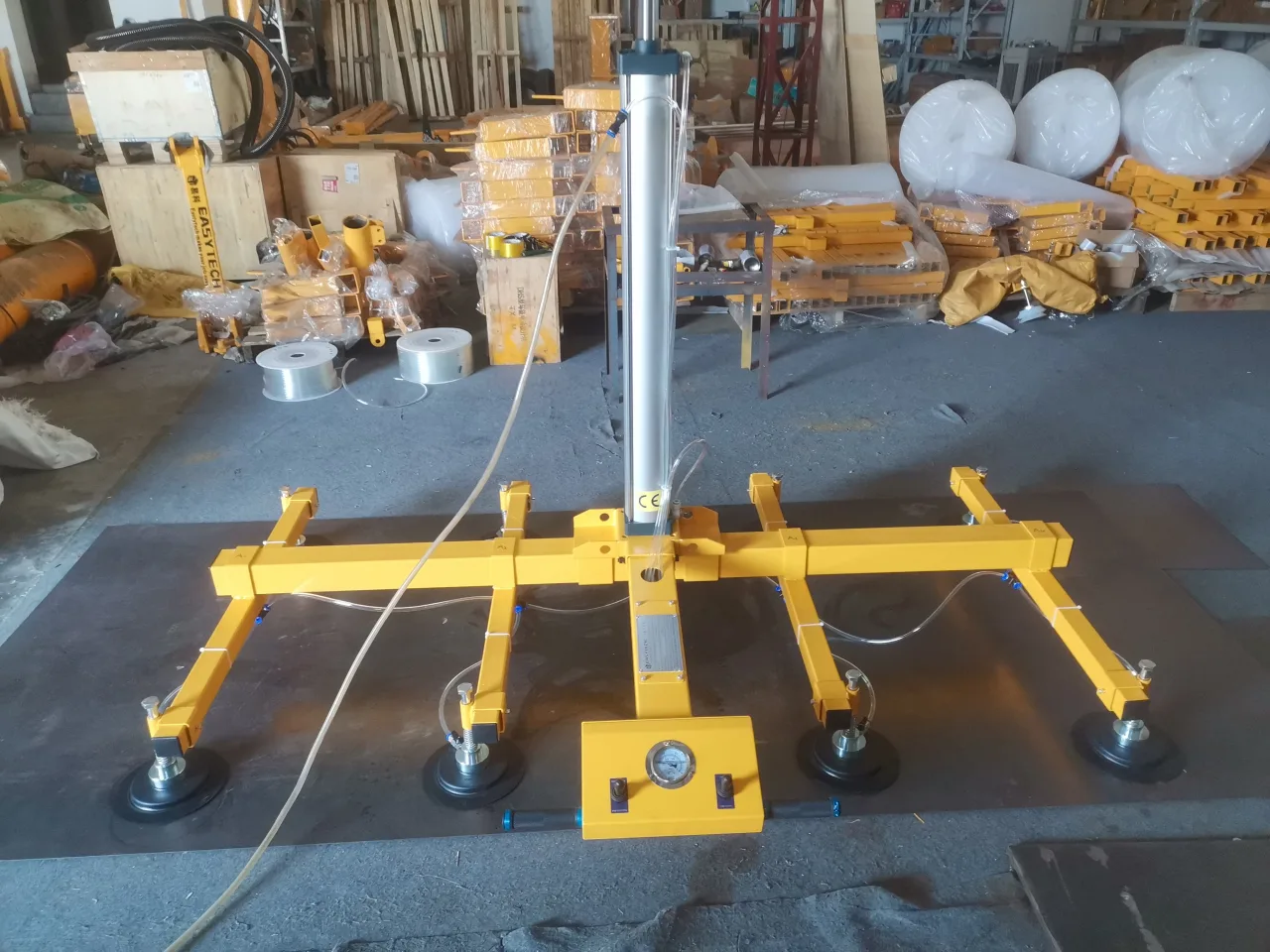
The assembled vacuum frame and upright pneumatic lifting mechanism before installation at the customer's workshop.

Design study

A pneumatic vacuum lifting station for a height-limited workshop

Lowering a crane column can make a lifting station fit beneath a roof. It can also remove the height needed to pick up and place the load. This Australian project pairs a reduced-height jib layout with a pneumatic lifting mechanism and vacuum frame, making the whole vertical stack the starting point for selection.

Column height
3,220 mmOverall height in the project drawing
Rail underside
2,740 mmNot the workpiece lifting height
Pad-plane height
1,020 mmIllustrated position, not the travel limit
Explore this case
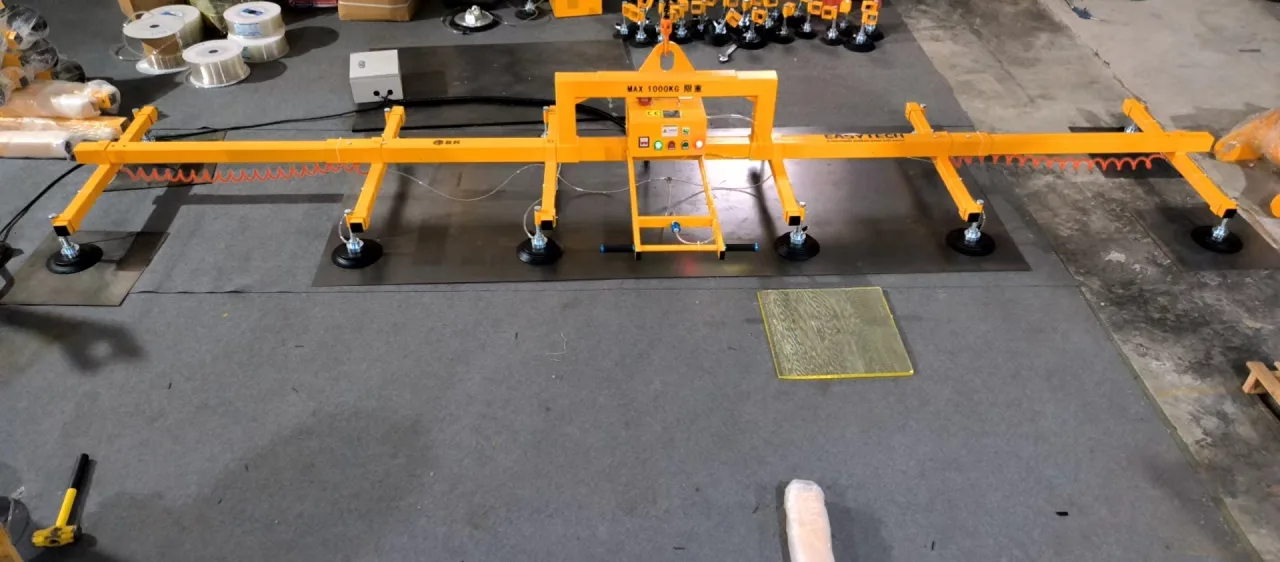
The assembled telescopic vacuum frame, with crossbars and suction pads distributed along its length.

Sample test

Handling 2–6 m steel sheets with one telescopic vacuum lifter

A short sheet and a long sheet can weigh the same and still need very different support. This Indonesian project used a telescopic vacuum frame to handle a specified sheet-length range of 2–6 m. The useful part of the design is how the frame brings the pads to the sheet—not simply its 1,000 kg capacity.

Specified capacity
1,000 kgHorizontal handling with the specified pad arrangement
Sheet lengths
2–6 mWorkpiece requirement, not beam extension length
Suction pads
12 × Ø200 mmConfiguration of this assembly
Explore this case
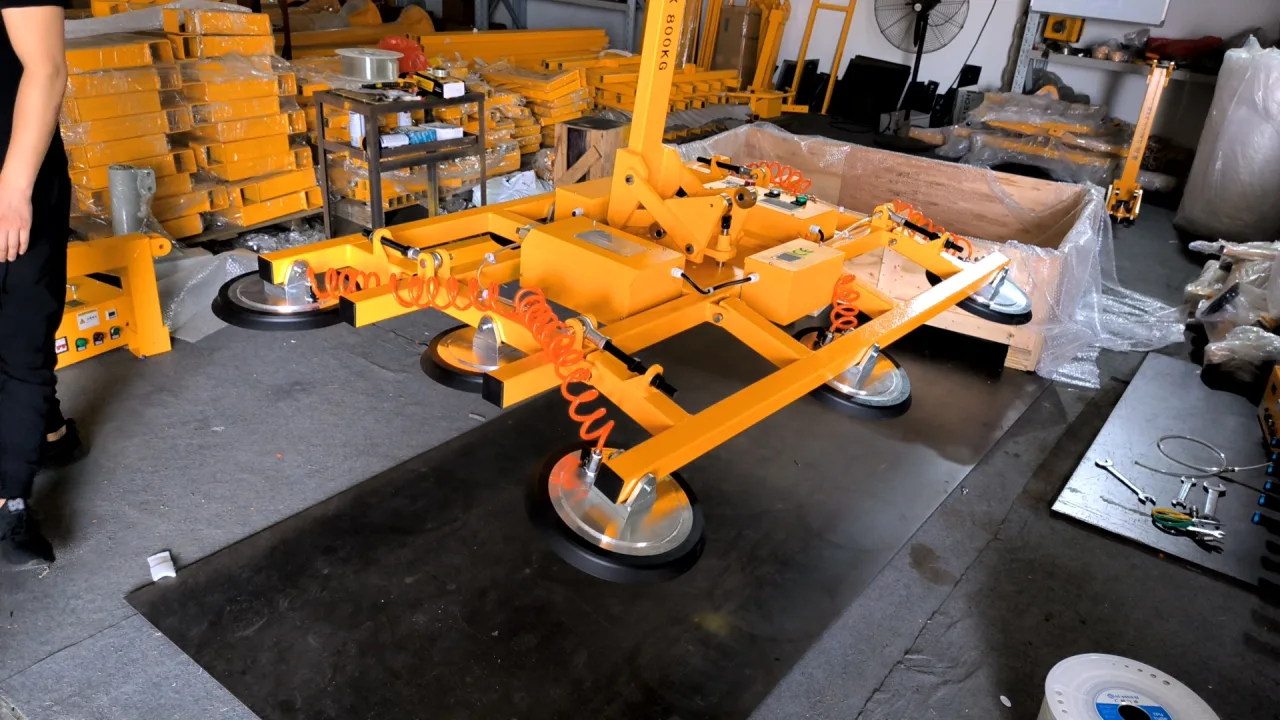
Custom eight-pad glass vacuum lifter assembled at the factory for the Singapore project.

Sample test

An 800 kg glass lifter for curved and flat panes: Singapore project

How an adjustable eight-pad frame combines curved and flat glass handling, manual tilt and rotation, and battery-powered vacuum in one custom Singapore project.

Project
SingaporeCustom curved- and flat-glass lifter
Rated capacity
800 kgRating for this project configuration; glass geometry and pad arrangement must also match the lifting task.
Suction pads
8 × Ø300 mmEight pads in the specified assembly
Explore this case
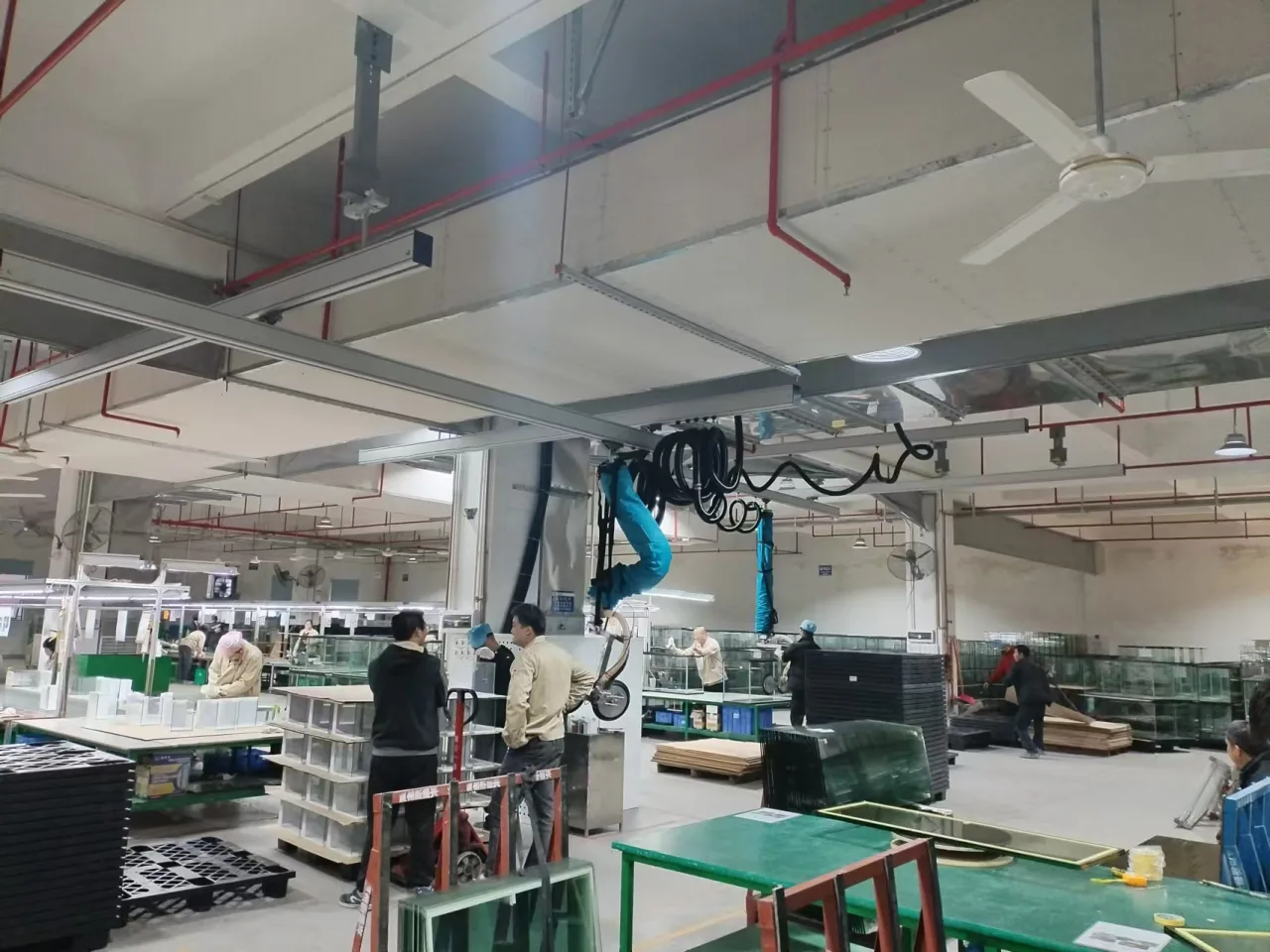
Installed overhead rails and tube lifter at the aquarium production station

On-site handling

Aquarium packing with an overhead tube lifter: load, access and rail layout

An aquarium-production case separates a 70 kg workpiece requirement from an 80 kg equipment configuration and checks gripping access, packing height and a 5 × 5 m rail workspace.

Workpiece requirement
70 kgWeight in the application requirements attachment
Equipment configuration
80 kgSpecified tube-lifter configuration; not a rating for every aquarium
Largest stated tank
1,200 × 400 × 800 mmRequirement includes internal partitions
Explore this case
Trial image of the lifting tube and elongated contact head for the warm-material project

Sample test

Vacuum handling of 10 kg warm butter packs: what the sample trial changed

A sample-led handling project compared warm and cooled product conditions and revised the pad arrangement and lifting tube. The 78°C figure describes the sample test.

Application mass
10 kgProject-specific handling requirement
Sample temperature
78°CTemperature stated for the heated sample trial; not an overall equipment rating
Contact arrangement
Five pads to sixInitial trial and later production arrangement described in the project narrative
Explore this case
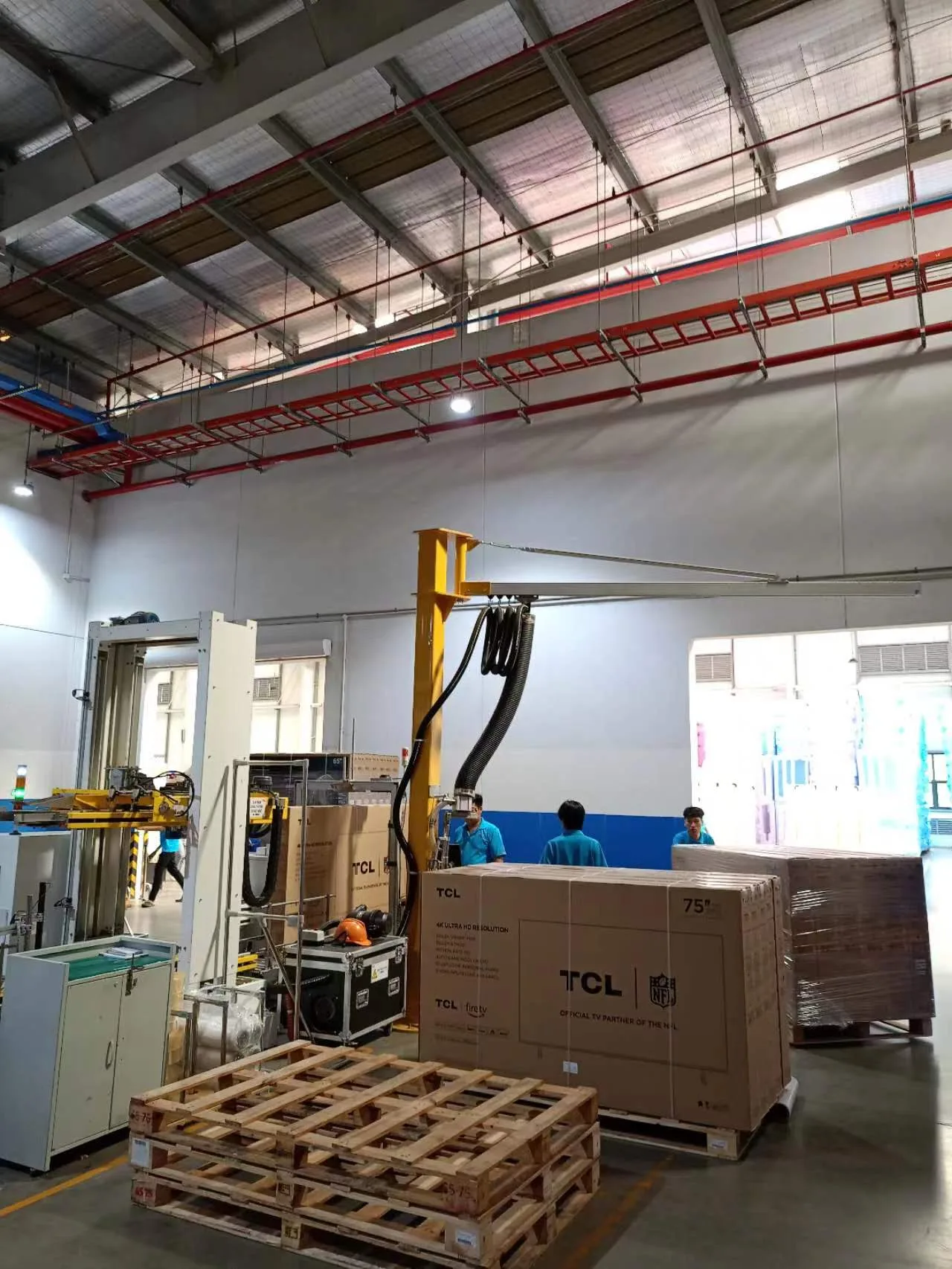
Suspended tube lifter beside narrow television cartons and pallets

Installed arrangement

Side-grip handling of narrow television cartons

A production-to-pallet handling case where cartons only 145–190 mm wide made the contact face and approach angle more critical than maximum lifting capacity.

Workpiece load
Up to 45 kgMaximum carton weight in the project-specific handling proposal
Carton width
145–190 mmFour documented packaging sizes
Carton length
1,265–1,850 mmPackaging dimensions, not screen dimensions
Explore this case
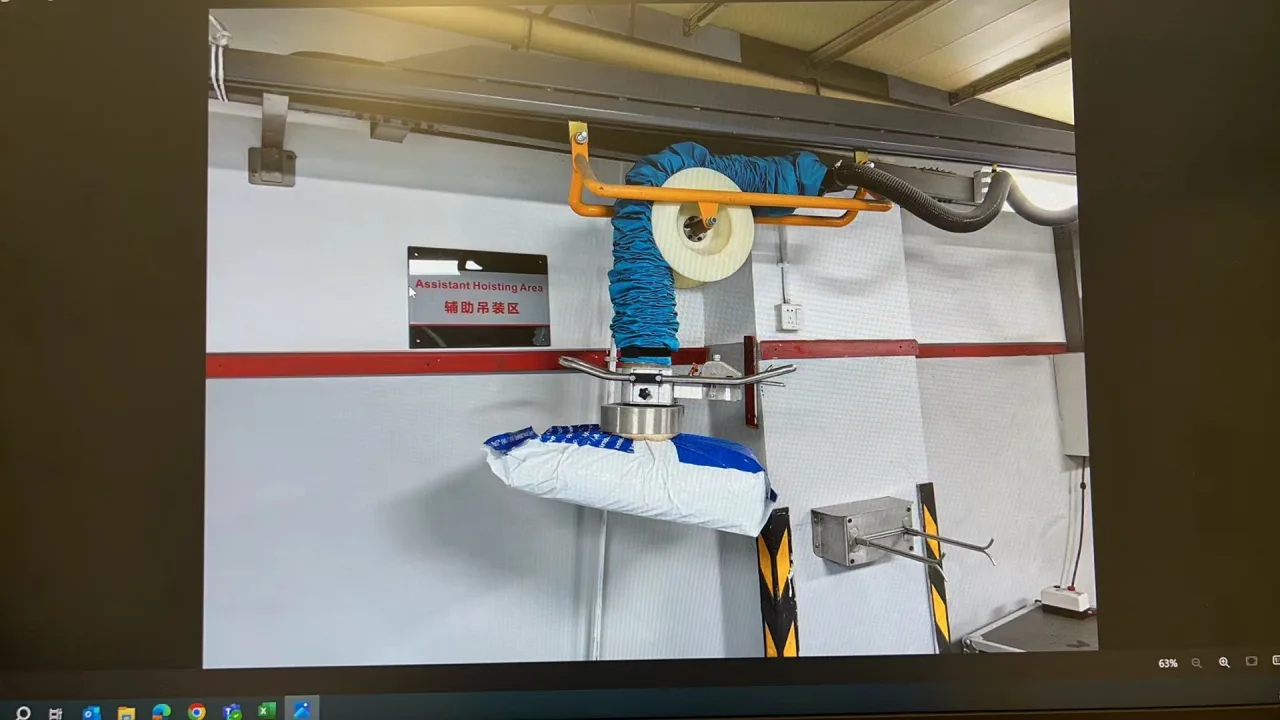
Folded vacuum lifting tube and sealed bag beneath the low ceiling

Installed arrangement

Bag feeding beneath a 2.6 m ceiling: a folded-tube lifting layout

How a folded lifting tube addressed restricted headroom for bags up to 30 kg, and why the design traded arm reach for vertical working space.

Bag load
Up to 30 kgProject requirement for sealed bags of plastic pellets
Effective building height
2,600 mmAvailable height stated in the site requirements
Transfer levels
300–1,700 mmRequested range; not a measured acceptance result
Explore this case

Photographs from handling discussions and installation

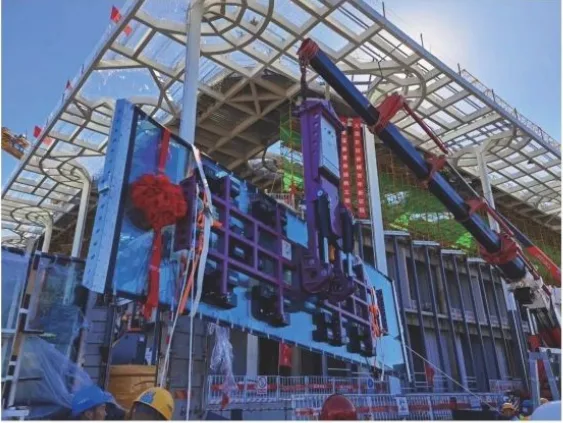
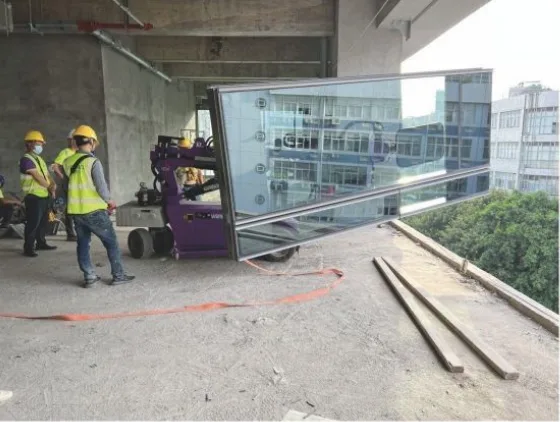
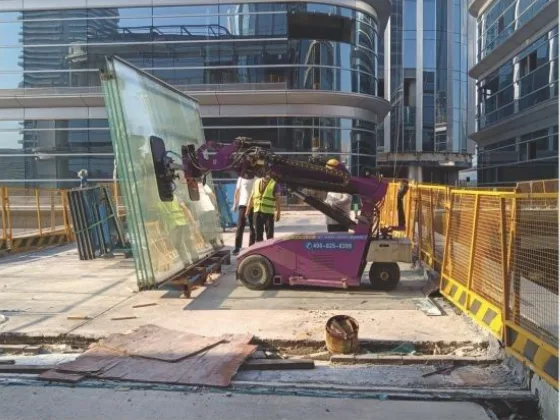
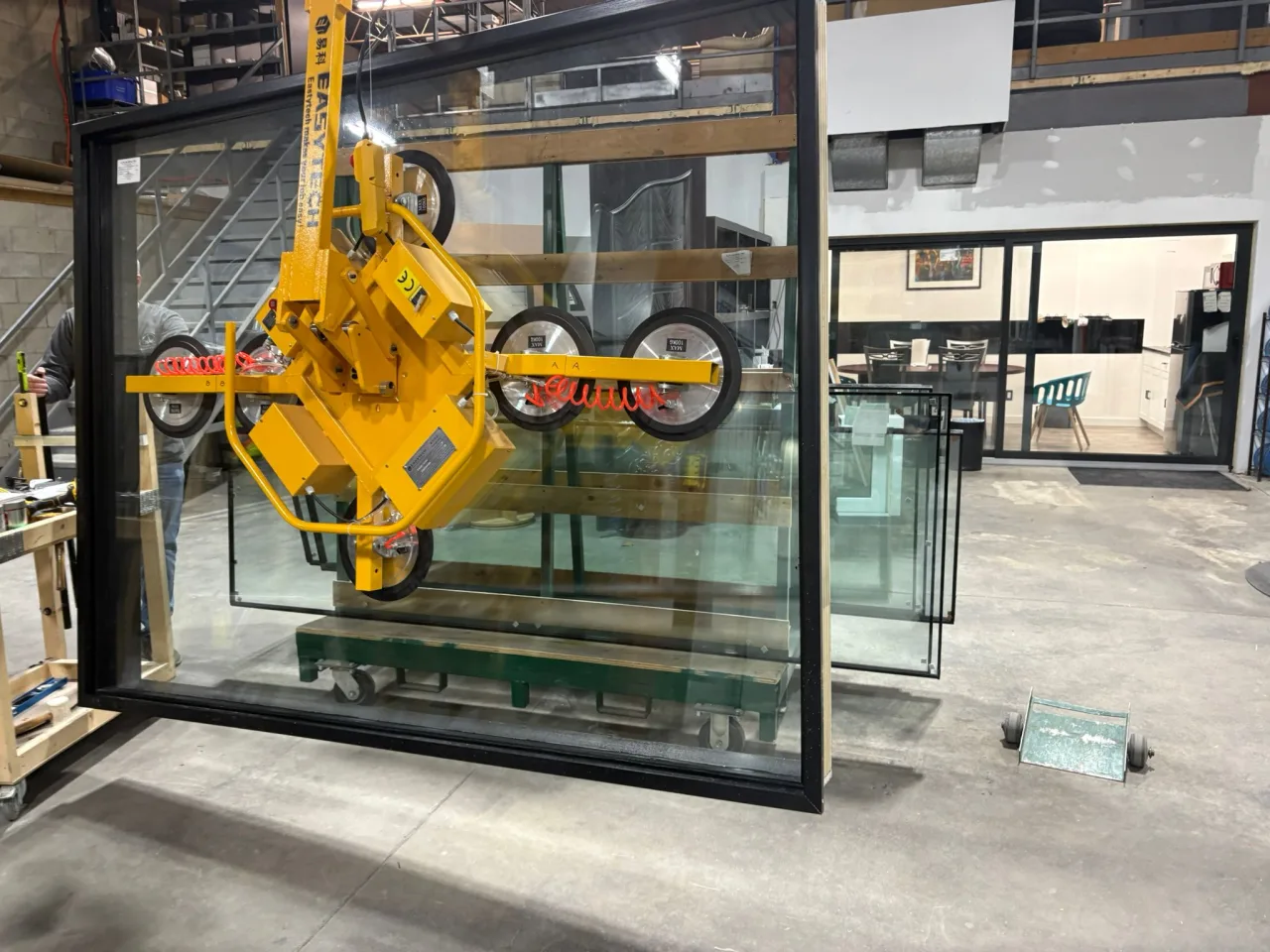
A vacuum frame holding a glass panel at an installation site. Application reference; check the specifications for your selected configuration.

Use these project examples to see how real handling setups work, then send us your own workpiece dimensions, surface details and site layout for a matched equipment recommendation.

Meet the people and process behind Easytech

Content updated

GET A QUOTE

Need a price or model recommendation?

Send your workpiece weight, size, or a photo — Jenny replies within 24 hours.

MOQ: 1 unit · Reply within 24 hours

WhatsApp
WhatsAppQuote now