
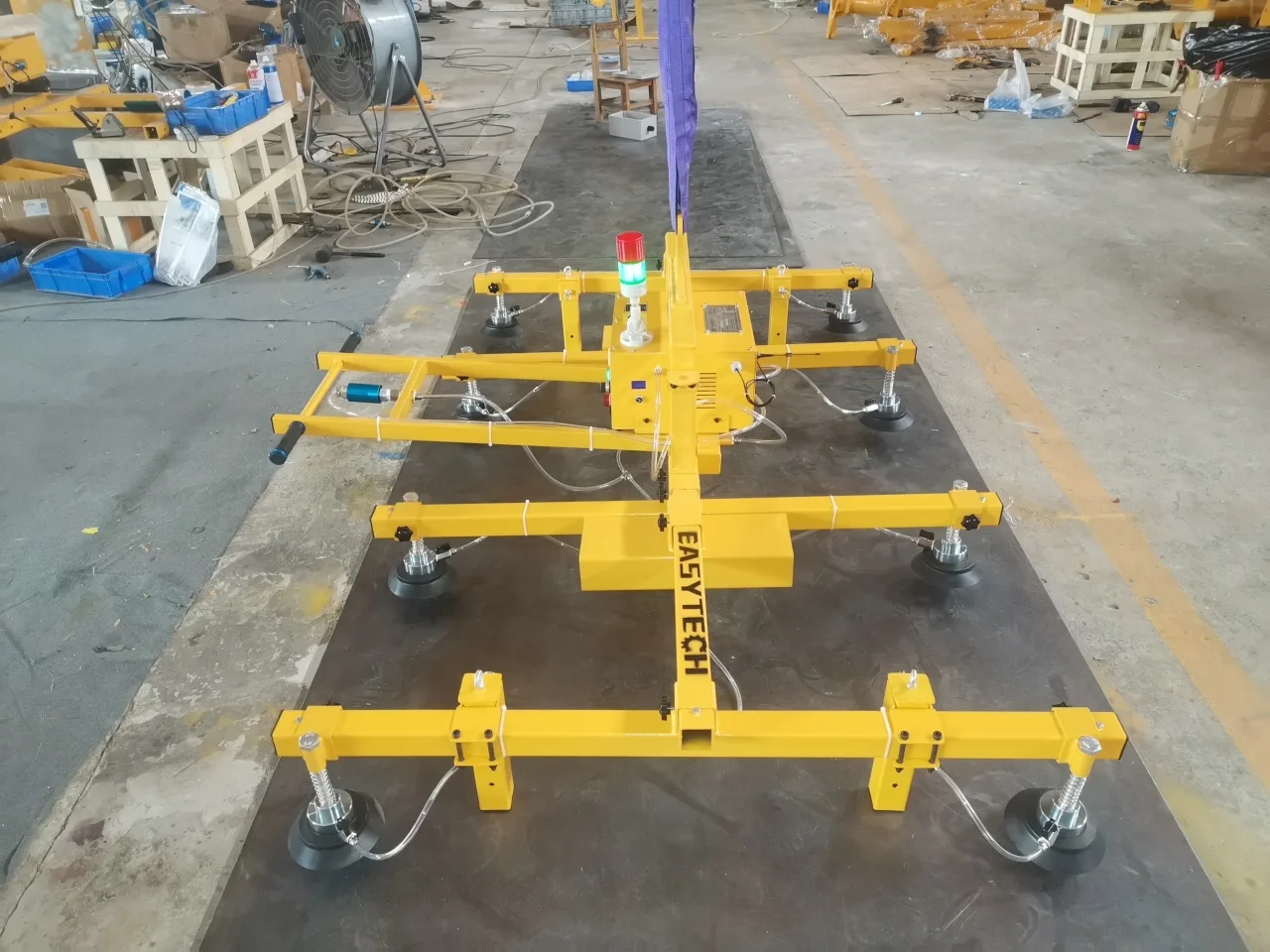
Why a crane vacuum lifter cannot simply be hung on forklift tines
This product family started from a practical plant constraint: a customer needed to move flat metal sheets across bays and loading zones where no bridge crane or jib existed, using an existing forklift. Hanging a standard mains-powered crane lifter from a fork hook fails immediately in real operation because power cables snag on aisles, the operator cannot climb out of the cab for every attach and release cycle, and braking inertia can slide an unsecured frame forward along smooth steel forks.
To address that operating reality, Easytech engineered a dedicated forklift-mounted vacuum frame and standardized it across 300 kg, 600 kg, 800 kg and 1,000 kg builds, including the catalog Forklift Sheet Metal Vacuum Lifter ET-AT-METAL-300 and ET-AT-METAL-600 alongside heavier custom 10-pad configurations.
Five design decisions driven by the forklift cab
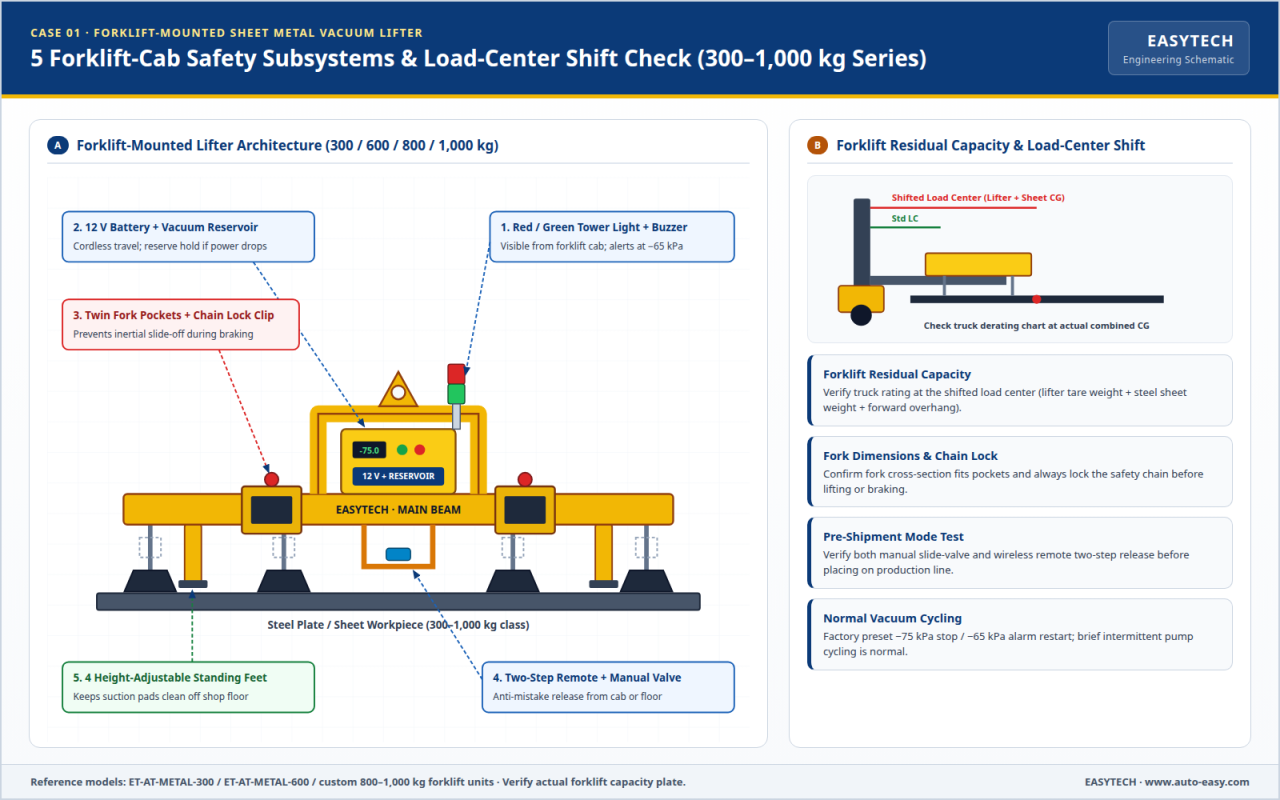
- Self-contained 12 V battery power instead of a trailing cable: On the pre-shipment inspected 300 kg unit (ETJS-J300-2M), a 12 V / 80 W DC vacuum pump gives the forklift full travel freedom between storage racks, outdoor yards and cutting tables.
- Two-step wireless remote plus manual backup valve: Because the operator stays in the forklift seat during travel and placement, wireless remote control handles attach and release directly from the cab. Both the remote handset and the frame-mounted manual slide valve require a two-step release action to guard against accidental single-button drops.
- High-visibility red/green tower light, buzzer and vacuum reservoir: A small panel gauge alone is hard to read from several meters back behind the forklift mast. The raised red/green tower light and audible alarm give immediate go/no-go feedback, backed by a dedicated vacuum reservoir that extends holding time if the battery runs low or power is interrupted unexpectedly.
- Twin fork pockets with an anti-slip chain lock clip: Unlike a suspended hoist hook, a forklift accelerates, turns and brakes horizontally. Welded rectangular fork pockets keep the beam level, and an auxiliary chain lock clip secures the lifter to the forklift carriage so inertia cannot pull the frame off the tines.
- Four height-adjustable standing feet: When detached from the forklift, four telescoping yellow support legs lower to hold the frame upright and keep every rubber suction lip clear of abrasive grit, coolant and metal shavings on the shop floor.
What pre-shipment inspection checks on 300 kg and 1,000 kg builds
Before shipping, each forklift attachment goes through live suction and release verification on a flat steel test plate. During factory inspection of the 300 kg eight-pad unit, technicians verify Manual Mode (sliding the blue frame-mounted release valve) and Remote Mode (cycling attach and two-step release from a distance) while watching the digital vacuum switch and tower light transition from red warning to steady green.
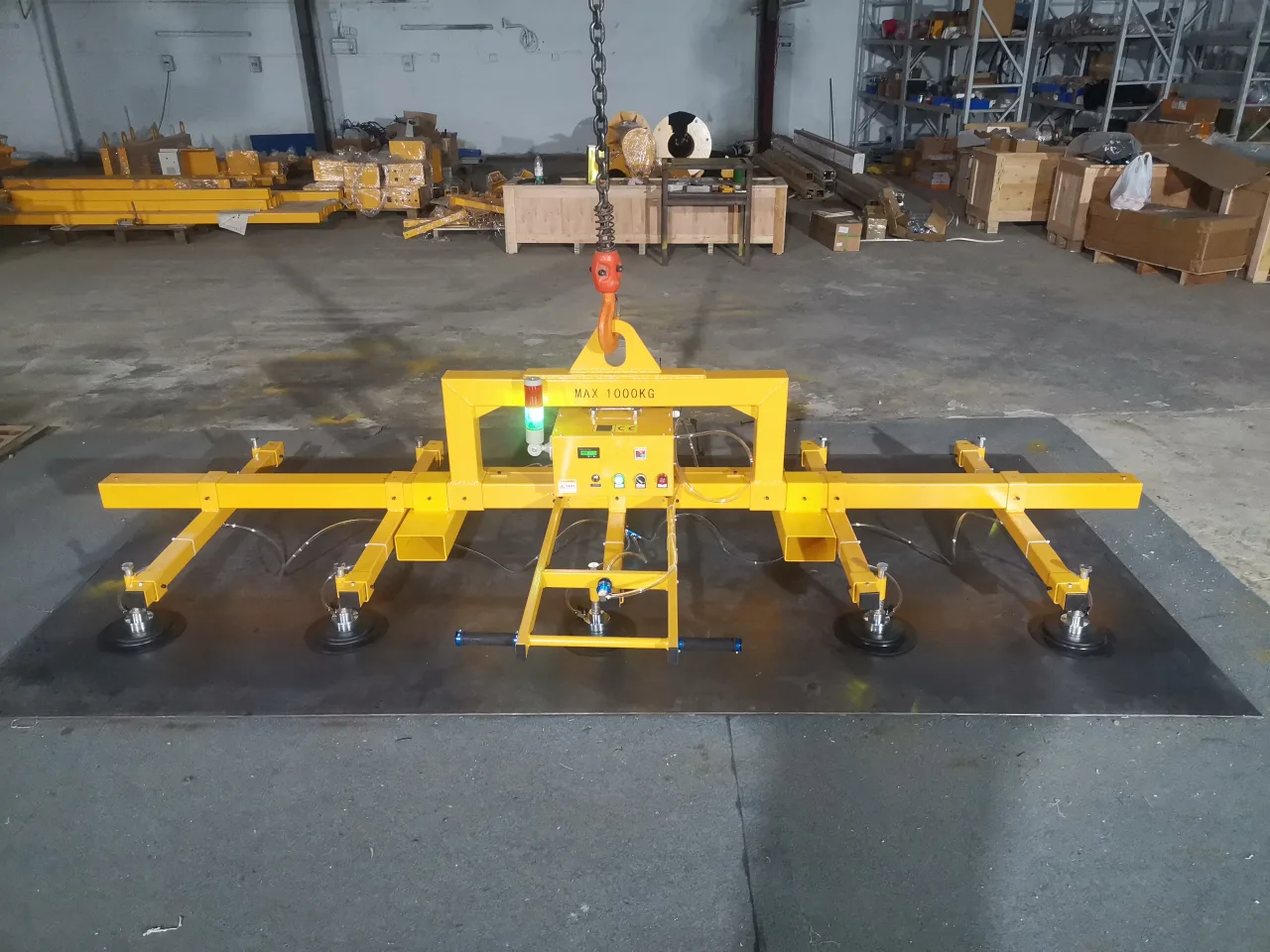
On the 1,000 kg ten-pad build shown above, the wider multi-crossbar layout distributes lifting force across five paired suction rows to limit plate sag, while keeping both twin fork pockets and a top crane lifting eye so the same unit can switch between a forklift and an overhead hoist.
Normal vacuum cycling vs. real air leaks after delivery
One recurring question from first-time buyers during commissioning is why the vacuum pump occasionally restarts for a few seconds while holding a plate. On Easytech sheet-metal lifters, the factory digital switch is preset to stop the pump at −75 kPa and trigger alarm/restart at −65 kPa at sea level. A gradual drift from −75 kPa to −65 kPa followed by an automatic pump recovery back to −75 kPa is normal intermittent holding behavior—not a pump failure.
If the pump runs continuously without climbing back to −75 kPa, technicians isolate the cause in four quick steps: disconnect and plug the inlet hose beside the control box to verify pump health, check that every pad seats flat without edge gaps, wipe mill dust or rust scale off the sheet and rubber lips, and block each manifold hose branch for 10 seconds to locate a leaking pad or fitting. For plants operating above 1,500 m elevation, barometric pressure also caps the achievable gauge reading—see our dedicated high-altitude 2,500 m after-sales diagnosis before adjusting any switch.
What forklift buyers must verify before ordering
- Forklift residual capacity at the shifted load center: Adding a vacuum frame moves the combined center of gravity further forward of the mast and adds the lifter's own tare weight. Check the truck's actual derating plate before sizing a 600 kg or 1,000 kg attachment—our forklift vacuum attachment sizing guide walks through the calculation.
- Fork cross-section and spacing: Confirm tine width, thickness and minimum/maximum fork spread so the tines enter the pockets cleanly and the safety chain anchors to the carriage.
- Sheet size, thickness and surface state: Thin large plates need wider pad spread (such as 8 to 10 pads) to prevent edge bending; oily, rusty or laser-filmed surfaces require matching pad compounds and clean sealing zones.
- Power-loss margin and charging discipline: Review how vacuum reservoirs and check valves behave during power interruption in our vacuum lifter power-failure protection guide, and assign a fixed end-of-shift charging routine.
Related equipment and planning guides
- Forklift and telehandler vacuum lifting attachments
- Sheet metal vacuum lifters for steel plate and machine loading
- Sheet metal handling applications
- Forklift Sheet Metal Vacuum Lifter ET-AT-METAL-300 and ET-AT-METAL-600
- Sheet metal vacuum lifters for laser cutting machine loading
- Request a forklift vacuum lifter quotation or contact our engineering team