A vacuum bag lifter must handle the filled package, not just its nominal material. Woven sacks, paper bags, liners and perforated films can leak and deform differently. The selected head and vacuum source must maintain the prescribed condition throughout the actual transfer.
Use the load condition for the actual package
Model / configuration | Load on sealed surfaces | Load on loose / porous surfaces | Lifting stroke |
|---|---|---|---|
30 kg | 25 kg | 1700 mm | |
40 kg | 35 kg | 1700 / 2500 mm | |
50 kg | 45 kg | 1700 / 2500 mm | |
65 kg | 60 kg | 1700 / 2500 mm | |
110 kg | 100 kg | 1700 / 2500 mm |
For example, ETJSQ-V140-50 lists 50 kg on sealed surfaces and 45 kg on loose / porous surfaces. A 50 kg porous sack must not be selected against the 50 kg sealed figure. Move to a configuration review using the correct load condition and the representative filled bag.
Head and control choices change the working position
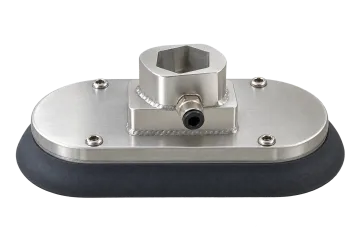
ET-VC-PAD-BAG-180 — Vacuum Cup for Bags & Boxes — The bag/box cup is 180 × 370 mm. Show an intact contact area clear of the bag seam, valve and loose folds.
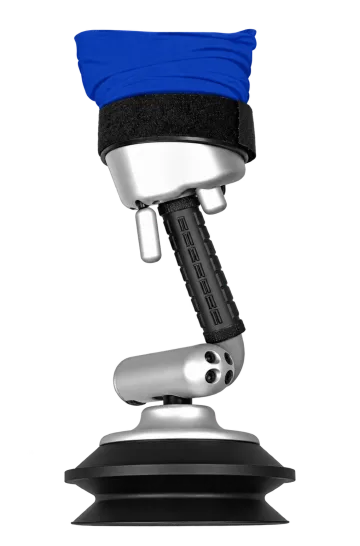
Type A — Single-Hand Control Handle — The single-hand control handle lists a maximum compatible bag load of 45 kg, 360° rotation and 90° tilting. It does not turn a heavier tube unit into an unrestricted one-hand arrangement.
Type C — Extended Two-Hand Control Handle — The extended two-hand handle has a series maximum compatible load of 250 kg. Confirm the complete handle/head/tube combination; a handle figure is not the machine rating.
Plan pallet pickup and hopper delivery separately
At the pallet, define the lowest bag and the farthest row. At a hopper, show the rim, guard and desired supported release point. Lifting a bag is different from holding it while cutting or emptying it; specify that separate process instead of assuming it is included in a standard transfer arrangement.
What changes between bag suppliers
Change | Why to include it in testing |
|---|---|
Outer weave or perforations | Changes leakage even at the same filled weight. |
Liner and closure | May change how the outer package transmits the load. |
Seam or valve position | Changes the available head contact area. |
Fill level or bulk material | Changes package deformation and movement of contents. |
Dust at pickup | Changes the contact and air-path conditions. |
Record the accepted head, source, filled bag format, pickup positions and complete cycle. Retain a sample or a clear packaging specification with the station requirement so that a later bag change can be assessed against the same conditions.
Does a stronger vacuum source solve every porous bag problem?
No. Leakage, contact geometry and package integrity have to be assessed together. A larger source does not repair an unsuitable seam or weak outer layer.
Can a bag lifter be used in a food or hazardous area?
Only when the supplied configuration and documentation cover that environment. Describe cleaning, food-contact or hazardous-area requirements early; the material name alone does not establish approval.
Details to include in your enquiry
Requirement | Details to provide |
|---|---|
Bag | Paper, woven or plastic construction; filled size and weight range. |
Surface | Seams, folds, perforations, leakage and accessible pickup area. |
Contents | How the filled bag deforms or shifts during handling. |
Transfer | Pallet/conveyor/hopper positions, lift range, reach and required orientation. |
Choose the next step
Bag and box selection checklist · Vacuum source and airflow · Tube lifter range
Build the complete handling sequence
Compare packaging surfaces and head changes against the same pallet positions and transfer cycle.