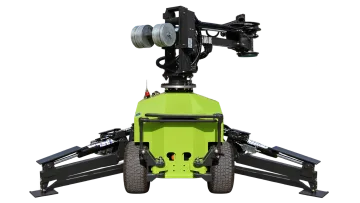
Separate the task of carrying a pallet from placing individual slabs. For vacuum placement, the contact face, porosity, tool access and final laying position all matter. The equipment must also reach the work area without damaging the prepared surface.
ET-PV-150: two operating scopes, two load figures
Model / configuration | Rated load | Maximum pallet fork load | Equipment weight | Maximum arm length | Maximum lifting height |
|---|---|---|---|---|---|
150 kg | 600 kg | 1280 kg | 2500 mm | 1700 mm |
Use 150 kg for the handling mode. The 600 kg figure belongs to pallet-fork mode and must not appear as a vacuum lifting capacity. Support-leg extension does not create an additional published 200 kg handling rating.
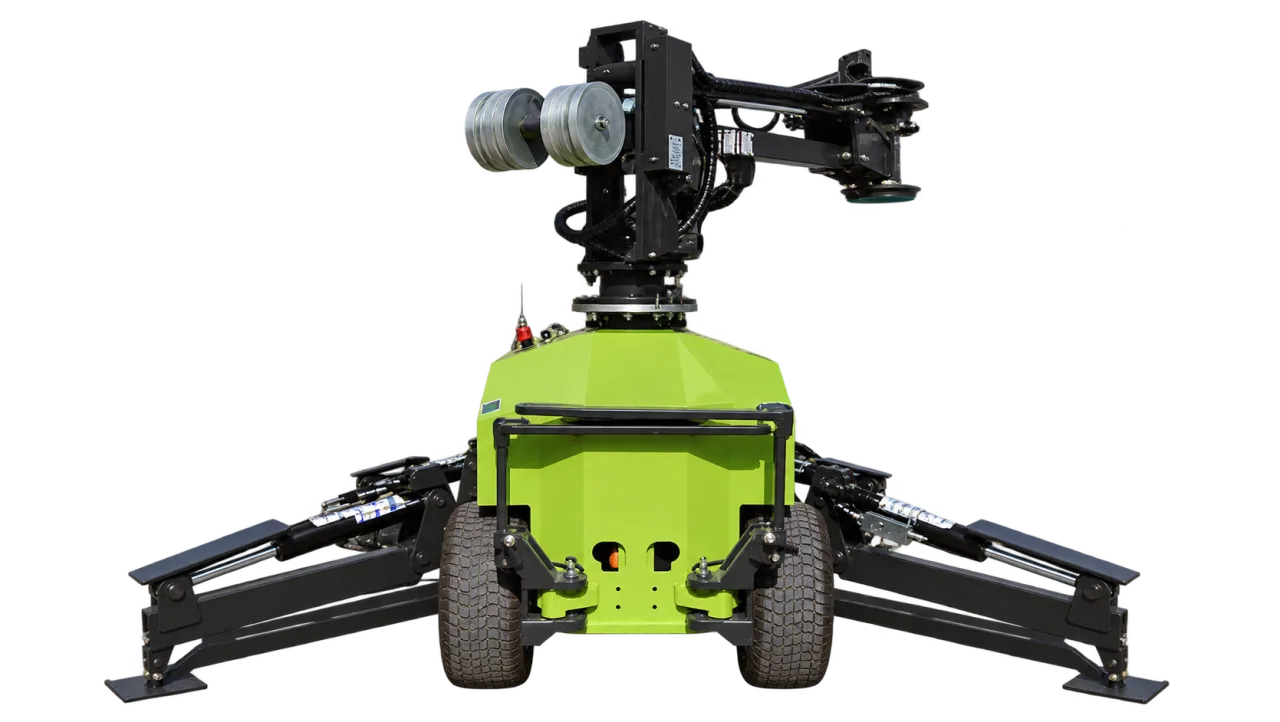
Check access before planning the laying pattern
The minimum overall dimensions are 2,650 × 1,500 × 1,820 mm and the equipment weight is 1,280 kg. Measure the route, turns and available working space with the selected attachment included. The machine has four hydraulically extending support legs; their required working footprint and ground support must be resolved for the site.
The listed 15% gradeability is unloaded. It does not approve lifting or loaded travel on a 15% slope. Likewise the 2,500 mm maximum arm length is not a load chart for every position.
A textured surface and a porous block are different problems
Texture affects the local seal. Porosity allows air to pass through the workpiece. A foam pad can help accommodate a particular contact profile, but that does not prove the selected source can sustain the required vacuum through porous concrete. Include actual dry and expected site-condition samples in the review.
Test the final row, not just an open area
Task | What to establish |
|---|---|
Pickup from a stack | Accessible face and spacing around the selected unit. |
Laying beside an installed slab | Room for the head and release without striking the neighboring edge. |
Placement near a wall | Reach, frame clearance and operator access at the restricted edge. |
Release | Full independent support and a withdrawal path that does not shift the laid unit. |
Format changes | Accepted pad/tool setting for each block or slab family. |
Does the machine include one head for every paver?
The end effector is documented as customized for the workpiece. Identify the paving formats and surface conditions so the tool and operating scope can be specified.
Can I use a handheld cup instead?
Review a handheld tool for its own permitted material, direction and handling arrangement. A portable cup is a different format from a powered placement machine and does not replace the site and load assessment.
Details to include in your enquiry
Requirement | Details to provide |
|---|---|
Paver/block | Dimensions, weight, texture, porosity and contact-face photographs. |
Pickup | Pallet or stack arrangement and accessible face. |
Placement | Laying pattern, joint/edge clearance and required rotation. |
Site | Ground, access route, operating area and supporting equipment if applicable. |
Choose the next step
Stone and paver selection · Stone/paving equipment · Handheld equipment use