
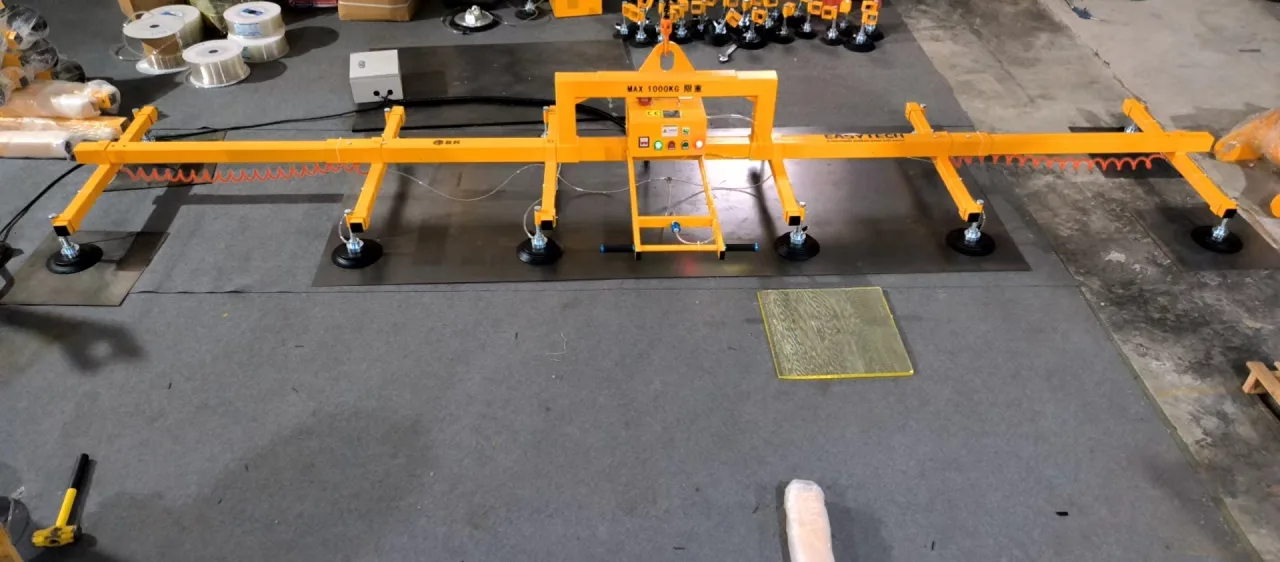
Why one fixed frame would make the job harder
A frame arranged only for the longest sheet can put its outer pads beyond the ends of a short sheet. A frame kept compact for every lift can leave a long, flexible sheet poorly supported. Changing only the lifting capacity does not solve either problem.
This project therefore combined an adjustable main structure with repositionable pad crossbars. The compact and extended layouts below illustrate the intended change in support distribution. The 2–6 m sheet-length range describes the workpiece requirement; it is not a statement that the beam itself extends from 2 to 6 m.
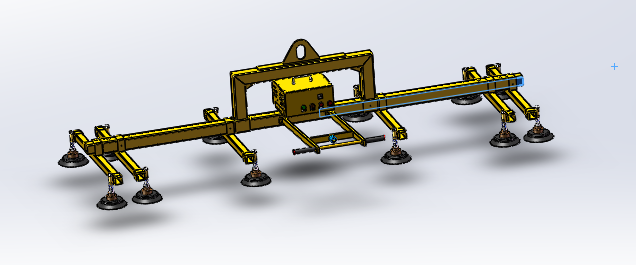
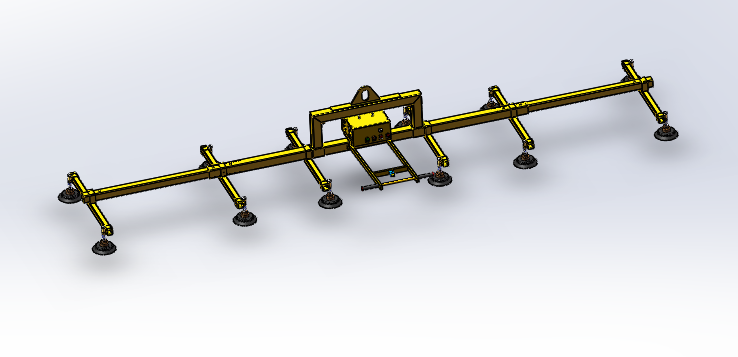
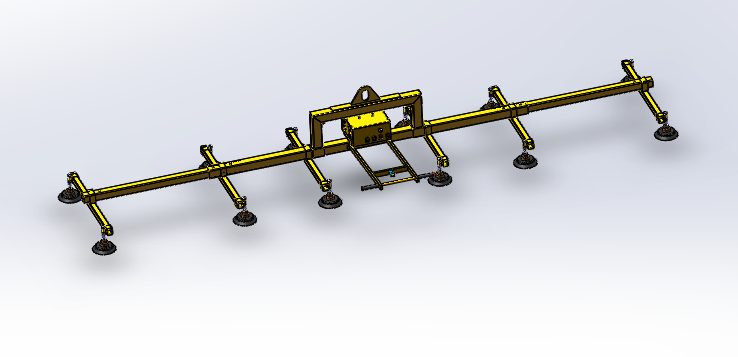
Three checks before choosing a pad layout
1. Can every pad seal on usable sheet area?
Check the actual pad footprint against edges, holes, cut-outs, surface damage and protective film. The overall sheet outline is not the same as the area available for a reliable seal. Do not leave a pad hanging beyond an edge to accommodate a smaller sheet.
2. How will the sheet behave between the pads?
Thickness, length and pad spacing affect the way a sheet bends. A sheet below the rated mass can still be awkward to handle if its ends or unsupported areas sag. Provide the thinnest and longest sheets as well as the heaviest one when specifying the lifter.
3. Where is the centre of gravity?
A cut sheet may be much heavier on one side. The suspension and pad layout must suit its balance as well as its dimensions. An apparently symmetrical pad pattern is not a substitute for checking an asymmetric workpiece.
The 1,000 kg rating belongs to this specified assembly and its approved operating configurations. Removing pads, changing their positions or handling a different surface requires a suitable approved arrangement; the number of pads alone is not a capacity calculation.
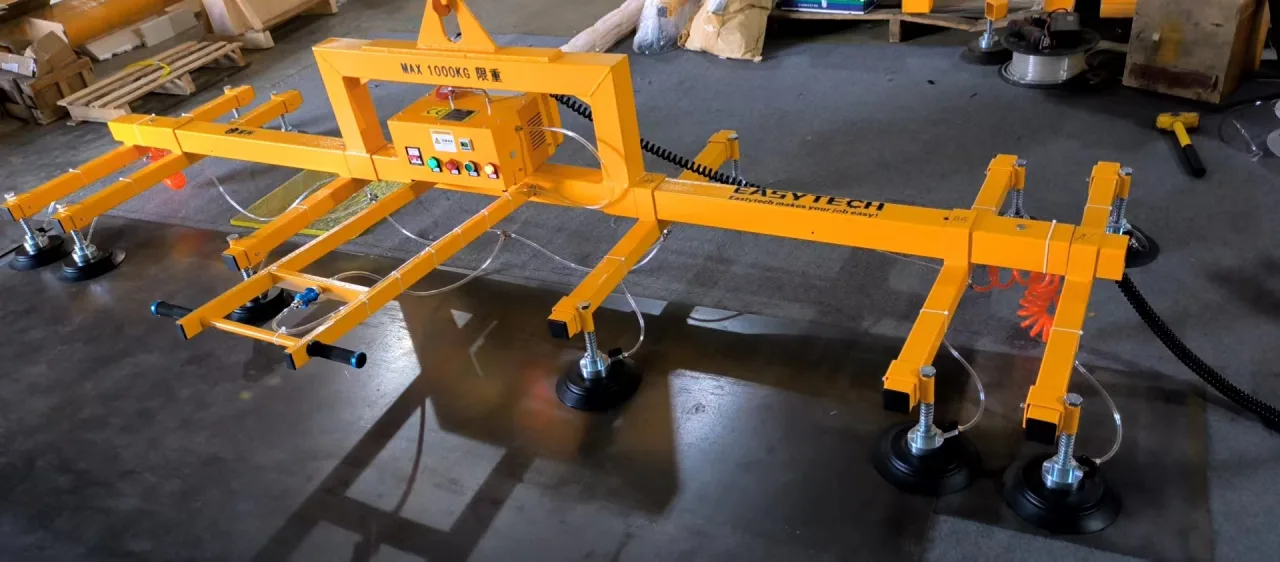
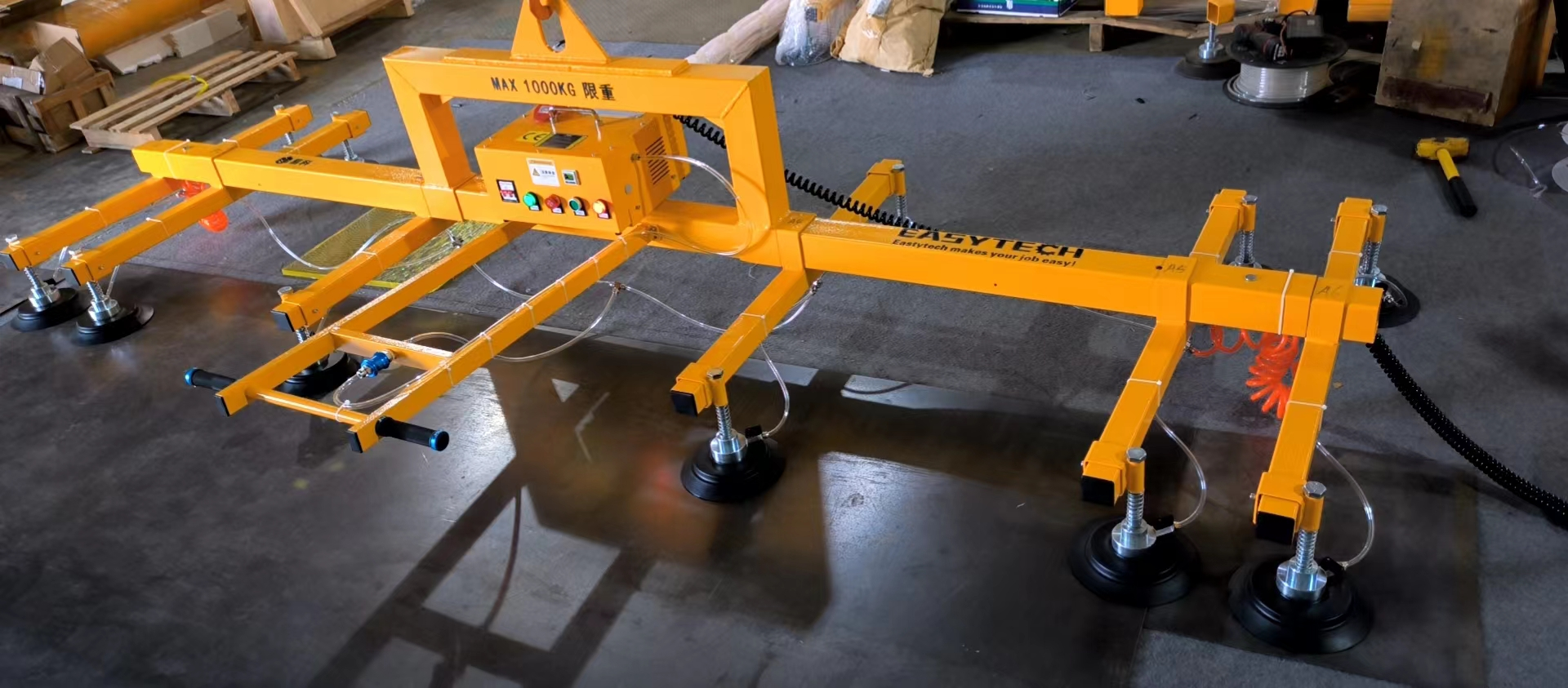
The lifting frame is only one part of the station
The crane or hoist carries both the sheet and the lifter. Selection therefore needs the equipment’s own mass in addition to the workpiece mass. It also needs sufficient height for the suspension, frame, sheet and clearance above the stack or machine bed.
Long sheets add a horizontal problem: the swept path can extend well beyond the central hook. Check the path between the stack and machine, including columns, guards and nearby material. A frame that reaches the sheet is not automatically a frame that can move it through the available aisle.
This build uses a wired power supply. Cable routing needs to follow the entire handling movement without snagging on the frame or crossing the operator’s working space. The pendant should remain accessible at the intended loading and unloading positions.
What the receiving team should check
The equipment was assembled and checked before dispatch. At the customer’s station, the receiving check should identify the delivered frame, pads, hoses, controls and power connection, then reconcile the machine with its operating instructions and the intended sheet range. Transport inspection and local commissioning are different steps.
Before production handling, have the approved setup established for each recurring sheet group. Record the relevant pad positions and workpiece conditions so that a changeover is repeatable. Do not treat an arbitrary vacuum reading or a factory retention check as permission to continue lifting after a supply failure.
Would this approach suit your sheets?
Send the shortest, longest, thinnest and heaviest sheet sizes; photographs of the lifting face; any holes or cut-outs; and the pickup and delivery heights. Include the existing hoist rating and a view of the route between stations. Those details determine whether an adjustable vacuum frame is useful and how it should be configured.
Can it handle every 6 m sheet below 1,000 kg?
No. Mass and length are only part of the selection. Width, stiffness, surface condition, pad support and the approved arrangement also matter. This project’s dimensions should not be applied to a different sheet range without checking those conditions.
Does the telescopic frame tilt the sheet?
This project is for horizontal handling. A requirement to turn a sheet upright changes the gripping, load and movement assessment and needs a suitable tilting configuration.