
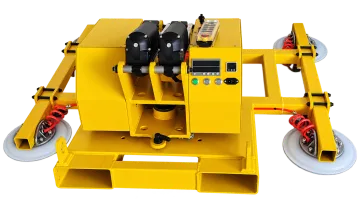
Equipment family
Forklift and Telehandler Vacuum Lifting Attachments
Compare sheet-metal and glass vacuum attachments for forklifts and telehandlers. Check coupling, attachment mass, load centre and host-machine capacity.
A vacuum attachment adds gripping and positioning capability to a separate host machine. Both the attachment specification and the host’s residual-capacity assessment apply. A larger truck nameplate does not automatically approve a particular attachment or working reach.
Start with your handling task
Compare models and configurations
Filters include documented loads and overlapping conditional ranges. A range does not guarantee its upper value for every workpiece. Check material, seal, orientation and complete configuration.
ET-AT-METAL-LEG-01
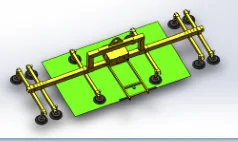
ET-AT-METAL-LEG-01 Forklift Sheet Metal Lifter Configuration
- Rated load
- 1200 kg; Horizontal pickup and placement only; no tilting
- Drive
- Battery
ET-AT-METAL-LEG-02
ET-AT-METAL-LEG-02 Forklift Sheet Metal Lifter Configuration
- Rated load
- 800 kg; Horizontal pickup and placement only; no tilting
- Drive
- Battery
No matching configurations.
Try a shorter model name or clear the load filter.
Forklift attachments for sheet and glass handling
Model | Documented data | Key integration check |
|---|---|---|
300 kg; eight Ø150 mm pads; battery supply; 3,000–5,000 mm telescopic length range. | Sheet geometry, fork interface and the actual load centre. | |
600 kg; six Ø200 mm pads; battery supply; 3,000–5,000 mm telescopic length range. | Telescopic structure; select the working reach together with the host machine and attachment load envelope. | |
600 kg; six Ø300 mm pads; electric 90° tilt and manual 360° rotation. | Glass contact, tilt sweep and forklift residual capacity. |
Telehandler positioning attachments
Model / configuration | Rated load | Pad configuration | Arm extension stroke | Hydraulic pressure |
|---|---|---|---|---|
800 kg | Ø400 mm × 6 | 500 mm | 16 MPa | |
1200 kg | Ø400 mm × 8 | 300 mm | 21 MPa | |
1500 kg | 450 × 850 mm × 4 | 250 mm | 21 MPa |
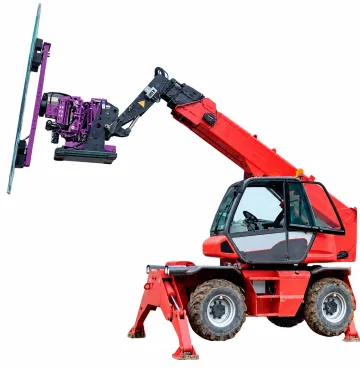
These SR models list 0–135° tilt, 360° continuous rotation, ±75 mm side shift and ±100 mm vertical fine adjustment. Their differing extension strokes and pad arrangements affect the setup. They do not establish that one coupling fits every telehandler.
Keep the four load inputs separate
Input | Why it matters |
|---|---|
Attachment mass | Adds to the carried assembly and changes the host-machine assessment. |
Workpiece mass | Must fit the attachment rating and the host’s permitted operating position. |
Load centre / offset | The load acts at a distance from the host reference point. |
Reach and posture | The applicable host capacity changes with the working arrangement. |
Send the host make/model, fork or coupling drawing and its applicable capacity information. The supplied arrangement must identify retention, utilities and movement clearances. A model sharing a code with another product family is not evidence of a shared interface.
What to verify in the complete demonstration
- Coupling and retention with the intended host.
- Unobstructed controls, hoses and cables through each required movement.
- Actual workpiece contact and permitted load posture.
- A supported release and clear withdrawal at the destination.
Can the attachment rating replace the truck load chart?
No. Both limits apply to the complete setup. Obtain the host-specific assessment rather than using the attachment rating as the truck payload.
Can the same attachment be moved between a forklift and telehandler?
Only if the exact interface, retention, utilities and load assessment support both arrangements. Similar appearance is insufficient.
Prepare a comparable quotation
Provide the host identity and interface, attachment/part weights where known, workpiece drawing, contact face and required positions. Include the actual fork dimensions or coupling drawing and the intended transfer sequence.
LET’S DEFINE YOUR APPLICATION
The right equipment starts
with your workpiece.
Tell us what you lift, where it moves and how it needs to arrive.