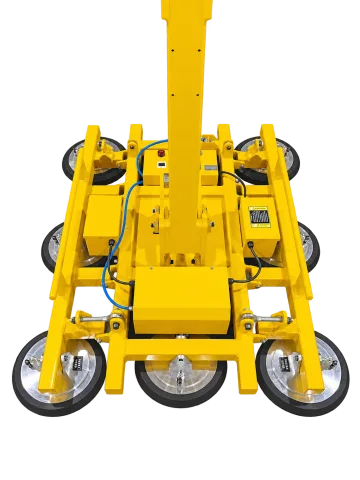
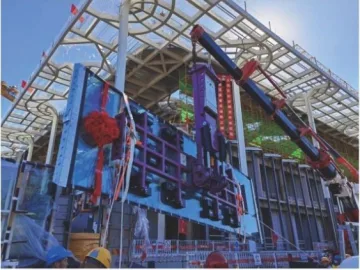
Curved glass requires the pads to seat on the actual lifting face throughout pickup, movement and placement. Send a section or 3D drawing of the pane: a width and height alone cannot describe the local curvature or tell whether the frame can reach the permitted contact zones.
Compare the documented curved-glass range
Model / configuration | Rated load | Number of pads | Pad diameter | Equipment dimensions | Compatible curvature radius |
|---|---|---|---|---|---|
300 kg | 4 pcs | 250 mm | 800 × 840 × 420 mm | ≥ 0.5 m | |
600 kg | 8 pcs | 250 mm | 1600 × 840 × 420 mm | ≥ 0.5 m | |
900 kg | 12 pcs | 250 mm | 2300 × 840 × 420 mm | ≥ 0.5 m |
All three list manual 90° tilting, manual 360° rotation, a 12 V / 12 Ah battery and a single vacuum circuit. The stated radius is at least 0.5 m. That number is a geometry boundary for review, not a guarantee that every pane with a larger radius is suitable.
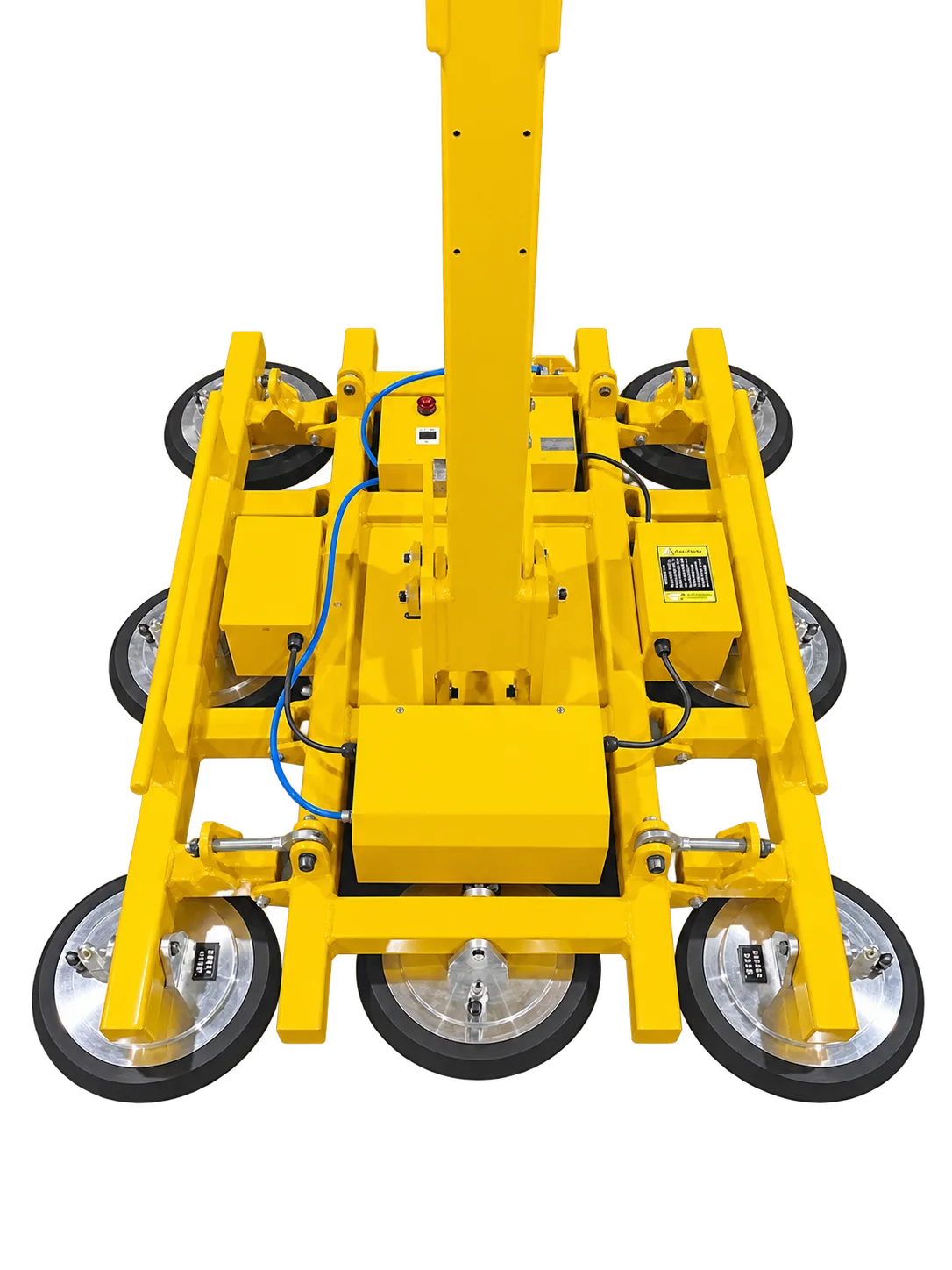
Concave and convex faces need separate contact drawings
Show which face the pads may touch and whether the radius is constant. With compound curvature, the radius can change across the contact area. Add coatings, frit, edge exclusions and cutouts. A pad that seats on one face or one radius must not be assumed to seat on the reverse face or a different batch geometry.
Shortlist by support pattern, not pad count alone
M312 has four pads on an 800 mm long equipment arrangement; M316 has eight on a 1,600 mm arrangement; M624 has twelve on a 2,300 mm arrangement. These equipment dimensions help assess access and contact distribution, but they are not maximum pane sizes. Confirm the adjustable positions, supported glass formats and complete frame layout for the order.
For heavier curved glazing, RDS models offer separately described curved pad options. Their standard flat-pad ratings do not establish the curved-option load. Use that route only after the pane drawing and option rating are reviewed.
RDS-5T — Heavy-Duty Glass Vacuum Lifter — Heavy-duty platform with a separately reviewed curved-pad option.
Trial the contact and the final placement
Stage | Evidence to record |
|---|---|
Pickup | Actual concave/convex face, pad locations, local radius and frame clearance. |
Movement | Required orientation changes, pane/frame clearances and the prescribed indications. |
Placement | Available opening, alignment adjustment, independent support before release and withdrawal space. |
Format change | Which radii, pane dimensions and pad settings were accepted; which remain outside the approved setup. |
Can a flat-glass lifter be converted with different cups?
Different cups alone do not establish an approved curved-glass system. The mountings, frame, support distribution and applicable rating must describe the same configuration.
Does the 0.5 m radius mean 0.5 m diameter?
No. Radius and diameter are different dimensions. Provide the drawing with its units and identify the contact face so the geometry can be assessed without that ambiguity.
Details to include in your enquiry
Requirement | Details to provide |
|---|---|
Geometry | Drawing with radius/profile, dimensions and local curvature at potential pad positions. |
Lifting face | Inside or outside face, coatings and areas excluded from contact. |
Load | Weight, centre of gravity, stiffness and storage orientation. |
Placement | Final orientation, turning movement and installation clearance. |
Choose the next step
Glass lifter selection guide · Available glass configurations · Request matching documents