For an industrial panel-lifting job, first choose the handling method: repeated board transfer at a production station, suspended lifting of a sheet, or installation of a long roof or wall panel. These tasks need different contact arrangements and motion. A vacuum panel lifter that suits one task is not automatically suitable for the others.
Which panel are you moving?
Your job | Equipment route | What decides the choice |
|---|---|---|
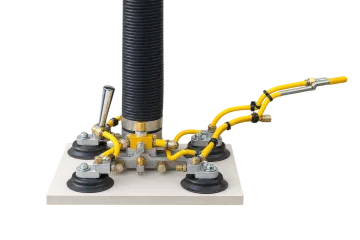
Vacuum tube lifter with a panel-compatible head, or a reviewed tilting arrangement. | Air leakage through the actual board, face finish, support spacing and pickup / placement orientation. | |
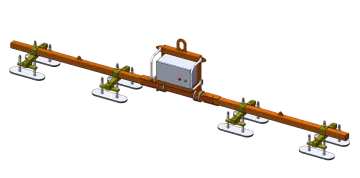
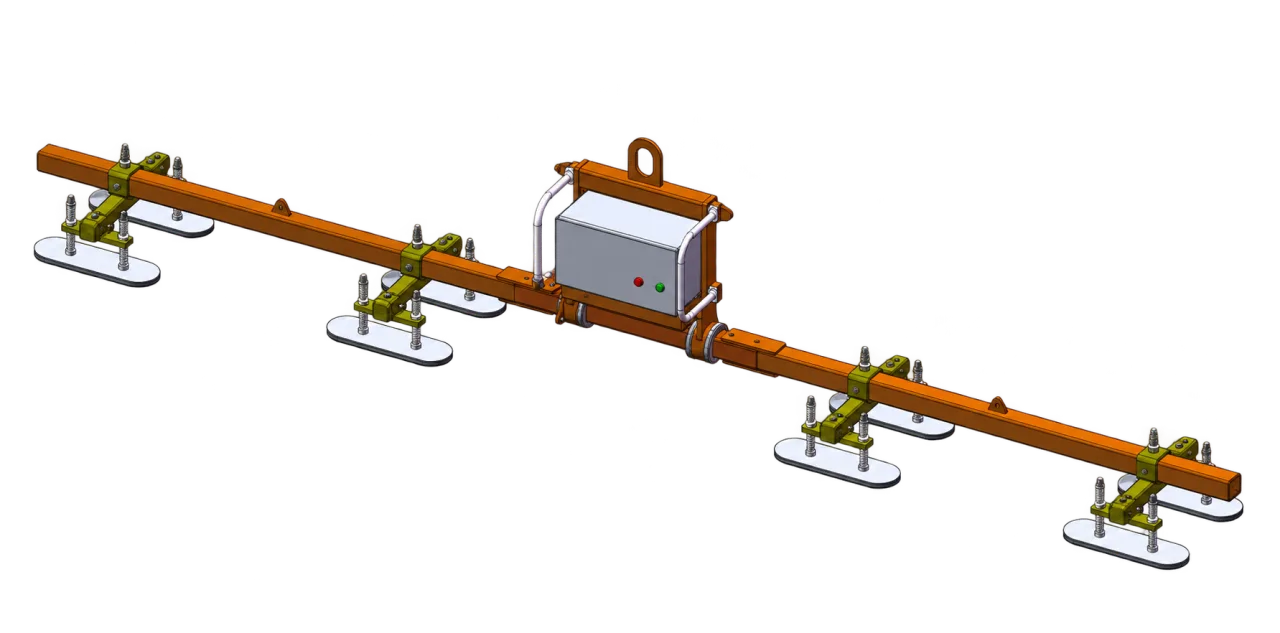
Suspended cladding vacuum lifter with a frame and pads matched to the panel profile. | Horizontal versus vertical rating, rib geometry, facing/core construction, support and installation clearance. | |
Sheet-metal vacuum frame and suitable supporting crane or lifting system. | Sheet size and deflection, oily or filmed faces, pad layout and clearance at the machine. | |
Glass vacuum lifter or lifting robot selected for the working position. | Pane geometry, pad contact, load chart and installation access. |
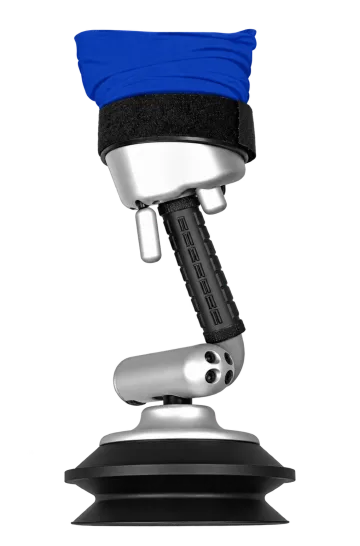
This guide covers powered industrial vacuum handling. If your task is temporary manual carrying, review a handheld unit and its permitted use separately. A portable suction cup does not by itself provide a powered lifting workstation.
Check the intended use of handheld vacuum lifters
Compare actual equipment choices, not one headline capacity
The values below describe different documented configurations. They are selection starting points, not interchangeable ratings or approval for every material named above.
Configuration | Documented values | What this means for your project |
|---|---|---|
ETJSQ-V160-60 — Vacuum Tube Lifter — Production-station lifting | 65 kg sealed; 60 kg loose / porous; stroke 1700 / 2500 mm | A board surface changes which load condition applies. Check the selected head, reachable positions and configuration together. |
ETJSV300-250 — Vacuum Tube Lifter — Larger tube-lifter configuration | 250 kg sealed; 200 kg loose / porous; stroke 1650 mm | The larger load rating does not give the longest stroke. Compare lifting range as well as weight. |
ET-CL-ROOF-1000 — Roof & Wall Sandwich Panel Vacuum Lifter — Roof and wall sandwich-panel installation | 1000 kg horizontal; 500 kg vertical; 60% vacuum level | A 1,000 kg horizontal rating must not be used as a 1,000 kg vertical rating. Confirm panel profile, support arrangement and orientation. |
ET-VC-HEAD-FLIP — Panel Tilting Suction Head — Tilting attachment for MDF | 90 °; application: MDF panels | This is a suction head, not a complete machine. Its own general load rating and compatibility with a particular lifting unit must be established. |
When vacuum contact needs a closer review
Condition | Why it matters | Useful information to send |
|---|---|---|
Raw or porous board | Air can pass through the material; achieving a seal on the face alone does not establish lifting performance. | Representative board, thickness, both faces and any coating; include the most permeable variant. |
Ribs, cutouts or narrow strips | A pad must contact an available sealing area. A large sheet can still have too little usable contact area. | Face photograph and a dimensioned profile / drawing showing openings and prohibited contact zones. |
Film, laminate or decorative finish | The contact layer and allowable marking need review; do not assume every protective film can transmit the lifting load. | Film/finish details, permitted pad positions and the panel supplier’s handling requirements. |
Long or flexible panel | Weight alone does not define support spacing or allowable overhang. | Panel dimensions, construction and permitted support / lifting points. |
Understand the role of pressure and airflow
Check the complete route from pickup to release
For a flat stack-to-table transfer, mark the lowest pickup surface and final table height. For upright storage, include the required turn and the space swept by the panel. At a machine, check the frame, handle and hose against guards and the loading opening. For installation, define how the panel is supported and secured before the lifting device is released.
A typical tube-lifting station includes the vacuum source, lifting tube, control handle, suction head and support structure. A suspended cladding frame needs a compatible lifting machine. Identify which of these you already have so that a quotation covers the missing equipment and interfaces.
Prepare a useful quotation request
Send these details | Example of the level of detail needed |
|---|---|
Panel range | Material and construction; smallest / largest length, width, thickness and weight. |
Contact surface | Raw, coated, ribbed or filmed; photographs of both faces and a profile drawing where relevant. |
Movement | Starting and final orientation; required tilt or rotation; lowest pickup and highest placement. |
Workstation | Layout and obstructions; available crane/support; electrical or compressed-air supply. |
Production requirement | Transfers per shift and required complete cycle; identify format changes and handling that must avoid marks. |
For example, “MDF panels from a horizontal stack to a saw, including the raw and laminated formats shown in the attached dimensions” gives a clearer basis than “send your strongest panel lifter.” The actual board and working positions still need configuration review; this is an enquiry example, not a completed customer case.
Request a panel-handling configuration and quotation
Panel lifter questions
Can one vacuum lifter handle MDF and sandwich panels?
Do not assume so. A porous woodworking board and a profiled metal-faced sandwich panel need different contact and support checks. A shared weight or a similar-looking pad does not establish compatibility. Compare the complete head, vacuum source, lifting unit and permitted movement.
Is the lifting capacity the same when a panel is tilted upright?
Not necessarily. ET-CL-ROOF-1000 lists 1,000 kg horizontal and 500 kg vertical at the specified vacuum condition. Use the rating for the actual orientation and configuration. Do not apply these numbers to another model.
Does a tube lifter automatically include panel tilting?
No. Tilting must be part of the selected arrangement. ET-VC-HEAD-FLIP documents a 90° MDF tilting head, but its availability does not prove that it can be fitted to every tube lifter.
Where are the detailed specifications?
Open the model links above for the complete adopted parameter tables and labelled images. The PDFs below provide the corresponding model information for an engineering or purchasing review.
Download ETJSQ-V160-60 specification PDF
Download ETJSV300-250 specification PDF