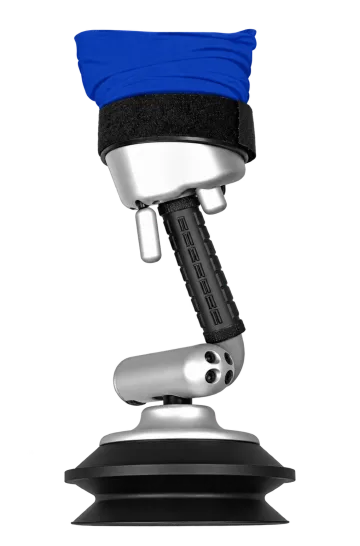
For carton handling, the box is part of the lifting interface. The suction head must grip a sound face that can carry the contents without separating a flap or collapsing the board. Use filled cartons with their actual tape, labels and internal packaging when defining the station.
Match the head to the available carton face
Head | Documented geometry | Review for your cartons |
|---|---|---|
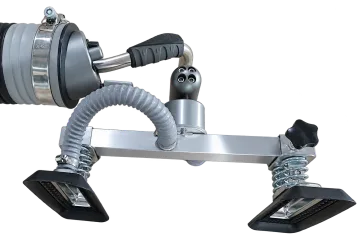
Two 85 × 200 mm pads; stated application load 45 kg. | Enough sound face for both pads; head/system compatibility and load conditions. | |
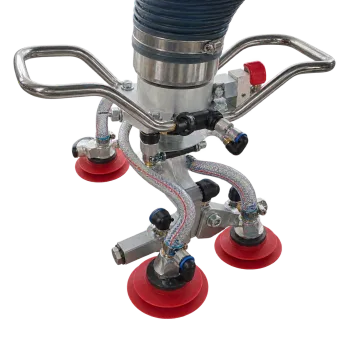
Ø140 mm bellows cup. | Local seating, folds and clear space around seams. | |
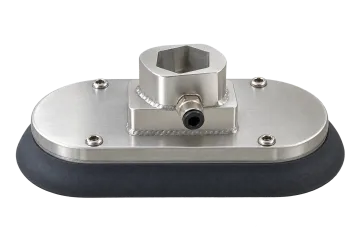
180 × 370 mm bag/box cup. | Whether that full footprint fits the smallest box face. | |
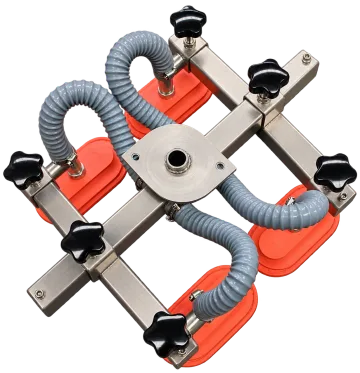
Four 140 × 70 mm pads; quick-change flange. | Pad positions, flange compatibility and format-change procedure. |
A component dimension or application-load figure does not authorize every tube-lifter/head combination. Identify the complete installed assembly and the accepted carton range.
Compare lifting stroke as well as package weight
Model / configuration | Load on sealed surfaces | Load on loose / porous surfaces | Lifting stroke |
|---|---|---|---|
30 kg | 25 kg | 1700 mm | |
50 kg | 45 kg | 1700 / 2500 mm | |
65 kg | 60 kg | 1700 / 2500 mm |
The carton construction determines which contact condition is appropriate. A taped surface does not automatically make a corrugated box airtight. Likewise the longer listed stroke is a configuration choice; confirm the installation height, handle and source supplied with it.

Check the bottom layer and the far corner
Draw the full pallet pattern, not just the nearest carton. The lowest layer challenges handle access and available travel; the far row challenges reach and the operator’s position. At the top layer, allow for the head, control and support assembly as well as the carton height.
Prepare a mixed-carton acceptance set
Include | Reason |
|---|---|
Smallest top face | Proves the head fits without bridging an edge. |
Heaviest filled carton | Checks the packaging as well as the lifting unit. |
Soft or vented carton | Reveals local collapse or leakage that a rigid sample can hide. |
Different closures | Checks tape seams, loose flaps and labels at the contact location. |
Full pallet sequence | Includes deep rows, final placement and any head changes. |
Can an open-top carton be lifted from its flap?
Do not assume so. The intended lifting face must support the filled carton. Show the actual construction and identify an approved contact arrangement.
Can one station alternate bags and boxes?
It can be reviewed with suitable heads, but each package/head combination needs its own acceptance scope. Include changeover time and any control or source adjustments in the complete task.
Details to include in your enquiry
Requirement | Details to provide |
|---|---|
Carton | Filled weight, size range, board type, panel stiffness and permitted contact face. |
Closure | Tape, seams, open/closed flaps, labels and surface variation. |
Pallet pattern | Lowest pickup, highest placement, deep rows and adjacent packages. |
Station | Conveyor/table height, reach, headroom and desired handling cycle. |
Choose the next step
Bag and box tube-lifter guide · Tube lifting configurations · Mixed packaging station example
Build the complete handling sequence
Record box closures, pickup faces and stack extremes before comparing one head or a documented changeover arrangement.