For moving wood, MDF or plywood from a stack to a saw, CNC loading position or worktable, select the vacuum head and lifting system around the actual board. Raw board, laminated board and a finished door can have different leakage, stiffness and usable contact areas even at the same weight.
Start with the movement you need
Handling task | Configuration to review | Decision that cannot be skipped |
|---|---|---|
Horizontal stack to horizontal table | Vacuum tube lifting with a panel-compatible head. | The lowest stack position, table height, reach and room to release the head. |
Upright rack to horizontal processing position | A documented tilting head or tilting lifting arrangement. | The orientation rating, turning clearance and control position throughout the movement. |
Wide, thin or flexible boards | A head/frame support layout matched to the board formats. | Pad spacing, available face area and acceptable deflection; a higher load rating alone does not solve poor support. |
Finished doors or panels with cutouts | A contact layout that avoids openings and protected areas. | Sealing locations, surface-marking acceptance and interference with edges or hardware. |
Tube-lifter values that change the shortlist
The adopted specifications distinguish sealed from loose / porous surfaces. Select the condition that has been established for your actual board and head; do not classify all plywood as sealed or all MDF as suitable without checking the face and construction.
Model | Sealed-surface load | Loose / porous-surface load | Lifting stroke |
|---|---|---|---|
ETJSQ-V100-30 — Vacuum Tube Lifter — Vacuum tube lifter | 30 kg | 25 kg | 1700 mm |
ETJSQ-V160-60 — Vacuum Tube Lifter — Vacuum tube lifter | 65 kg | 60 kg | 1700 / 2500 mm |
ETJSV300-250 — Vacuum Tube Lifter — Vacuum tube lifter | 250 kg | 200 kg | 1650 mm |
ETJSV300-250 provides the largest rated load in this comparison, but its stated stroke is 1,650 mm. ETJSQ-V160-60 lists 1,700 / 2,500 mm stroke configurations. A heavier-duty model is therefore not automatically the right answer when the main constraint is pickup height. These are configuration values, not a guarantee of performance on every board.
Choose the panel head and control position
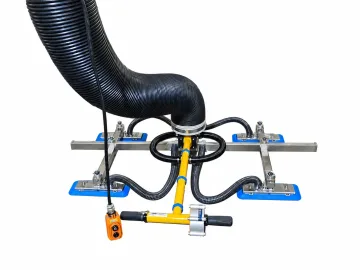
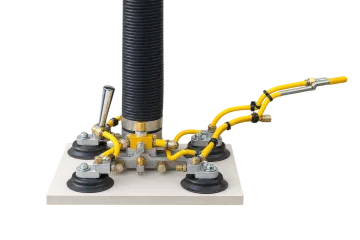
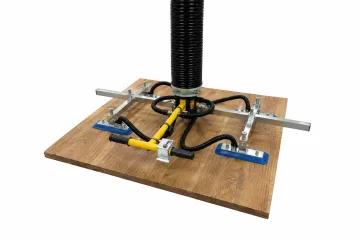
ET-VC-PAD-SHEET-4 — Four-Pad Suction Head for Large Panels — Four pads of 140 × 370 mm are documented. Review whether the pad layout fits the smallest board and supports the largest. The head does not have an independently adopted complete-machine load rating.
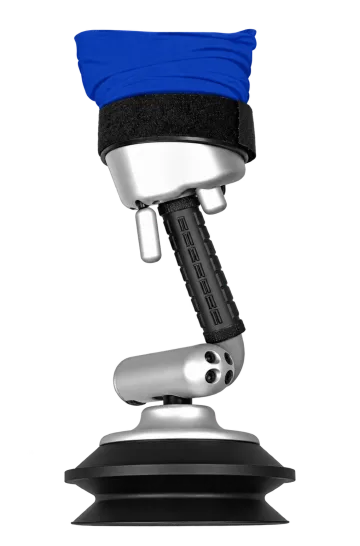
ET-VC-HEAD-FLIP — Panel Tilting Suction Head — A 90° tilting head documented for MDF panels. Request the compatible lifting unit, load and orientation scope before specifying it.
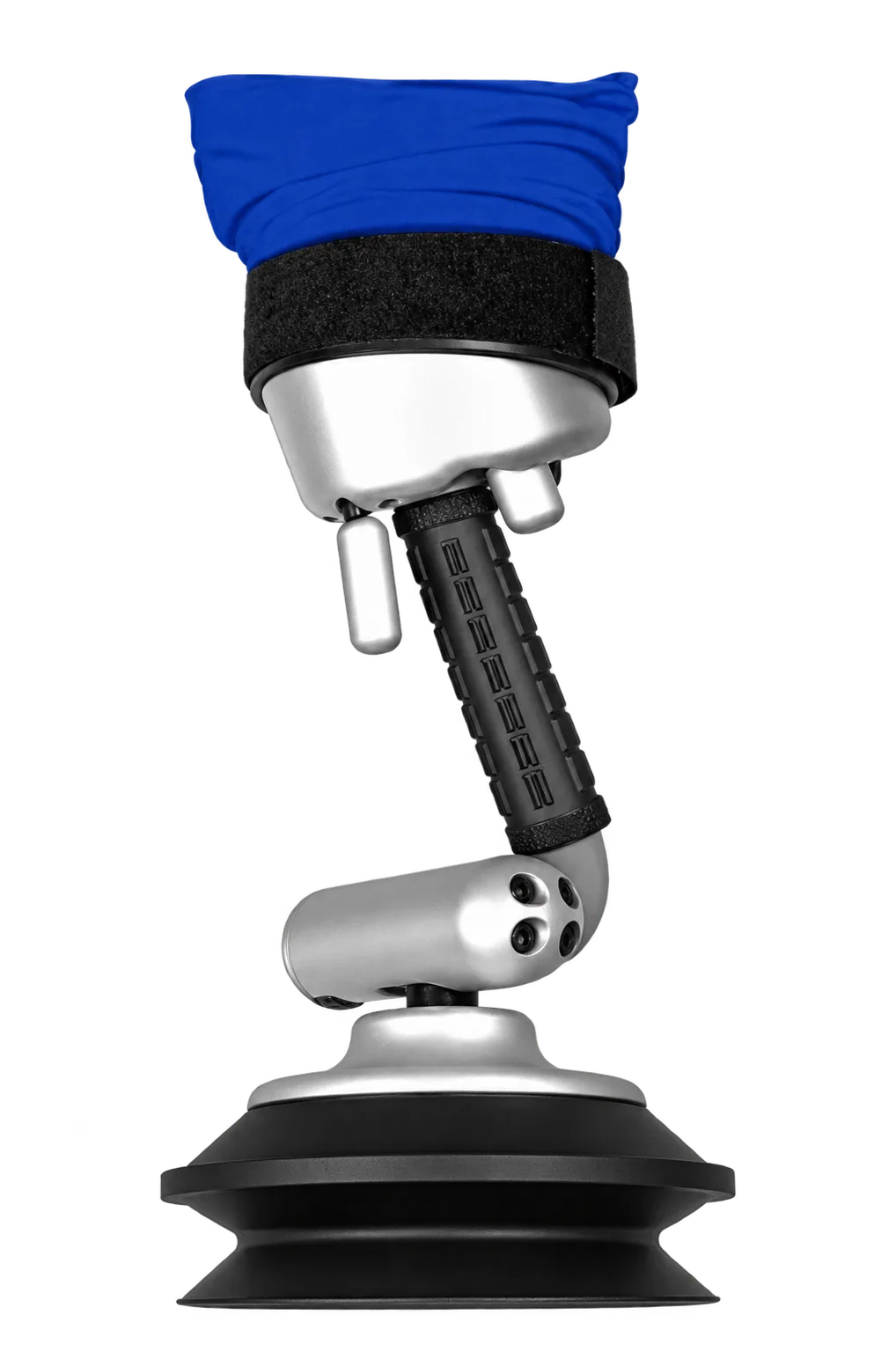
Type E — Extended Motorcycle-Style Control Handle — Control-handle options of 350 / 550 / 750 mm are documented for applications including wood panels. Handle length is not the same as crane reach or permissible panel size.
These components illustrate different selection decisions. They are not presented as an approved combined kit. A quotation should identify the exact head, handle, lifting unit, source, support and their compatible interfaces.
Why raw MDF and laminated boards need different checks
A porous board can allow air to pass through its thickness. A coated face may reduce leakage at one surface while exposed edges, holes or a different batch change the handling conditions. Dust also affects contact and the vacuum system. Use representative material rather than choosing only from nominal board weight.
For a stack, the requirement is to pick the intended single board. Do not assume that a general vacuum tube lifter includes an automatic separation function or double-board detection. State that requirement and obtain a configuration-specific response.
Compare vacuum pressure, airflow and surface conditions
A useful board-handling trial
Check | What to record |
|---|---|
Formats | Smallest and largest boards, thin/flexible variants, raw and finished faces. |
Contact | Actual head locations, vacuum response, visible marks and permitted surface preparation. |
Movement | Single-board pickup; lowest and highest working positions; required turns and clearance at the machine. |
Release | Board fully supported at the destination; accessible release control and withdrawal space. |
Repeatability | Agreed transfer sequence over the representative format range, including any head adjustment. |
Agree the acceptance method with the equipment supplier and site team for the supplied configuration. This selection checklist does not replace the machine instructions or authorize a lifting method outside them.
What to include in the equipment enquiry
Send board material, raw/laminated face details, dimensions and weights, a stack-and-machine layout, pickup and placement heights, required turning, available utilities and transfers per shift. Include existing crane or workstation information, and state whether you need a complete station or only a compatible lifting assembly.
Request a wood-panel handling configuration
Wood and MDF lifting questions
Can a glass vacuum lifter be used for MDF?
A glass rating does not establish a rating on MDF. The board’s leakage, contact surface and required support must suit the complete head and vacuum source. Review a documented panel-handling configuration instead of transferring the glass rating.
Do I need a tilting head for every machine-loading task?
No. A horizontal stack-to-horizontal-table task may keep the board flat. A move from upright storage may require tilting. Specify the starting and finishing positions so that the quotation includes only the motions needed, with their applicable load conditions.
Does this equipment hold the panel during CNC machining?
This page covers material transfer and loading. Workholding during machining is a separate machine and clamping requirement; a loading device does not automatically provide machining restraint.
Download ETJSQ-V100-30 specification PDF
Download ETJSQ-V160-60 specification PDF