
Why one room-temperature sample was insufficient
The application involved a 10 kg butter product that was warm and semi-fluid after filling, then became solid as it cooled. The project therefore had two handling conditions rather than one. A contact arrangement that works on the cooled package may not behave the same way while the contents and package are more deformable.
The project narrative records that a customer sample was heated to 78°C to reproduce the warm condition and was also assessed after cooling. That is the scope of the temperature evidence. It does not establish that every component, control or seal in the complete installation is continuously rated for 78°C.
The contact head and lifting tube were developed together
The narrative describes an initial five-pad test as broadly stable. It then describes a six-pad production arrangement and a change from a 120 mm lifting tube to a 100 mm tube to obtain steadier raising and lowering. These are reported project changes, not a general rule that a smaller tube is always better.
The useful lesson is to assess contact stability and controllability together. More pad positions alone do not prove that a warm package can be handled in every state, and a tube chosen only by nominal capacity can miss the handling behavior that matters at the workstation.
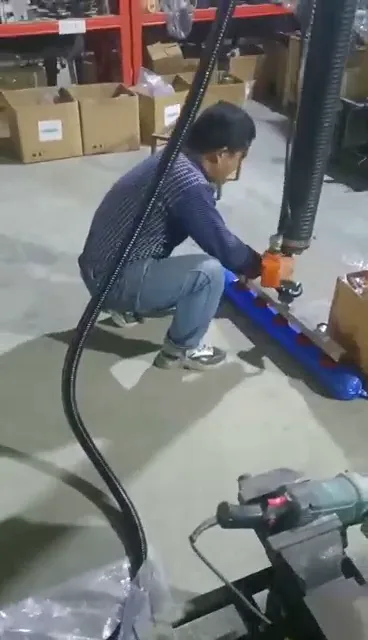
What the photograph shows
The trial image shows the suspended tube and elongated contact head during a pre-dispatch handling check. It is a record of the trial arrangement, not a dimensioned drawing of the final production version. Do not infer pad diameter, exact tube diameter or the final pad count from this single view.
The available narrative and configuration table disagree on pad diameter. That unconfirmed dimension is deliberately not reproduced as a specification. The meaningful, consistent application facts are the 10 kg task, the two material states and the documented sequence of configuration changes.
Temperature and food contact need separate answers
The original requirement included suitability for the food-production task. A requirement is not evidence of certification. For a new installation, identify whether the head touches the food itself or its packaging, which surfaces require cleaning and which cleaning agents and temperatures will be used.
Confirm the selected contact material and the complete operating conditions with the equipment documentation. A successful warm-sample pickup cannot by itself answer questions about hygiene, migration, cleaning compatibility or prolonged thermal exposure. This case makes no food-grade certification claim.
How to make a representative trial useful
Prepare samples at the normal warm condition and after cooling, using the actual packaging and fill quantity. Record temperature at the relevant point and time, sample mass, contact locations and the observed behavior during pickup, transfer, positioning and release. Note deformation or changes in the contact surface.
Keep each result linked to the head and tube configuration used. If the pad arrangement or lifting tube changes, repeat the relevant checks rather than combining results from different versions. Document unsuccessful attempts as well as successful ones so that the accepted working conditions are clear.
Use the evidence to define a configuration
This case is useful when a material changes condition during production and a standard catalog selection cannot answer the contact question. It supports a sample-led selection process, not a universal high-temperature capacity table.
The evidence comprises the project narrative, configuration records and a genuine trial image. Conflicting pad dimensions, unrelated nominal capacities and unmeasured performance improvements are not adopted. Provide your process state, package and movement requirements when discussing a comparable task.