
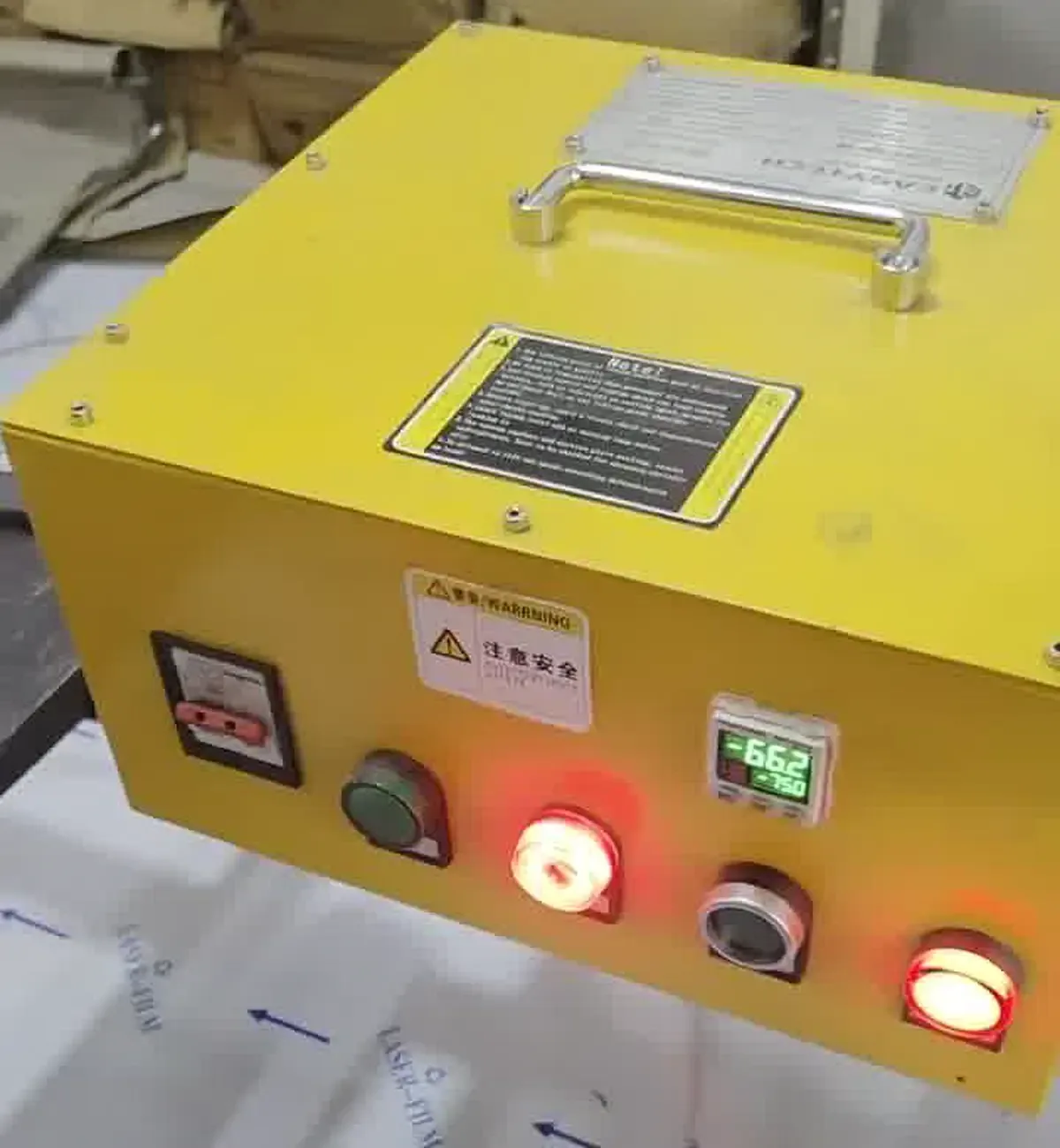
The after-sales call: gauge plateauing at −66.2 kPa with ALARM active
When a metalworking shop commissions a vacuum plate lifter and sees the vacuum pump running continuously without reaching its factory shutoff target, the natural assumption is a defective pump or a hidden air leak. That is exactly how this real Easytech after-sales case began.
A metalworking workshop operating at 2,500 m above sea level reported that its Easytech ETJS-C series sheet-metal vacuum lifter repeatedly plateaued near −66 kPa, never reaching the −75.0 kPa factory upper stop setpoint. Video recorded on an unloaded sheet from the shop floor showed the digital pressure switch holding at −66.2 kPa against −75.0, while the green VACUUM ready lamp stayed off, the red ALARM flashing buzzer indicator remained active, and the red POWER supply lamp on the far right stayed steadily lit.
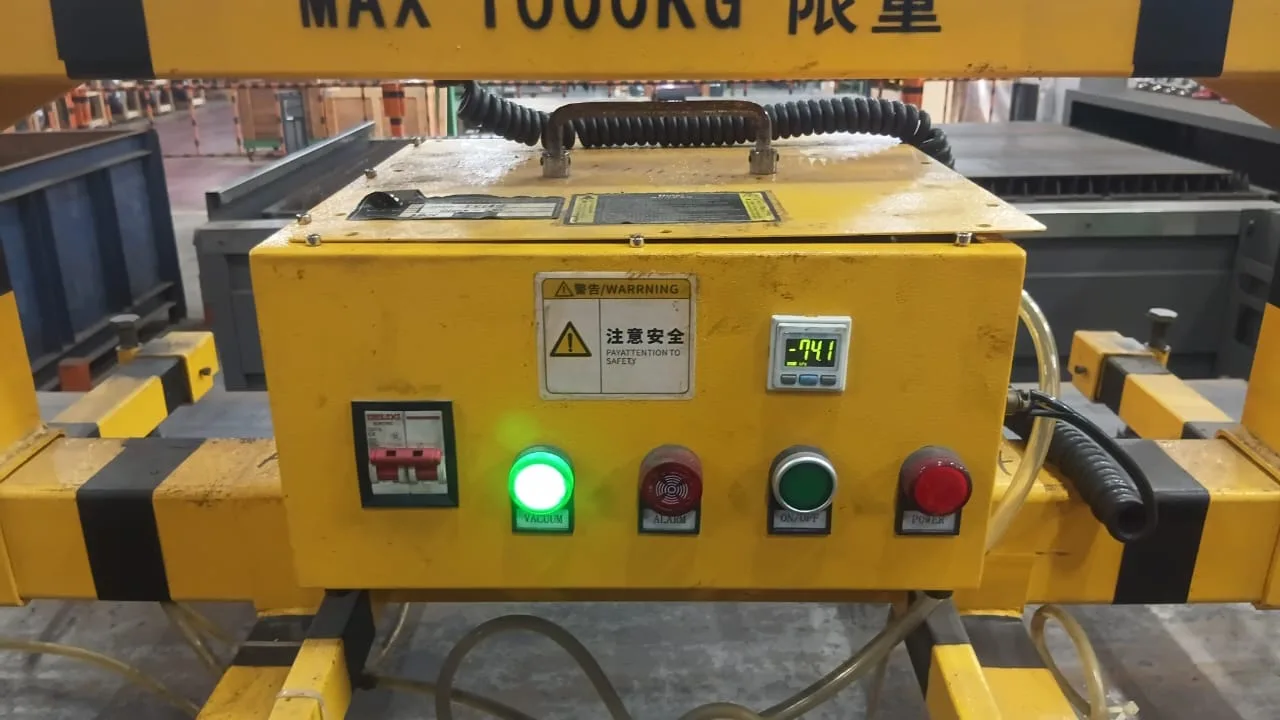
Compare that with a sea-level Easytech sheet-metal lifter (ETJS-C1000-3M, operating continuously in a customer factory for four years), where the identical control box reaches −74.1 kPa cleanly with the green VACUUM ready lamp illuminated and ALARM dark:
How Easytech structured safe unloaded checks to rule out leaks and low voltage
Before attributing a low vacuum reading to altitude or touching any control setting, every inspection must follow the safety prerequisite in the Easytech model handbook and our vacuum lifter power-failure protection guide: remove any load, rest the lifter on the floor or a stable support, and have trained, qualified technicians inspect the machine according to the supplied manual.
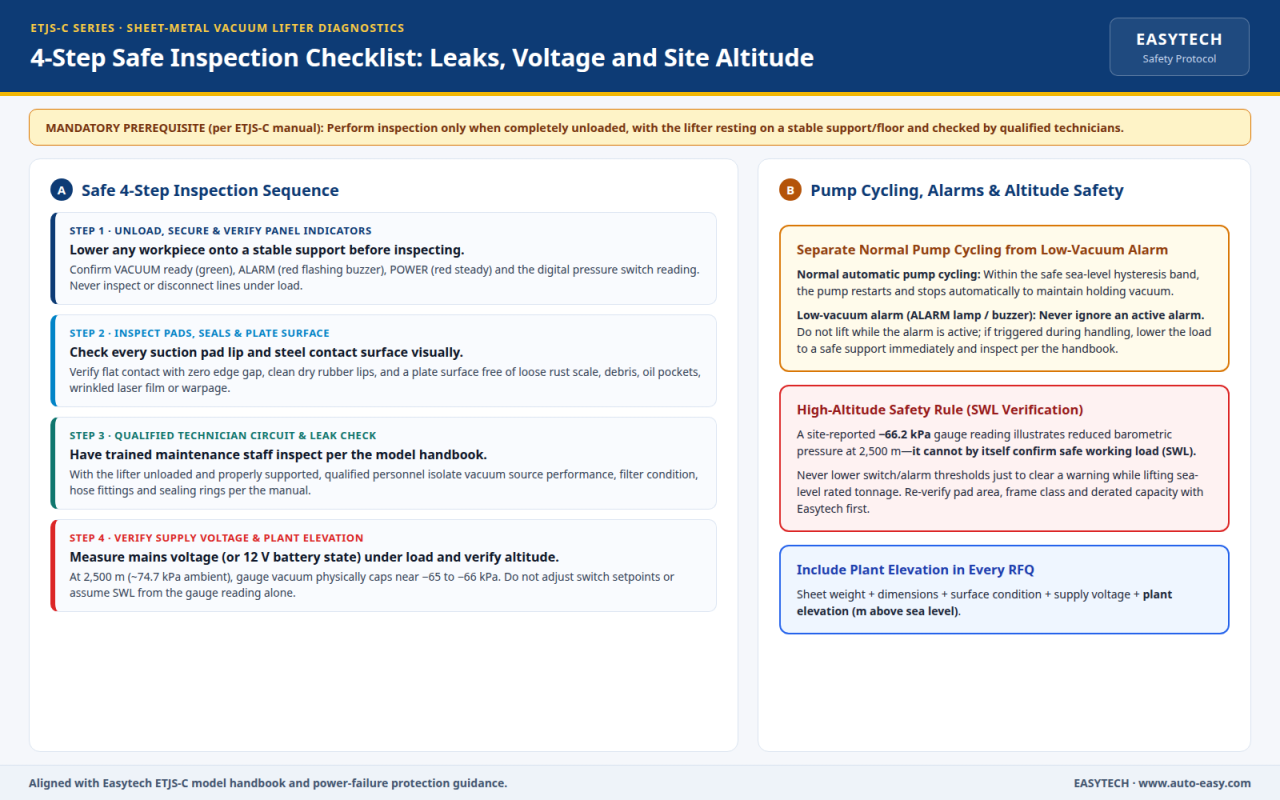
- Unload, secure and read all control-panel indicators first: Lower any workpiece to a stable support before inspecting. Verify the actual panel states—VACUUM ready (green), ALARM low-vacuum warning (flashing red buzzer), POWER supply (steady red) and the digital switch readout—and never disconnect vacuum lines or perform leak tests while a load is suspended.
- Inspect suction pads, rubber lips and steel surface condition: Confirm every pad seats flat against a clean, dry, nonporous steel surface with zero edge gap. Wipe the sealing lips with a clean cloth and check for cuts, hardening, loose rust scale, mill debris, oil pockets, wrinkled laser protective film or plate warpage.
- Have qualified maintenance personnel isolate the vacuum circuit per the model handbook: With the lifter completely unloaded and properly supported, trained technicians follow the supplied model manual to check vacuum source performance, air-filter cleanliness, hose fittings, valves and sealing rings rather than improvising ad-hoc line disconnections on the shop floor.
- Verify supply voltage under load—then confirm plant elevation: Measure actual mains voltage (or 12 V battery charge state on battery models) while the pump is drawing load. In this case, once sealing integrity and supply voltage were verified, the customer answered the decisive question: 'We are at 2,500 meters above sea level.'
The physics: why gauge vacuum caps below −75 kPa at 2,500 m
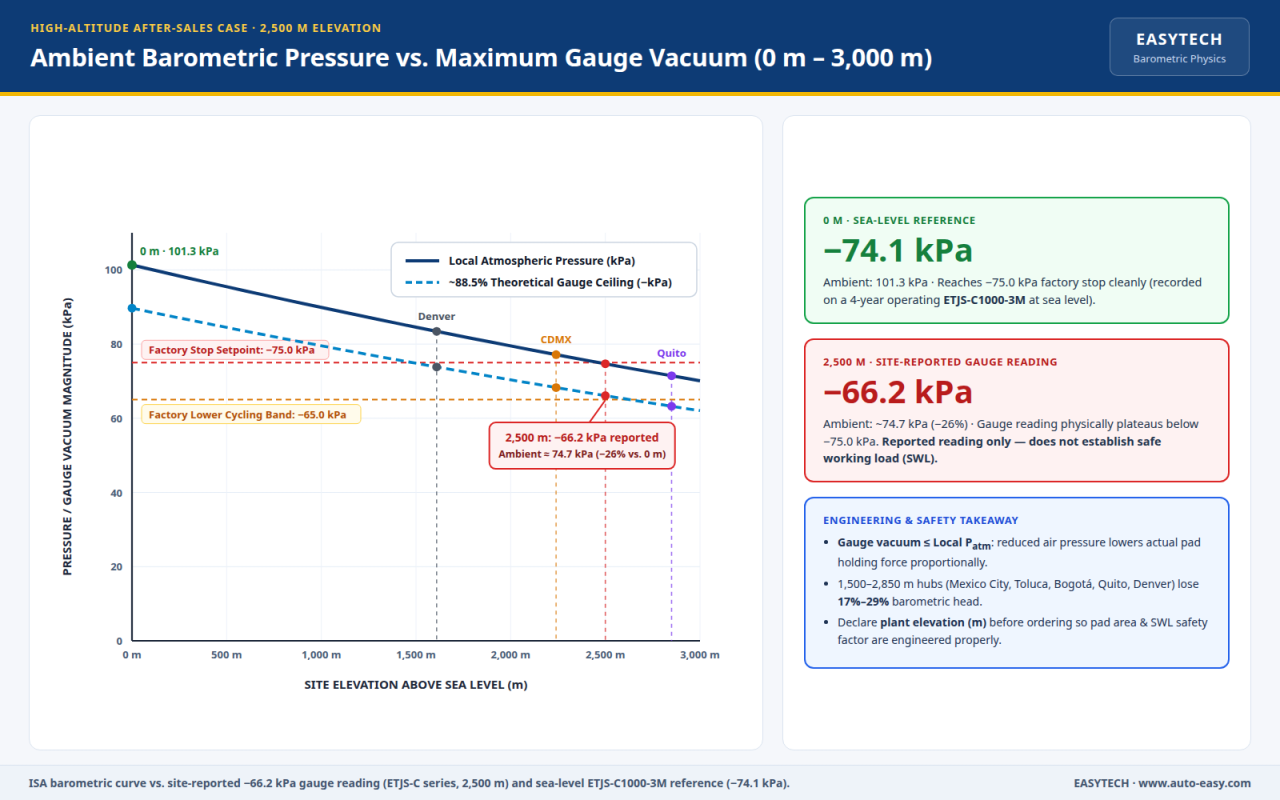
Vacuum gauges on industrial lifters measure gauge pressure—the pressure difference between ambient air outside the pad and partial vacuum inside it. No pump can pull a deeper gauge vacuum than the local atmosphere pressing down on the workshop.
- At sea level (0 m): Standard atmospheric pressure is 101.3 kPa. A properly sealed dry vacuum system reaching roughly 88% of local barometric pressure easily exceeds −75.0 kPa, triggering automatic pump shutoff and illuminating the green VACUUM ready lamp.
- At 2,500 m elevation: Standard barometric pressure drops to roughly 74.7 kPa—about 26% lower than sea level. Even without air leaks, ~88.5% of 74.7 kPa physically plateaus around −65 to −66 kPa, matching the site-reported −66.2 kPa gauge reading.
This exact barometric limit matches Easytech's field records in high-elevation regions of Yunnan, China (where sea-level-rated units likewise plateau near −65 kPa). It affects major industrial hubs worldwide—including Mexico City (2,240 m), Toluca (2,660 m), Puebla (2,135 m), Bogotá (2,640 m), Quito (2,850 m), Denver (1,609 m) and Johannesburg (1,750 m).
Separating normal pump cycling from low-vacuum alarms—and why −66.2 kPa does not prove safe load
Three strict safety rules apply directly to this case and align with Easytech's official ETJS-C model handbook:
- Separate automatic pump cycling from low-vacuum alarms: On a properly sized sea-level unit, the vacuum pump automatically restarts and stops within its factory hysteresis band to maintain holding vacuum—that automatic recovery cycle is normal. A low-vacuum visual or audible alarm (ALARM) is never something to ignore: per the model handbook, never lift a load while an alarm is active or when the green VACUUM ready indicator is off. If an alarm triggers during handling, lower the workpiece to a safe support immediately and inspect before resuming work.
- Treat −66.2 kPa as a site-reported gauge reading, not proof of safe working load (SWL): The −66.2 kPa figure explains why the gauge could not reach the sea-level −75.0 kPa shutoff at 2,500 m, but a gauge reading alone never certifies lifting capacity. Lower local atmospheric pressure proportionally reduces the actual holding force per square centimeter of suction pad.
- Never lower switch or alarm setpoints just to clear a warning: Simply reducing the digital pressure-switch setpoint so the green lamp illuminates while still lifting full sea-level rated tonnage erodes the structural safety factor. Any high-altitude derating or setpoint adjustment must be engineered and approved by the manufacturer for the exact model, pad area and surface condition.
What high-altitude buyers should do before ordering
If your workshop sits above 1,000–1,500 m elevation, treat altitude as a mandatory quotation parameter alongside plate weight and dimensions:
- State exact plant elevation (meters above sea level) in your initial equipment quotation request.
- Size for derated barometric head: Easytech compensates at the specification stage by either increasing total suction pad area (larger pad diameter or additional pads) or specifying the next capacity frame class so the required safety factor holds at local ambient pressure.
- Factory-calibrate switch thresholds only to the engineered design: Pressure-switch stop and low-vacuum alarm thresholds must match the manufacturer-verified pad area and derated working load limit for your site elevation.
Related equipment and troubleshooting guides
- Sheet metal vacuum lifters for steel plate and machine loading
- Glass vacuum lifters for flat, curved and heavy-duty frames
- Sheet metal handling applications and panel handling
- Vacuum gauge and alarm assembly (ET-VC-GAUGE)
- What happens to a vacuum lifter when the power fails?
- Sheet metal vacuum lifters for laser cutting machine loading
- Forklift-mounted battery vacuum lifters (300–1,000 kg case study)
- Contact Easytech technical support or request a high-altitude sizing quotation