
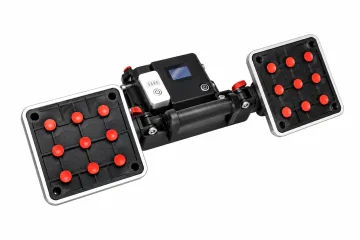
ETJSZ-N300
ETJSZ-N300 Twin-Pad Portable Vacuum Lifter
- Recommended horizontal suction load
- 300 kg
- Drive
- Lithium battery
Equipment family
Compare electric handheld cups and portable vacuum lifters by contact footprint, horizontal suction load and surface limits. Review model-specific use.
Portable vacuum equipment provides a grip for a defined contact surface and handling arrangement. Compare the actual pad footprint, stated load direction and surface limits. A portable unit is not automatically an approved crane-suspended attachment.
Filters include documented loads and overlapping conditional ranges. A range does not guarantee its upper value for every workpiece. Check material, seal, orientation and complete configuration.
ETJSZ-N300
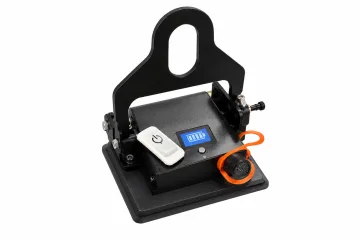
ETJSZ-N100
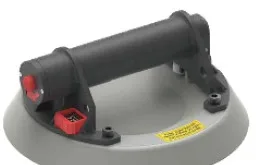
ETJSZ-N100
ETJSZ-N200
Try a shorter model name or clear the load filter.
Model / configuration | Recommended horizontal suction load | Pad / panel dimensions | Net equipment weight | Surface limitations |
|---|---|---|---|---|
120 kg | 8 in | 0.9 kg | Peak-to-valley < 2 mm; curvature < 3° | |
120 kg | 142 × 232 mm | 1.3 kg | Peak-to-valley < 2.5 mm; curvature < 3.5° | |
200 kg | 260 × 260 mm × 1 | 3 kg | Peak-to-valley < 3 mm; curvature < 5° | |
300 kg | 260 × 260 mm × 2 | 8.5 kg | Peak-to-valley < 2.5 mm; curvature < 3.5° |
The two ETJSZ-N100 records are different products: an 8-inch electric handheld cup and a 260 × 260 mm single-pad portable lifter. Use the full product description and pad dimensions when ordering, not the shared model text alone.
The specifications state recommended horizontal suction loads and separate surface profile/curvature limits. These values do not establish a vertical load, approval for every stone surface or permission for a particular overhead lifting method. Identify the material, orientation and complete handling arrangement.
Feature | What the records say | Buyer implication |
|---|---|---|
Vacuum replenishment | Automatic replenishment and start/stop are listed. | Keep the prescribed indication and battery checks part of the handling process. |
Power supply | Battery voltage/capacity differ by configuration. | Order the compatible battery/charger arrangement for that unit. |
Tilting | Manual 90° is listed for the single- and twin-pad portable lifters. | It does not create an unrestricted vertical lifting rating. |
Operating duration | 24 h+ is stated with duty-cycle qualification. | Define the actual use pattern; do not treat it as guaranteed continuous pumping time. |
Review handheld contact and handling methods
Not to establish a permitted complete lift. Load sharing, pane geometry, direction and the handling method must be assessed.
Not by itself. Leakage, airflow, seal and material behavior matter alongside pressure. Use the model’s approved surface scope.
Send the material, actual face condition, size/weight, intended carrying direction and whether the tool will be handheld or connected to another machine. Include the smallest available contact area and any coating or film.
CUSTOMER EXPERIENCES
Feedback from customers using this equipment family. These messages describe their own configurations and are not reviews of every model shown here.
Suction-cup customer, Germany
English translation from German
Hello, thank you very much. The suction cups are perfect.
English translation of a short customer message about the received suction cups. Compatibility, surface condition and working load still depend on the selected equipment.
 View the original message
 LET’S DEFINE YOUR APPLICATION
Tell us what you lift, where it moves and how it needs to arrive.