
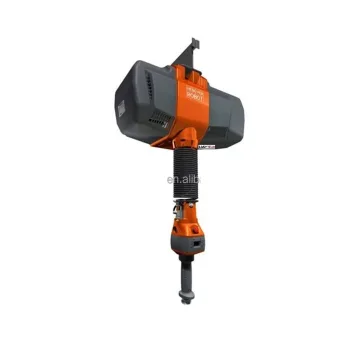
Equipment family
Intelligent Lifting Balancers and Electric Hoists
Compare float-assist balancers and up/down electric hoists by documented control function, load and supporting workstation. Define the complete tool scope.
A float-assist balancer and an up/down hoist provide different operator control. Start with how the load must be guided during placement, then choose the capacity and support structure. The word intelligent is not a substitute for a stated control function.
Start with your handling task
Compare models and configurations
Filters include documented loads and overlapping conditional ranges. A range does not guarantee its upper value for every workpiece. Check material, seal, orientation and complete configuration.
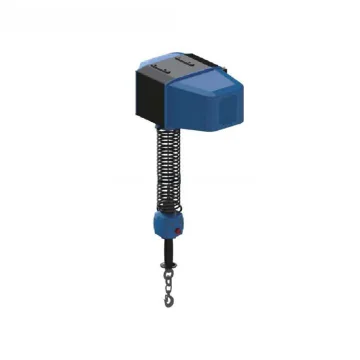
No matching configurations.
Try a shorter model name or clear the load filter.
Three documented control groups
Control group | Examples | Published load choices |
|---|---|---|
Float assistance throughout the travel. | ET-IL-FB-80 (80 kg) · ET-IL-FB-200 (200 kg) · ET-IL-FB-300 (300 kg) · ET-IL-FB-600 (600 kg) | |
Assisted float mode. | ET-IL-AS-100 (100 kg) · ET-IL-AS-200 (200 kg) · ET-IL-AS-300 (300 kg) | |
Up/down lifting without float mode. | ET-IL-UP-125 (125 kg) · ET-IL-UP-250 (250 kg) · ET-IL-UP-500 (500 kg) |
The range labels describe different functions. The documents do not establish a universal positioning accuracy, lifting speed or user-programmable I/O capability for these records. Set those requirements in the enquiry and request the corresponding configuration response.
Select the whole suspended arrangement
Part of the station | Selection question |
|---|---|
Lifting device | Which load and control mode suit the actual placement task? |
End tool | How will it grip, retain and release the workpiece, and what does it weigh? |
Jib or rail | Does its coverage reach every pickup and placement without obstruction? |
Utilities and controls | Which connections and operator position are required? |
Handover | Which instructions, checks and spares apply to the supplied assembly? |
Use placement work to compare the controls
A demonstration should include the lowest pickup, travel through the required area, alignment with the fixture and release. Use both the light and heavy workpiece variants and the intended tool. Measure the whole task if productivity matters, including any grip change or wait for the next part.
The supporting jib or articulating jib needs its own structural calculation. A listed compatibility statement does not supply a foundation design or prove that an existing support can accept the new device and tool.
Compare lift assist in an assembly station
Does the electric hoist provide float mode?
ET-IL-UP records explicitly describe up/down lifting without float mode. Review the FB or AS group when assisted placement is needed.
Can the published load be used for the workpiece alone?
The complete suspended tool and workpiece must be considered under the selected configuration’s load definition. Ask for that definition before comparing capacities.
Prepare a comparable quotation
Include part/tool weights, grip method, placement tolerances, lift range, support coverage and utilities. State which control behavior you need to evaluate and identify any existing structure or tool to retain.
LET’S DEFINE YOUR APPLICATION
The right equipment starts
with your workpiece.
Tell us what you lift, where it moves and how it needs to arrive.