
Why this paint line kept the vacuum tube—and dropped the suction cups
When buyers hear vacuum tube lifter, they usually picture a rubber suction pad gripping a flat carton or smooth drum lid. In this Ecuador paint packaging plant, suction pads were Easytech's first suggestion too—until the lid geometry and line speed ruled them out.
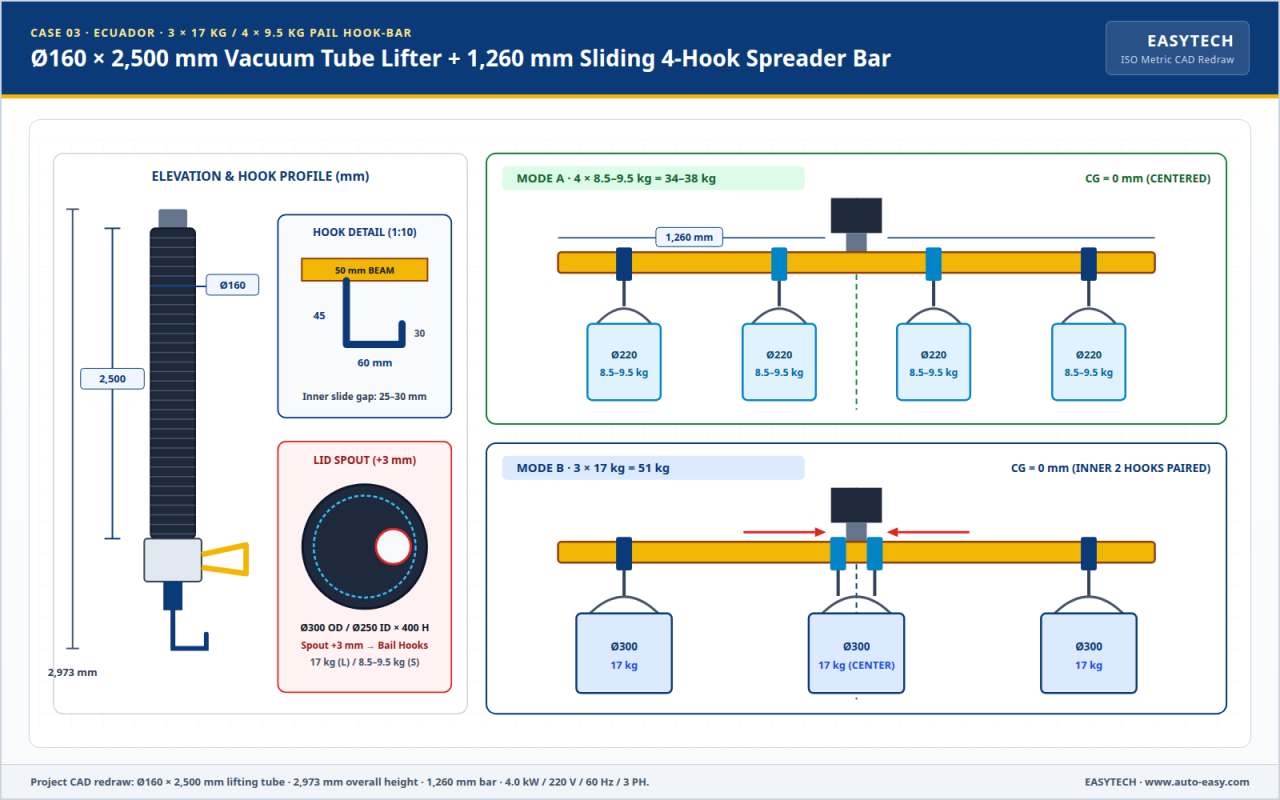
Both pail sizes coming off the plant's two fast discharge conveyors carried a raised ~3 mm pouring spout molded into the lid (large 17 kg pails at Ø30 cm outer / Ø25 cm inner diameter × 40 cm high; small 8.5–9.5 kg pails at Ø22 cm inner diameter × 40 cm high). Sealing multiple vacuum pads simultaneously across irregular spouted lids slows operator alignment, whereas operators already worked rapidly with the pails' wire bail handles. The customer therefore specified zero suction cups: keep the ergonomic one-hand vacuum lifting tube for fast vertical balance, but engage the pails mechanically with hooks.
Solving the 4-pail vs. 3-pail center-of-gravity problem
Lifting four identical small pails on a four-hook bar is straightforward: two hooks sit left of the tube centerline and two sit right. The real engineering trap appears the moment production switches to three larger 17 kg pails (51 kg total).
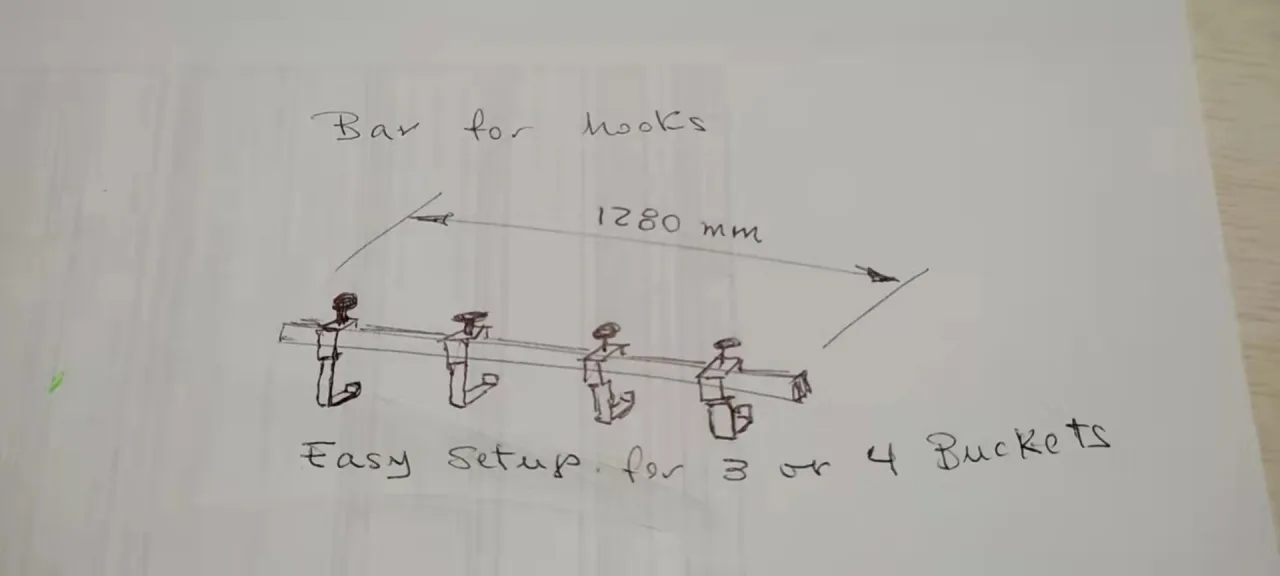
If you hang three pails on three positions of a fixed four-hook bar, the empty fourth slot shifts the combined center of gravity off-axis, tilting the lifting tube and dragging against the guide sleeve. The buyer sent an initial hand sketch proposing a ~1,280 mm bar with adjustable hooks for quick 3-or-4 bucket changeover:
Easytech translated that concept into a 1,260 mm engineered spreader bar (50 mm beam section, 45 mm hook drop × 60 mm hook length × 30 mm throat opening) mounted beneath the extended pull-up control unit of a Ø160 × 2,500 mm lifting tube (2,973 mm overall assembly height):
- Mode A (4 small pails, 34–38 kg): All four hooks lock at symmetrical intervals along the 1,260 mm bar so four Ø22 cm pails hang evenly.
- Mode B (3 large pails, 51 kg): The two inner sliding hooks move inward and pair at the centerline (25–30 mm inner spacing) to engage the center 17 kg pail directly on the vertical axis of the Ø160 tube, while the two outer hooks carry the left and right 17 kg pails.
Because both modes keep the resultant load vector centered directly under the lifting tube, vertical contraction stays straight, smooth and free of side torque—protecting lifting-tube longevity.
Columnless 4 m jib layout, bail-handle height and 220 V / 60 Hz utilities
Multi-pail palletizing fails if only the hook bar is engineered while the surrounding bay is ignored. In this Ecuador facility, two conveyor lines (Line 1 and Line 2) fed a 6 × 6 m palletizing area holding four active pallets beneath a 6 m factory roof.
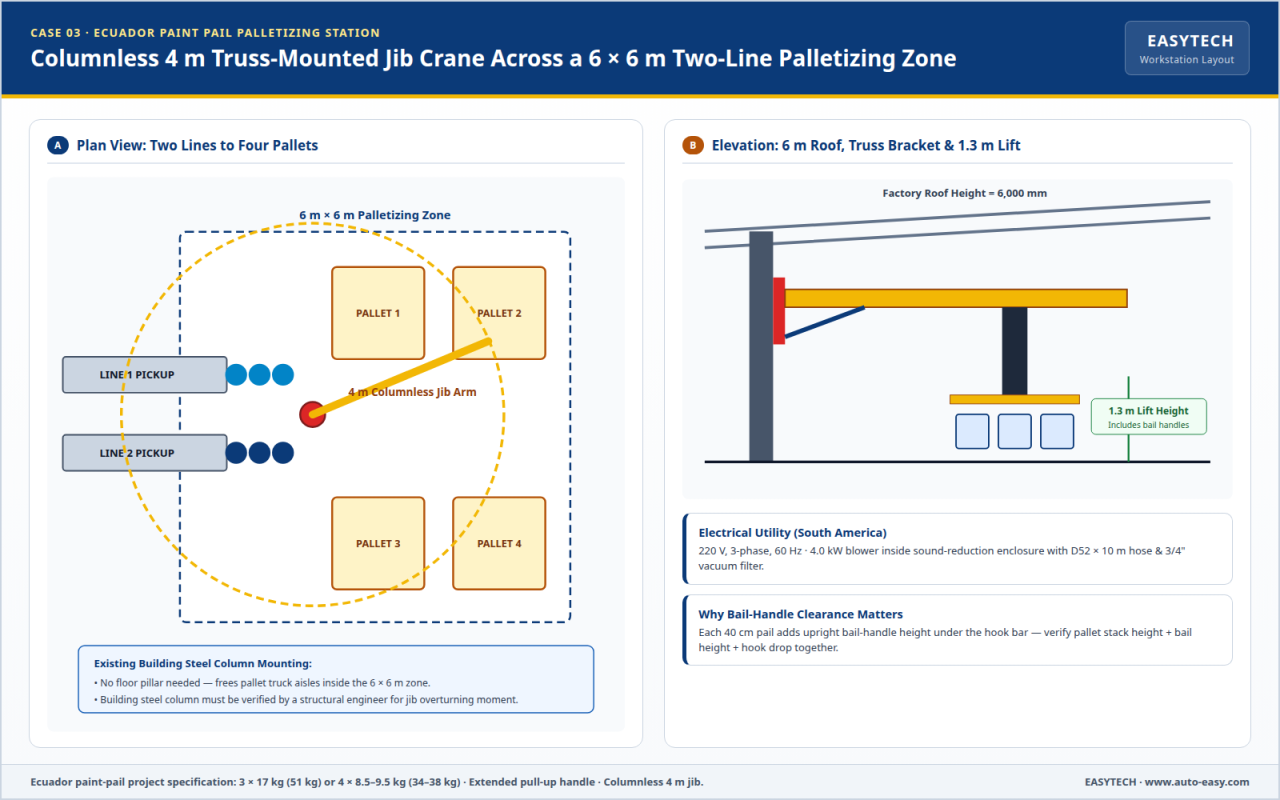
Three site conditions shaped the final package:
- Columnless 4 m jib arm on existing building steel: Installing a freestanding floor column in the middle of a 6 × 6 m four-pallet bay would block pallet jacks and fork traffic. The customer supplied a steel mounting plate on their existing roof-truss column to carry the 4 m jib arm—a setup that always requires structural verification of the host column for cantilever overturning moment.
- 1.3 m lift height including bail-handle allowance: A 40 cm tall pail suspended from its wire bail adds significant vertical stack height between the hook throat and the pail bottom. Specifying 1.3 m usable lift height after accounting for bail handles and the 2,973 mm total assembly height prevented running out of top stroke on the upper pallet layer.
- South American 220 V / 3-phase / 60 Hz power package: The Ø160 lifting tube was paired with a 4.0 kW, 220 V, 3-phase, 60 Hz vacuum blower housed in a sound-reduction enclosure, connected via 10 m of D52 supply hose, a 3/4-inch vacuum filter and a 360° swivel joint with integrated non-return valve.
When a hook-bar tube lifter beats a wire-rope manipulator—and when it does not
Compare this Ecuador multi-pail project with our Australian single-pail pneumatic wire-rope manipulator case:
- Choose a vacuum tube lifter + multi-hook bar when you have fast, repetitive upright palletizing of multiple pails (3–4 at a time), three-phase electric power available, and straightforward vertical transfer from conveyor to pallet.
- Choose a pneumatic wire-rope manipulator when you move single heavy pails in tight machine-loading spaces, need mobile base relocation, or require compressed-air operation without an electric blower at the station.
- Verify bail-handle strength first: Mechanical hooks only work safely when every filled 17 kg pail has a rigid bail handle rated for vertical lifting and does not flex or pop out of its ears during rapid cycles. If you need tilting or pouring rather than upright palletizing, review our vacuum drum lifter vs. mechanical handler comparison.
Related equipment and planning guides
- Vacuum tube lifters for bags, cartons and panels
- Drum handling hook concept (ET-VC-HOOK-PAIL) and vacuum components
- Drum and pail handling applications
- Vacuum Tube Lifter ETJSQ-V160-60 (reference Ø160 tube family)
- Roll, reel and drum handling specification checklist
- Moving pails with a pneumatic wire-rope manipulator (40 kg case study)
- Request a custom multi-pail lifter quotation or contact Easytech engineering