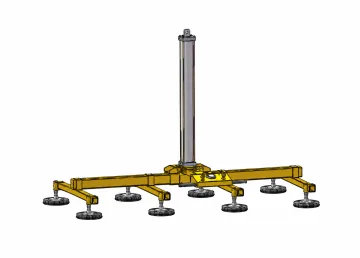
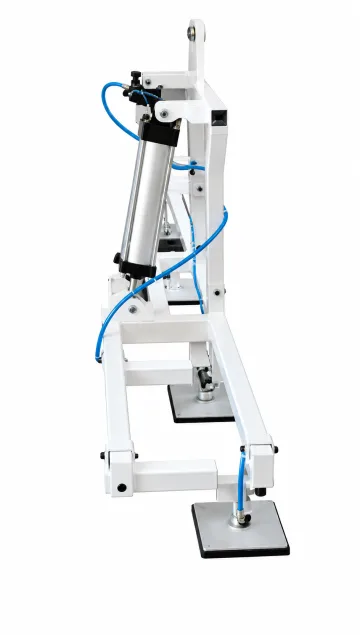
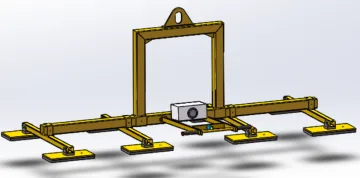
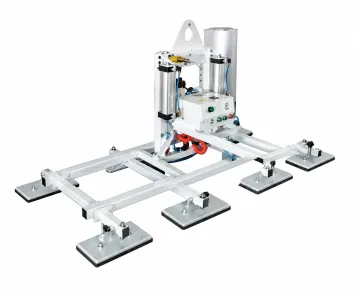
For stone slab transfer, establish the start and finish orientations first. Moving a horizontal slab between tables differs from taking a vertical slab from a rack. The stone finish, porosity and cutouts then determine whether the proposed pad layout is suitable.
Compare horizontal transfer and tilting configurations
Model | Documented contact and load | Movement / supply |
|---|---|---|
300 kg; six Ø200 mm pads. | Horizontal gripping; external air supply and reservoir; no alarm fitted to this configuration. | |
300 kg; four 200 × 400 mm pads. | Pneumatic 90° tilting; external compressed air; alarm included. | |
400 kg; six 200 × 400 mm pads. | Pneumatic 90° tilting; external compressed air; alarm included. | |
500 kg; eight 200 × 400 mm pads. | Pneumatic 90° tilting; external compressed air; alarm included. |
The ET-ST-TILT-300, ET-ST-TILT-400 and ET-ST-TILT-500 configurations each provide pneumatic 90° tilting. Check slab and frame clearances through the complete movement between pickup and placement.
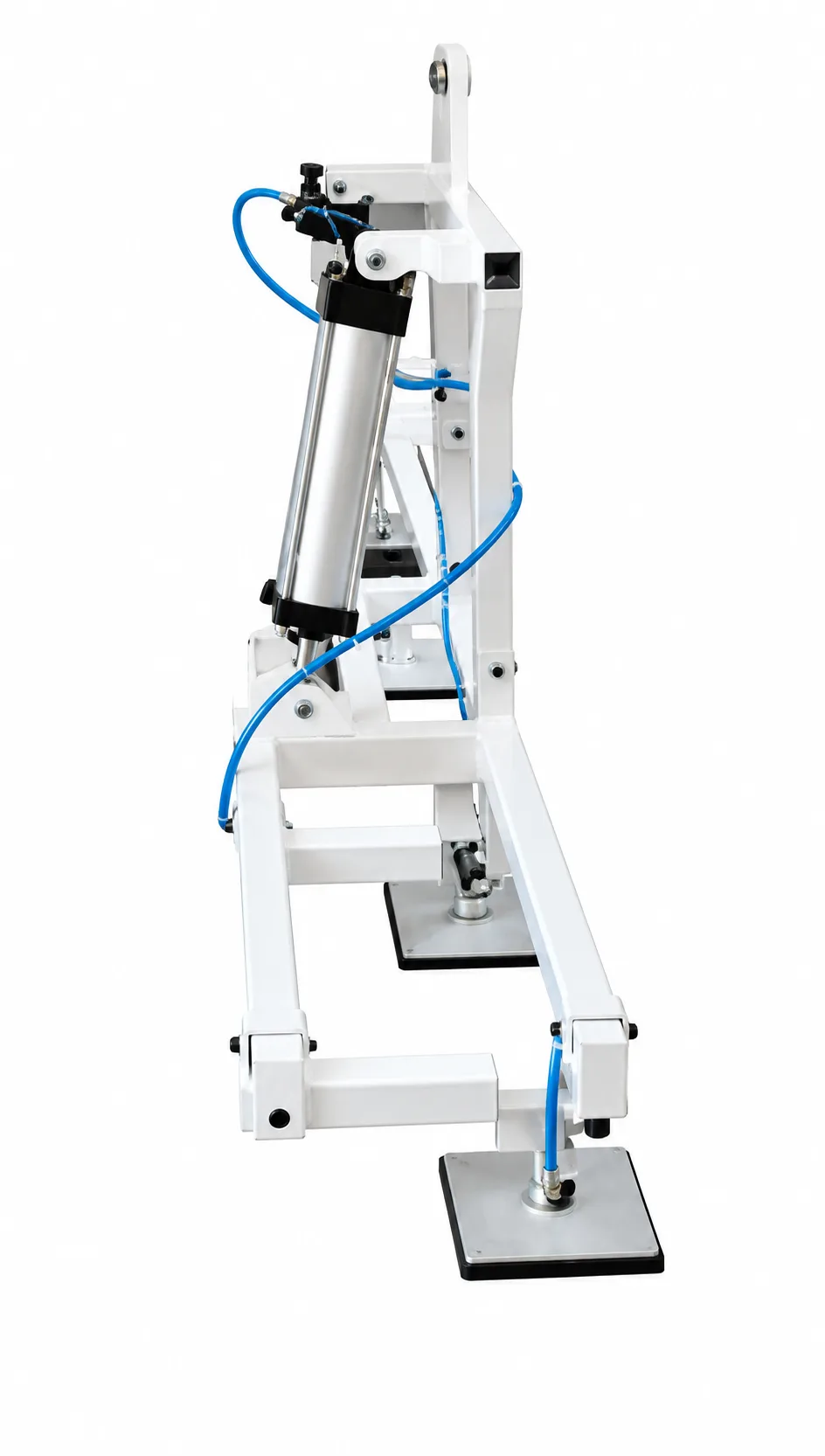
Stone geometry can rule out an otherwise adequate capacity
Show sink openings, narrow bridges, long overhangs, repairs and other fragile areas on the slab drawing. Pads need usable contact positions and the slab needs an acceptable support pattern. A heavier-rated lifter does not prevent a thin or cut slab from bending between its supports.
Review rough-surface equipment separately
Configuration | What is documented | What still needs a project answer |
|---|---|---|
500 kg rated configuration; foam pad, compressed-air vacuum generator, no tilt and no alarm fitted. | Permitted stone face, seal performance and accepted operating arrangement within the 500 kg configuration rating. | |
300 kg rated configuration; foam pad, compressed-air generator, pneumatic 90° tilt and alarm module. | Actual porosity, pad geometry and load conditions for the slab range. |
The 300 kg and 500 kg configuration ratings do not establish equal performance on every stone surface. A polished face can still be porous; a textured face may require a different seal without being highly permeable. Review both features with representative material.
Plan rack pickup through to supported release
- Record the rack angle and the clearance available between stored slabs.
- Allow for the sweep of the slab and frame during the intended turn.
- Check hose travel, controls and the supporting crane through the transfer.
- Define how the receiving table supports the slab before release and how the pads withdraw.
Can the horizontal 300 kg model tilt a slab?
No tilting capability is established for ET-ST-FLAT-300. Select a documented tilting configuration when the process needs an orientation change.
Does more foam make porous stone suitable?
Not by itself. The complete seal, workpiece leakage, source and permitted operating conditions need to be assessed together.
Details to include in your enquiry
Requirement | Details to provide |
|---|---|
Slab | Stone/product type, dimensions, thickness, weight and centre of gravity. |
Contact | Polished, sawn or textured face; porosity, moisture and surface treatments. |
Geometry | Cutouts, narrow sections, edge limitations and potential flex. |
Task | Rack-to-table, transport or installation; required tilt and placement clearance. |
Choose the next step
Surface selection guide · Stone lifting configurations · Vacuum source selection