
Why EN 13155 and ASME B30.20 decide whether a vacuum lifter passes site inspection
For glazing contractors, curtain-wall installers and heavy metal fabrication plants across Europe and North America, selecting a vacuum lifter is not just a payload calculation. Site safety officers and principal contractors routinely audit suspended below-the-hook attachments against EN 13155 (Europe) or ASME B30.20 (North America) before allowing a frame onto the crane hook.
Ordering a single-circuit indoor workshop lifter for an outdoor construction facade—or missing required nameplate data, reserve-tank specifications or guarded release controls—can halt crane time on day one. The table below summarizes the five technical checkpoints buyers actually need to confirm at quotation.
Compliance requirement | EN 13155 (Europe / construction) | ASME B30.20 (North America) | What to confirm at quotation |
|---|---|---|---|
Vacuum circuit redundancy | Dual independent vacuum circuits (or approved secondary positive holding restraint) required for construction-site suspended loads. | Requires vacuum reserve, holding design and documented recovery procedure under power or pump loss. | Specify indoor factory vs. outdoor construction site; select dual-circuit models (such as ET-GL-DUAL or RDS frames) for facade glazing. |
Safety factor & load rating | Minimum 2:1 holding-force safety factor on smooth, dry, nonporous flat surfaces (higher margins for tilted or textured loads). | Rated load established from pad area, minimum operating vacuum, surface friction and load orientation. | Declare max weight, dimensions, tilt angle (0°–90°), surface condition and site elevation (m above sea level). |
Power-loss & low-vacuum alarm | Integrated reserve tank, non-return valve and clear audible/visual warning below minimum working vacuum. | Visible vacuum gauge/indicator plus warning device; lifting while an alarm is active is prohibited. | Confirm independent alarm power supply, reserve-tank configuration and emergency lowering instructions in the model handbook. |
Unintended release prevention | Two-step or guarded release control to prevent accidental drop while a load is suspended. | Release controls must be guarded or require deliberate two-action operation. | Confirm locked manual slide valve, delayed release or two-button remote release interlock on the ordered model. |
Nameplate & documentation | Rated load (SWL), tare weight, serial no., year, manufacturer, CE Machinery Directive documentation and operating manual. | Rated load, lifter weight, serial no., manufacturer ID, inspection log and operating manual. | Easytech holds CE-MD compliance under EN ISO 12100:2010 & EN 60204-1 (Cert. ATS202605198880201C-01C); declare any project-specific third-party EN 13155 or ASME B30.20 sign-off upfront. |
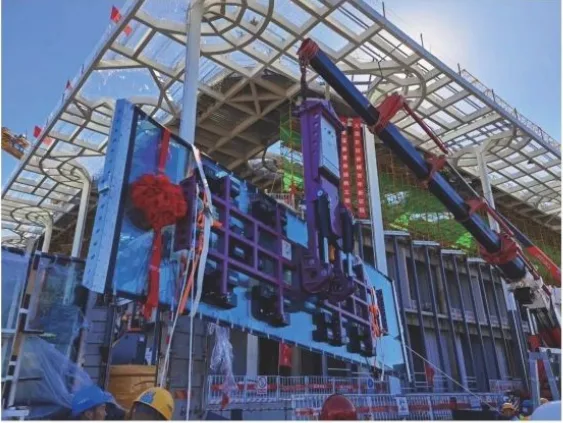
1. Dual independent vacuum circuits vs. single-circuit workshop frames
The single most frequent site rejection occurs when a single-circuit lifter arrives on an outdoor glazing construction site.
- EN 13155 construction-site expectation: Where suspended loads are handled over construction sites—especially architectural glass panels—buyers typically require dual independent vacuum circuits (each with its own reserve tank, non-return valve, gauge and monitored circuit) or an approved secondary positive holding device so that a failure in one circuit does not immediately release the load.
- ASME B30.20 below-the-hook focus: Emphasizes clear identification of the vacuum reserve, non-return protection, monitored indicator visibility and documented emergency recovery procedures matching the actual machine and workpiece.
- How to specify cleanly: For curtain-wall and heavy curved glass jobs, specify dual-circuit configurations such as curved and heavy dual-circuit glass vacuum lifters or a self-propelled glass lifting robot with dual vacuum circuits. For indoor workshop sheet transfer over guarded laser tables, confirm whether your plant safety rules require single-circuit reserve protection or dual circuits.
2. Safety factor (2:1 baseline) and why horizontal capacity differs from vertical tilt
Both European and North American buyers evaluate holding capacity against a minimum 2:1 safety factor on clean, smooth, dry, nonporous horizontal surfaces—and higher margins when panels are tilted vertically, rotated or textured.
- Shear vs. direct pull: When a glass pane or steel plate is tilted 90° to vertical, the pads carry load through surface friction rather than pure perpendicular pull. Moisture, oil film, protective laser film wrinkles or dust directly reduce slip resistance.
- High-altitude barometric derating: If the jobsite sits above 1,000–1,500 m elevation (such as Denver, Mexico City, Toluca, Bogotá or Quito), lower ambient atmospheric pressure reduces both maximum achievable gauge vacuum and actual holding force per suction pad. Never adjust switch thresholds to silence a warning without recalculating safe working load—see our 2,500 m high-altitude sheet-metal lifter diagnosis and vacuum suction cup force guide.
3. Reserve tank, non-return valve and low-vacuum alarm rules
A vacuum reservoir, a non-return valve and a low-vacuum alarm perform three completely different safety roles—none replaces a sound pad seal:
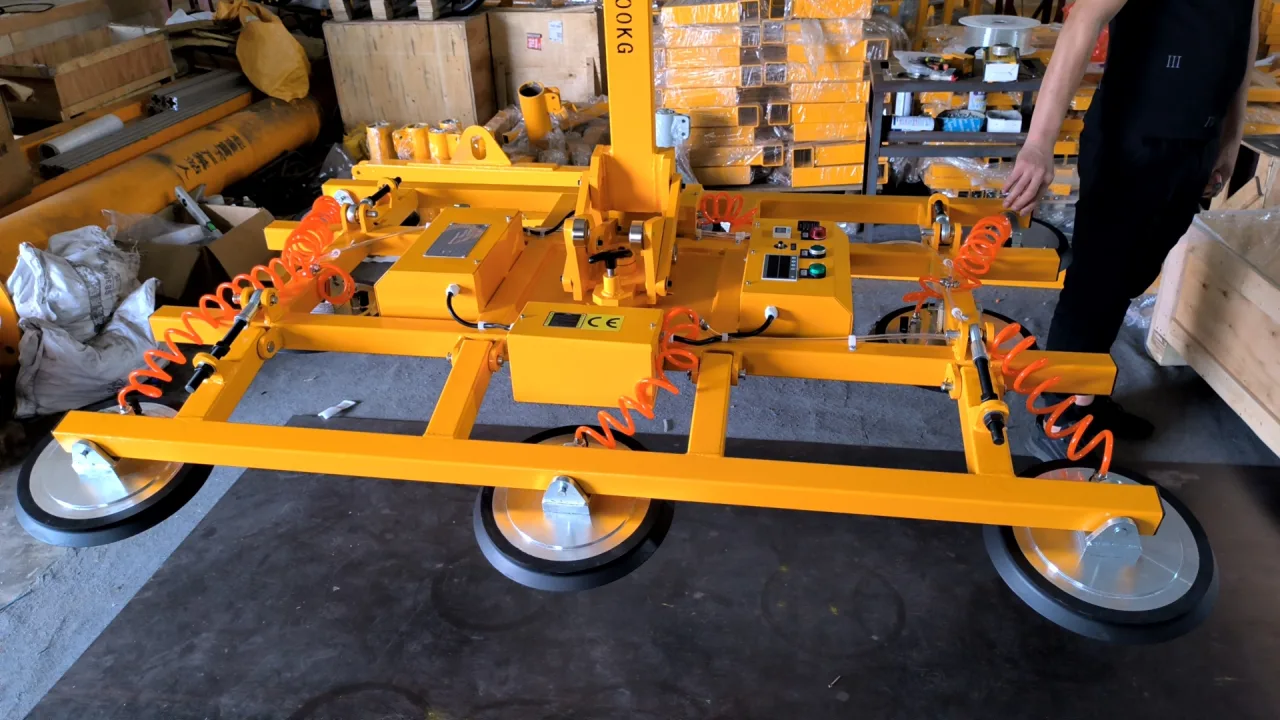
- Vacuum reservoir and non-return valve: Provide temporary retention of evacuated volume if the vacuum pump or power supply stops while the pad seal stays intact. As explained in our vacuum lifter power-failure protection guide, retention is always configuration-specific and cannot seal a torn pad lip or porous material.
- Audible and visual low-vacuum alarm: Warns the operator immediately when vacuum falls below the safe working threshold. Separate normal automatic pump cycling from a low-vacuum alarm: automatic pump restart within a healthy sea-level hysteresis band is normal recovery, whereas an active low-vacuum alarm must never be ignored. Per Easytech operating handbooks, never lift while an alarm is active or when the green vacuum-ready lamp is off; if an alarm triggers mid-lift, lower the workpiece onto a stable support immediately and inspect before resuming.
4. Guarded two-step release controls and safe maintenance boundaries
Both EN 13155 and ASME B30.20 target unintended load release and unsafe field interventions:
- Two-step or guarded release: Release controls must prevent accidental single-bump activation while a load is suspended—using a locked manual slide valve, delayed release button or deliberate two-button remote release sequence.
- Unloaded inspection only: Per Easytech official model handbooks, troubleshooting, seal replacement and electrical or circuit checks must only be performed by trained, qualified personnel after the load is completely removed and the lifter rests safely on the floor or a stable maintenance support.
5. Nameplate data, pre-shipment testing and Easytech's verified compliance boundary
Before issuing a purchase order, buyers should request clear documentation rather than vague marketing claims. Here is Easytech's exact, verifiable compliance scope:
- Verified CE Machinery Directive compliance: Dongguan Easytech Automation Mechanical and Electrical Equipment Co., Ltd. holds CE Machinery Directive compliance documentation under EN ISO 12100:2010 (safety of machinery risk assessment) and EN 60204-1:2018/A1:2025 (electrical equipment of machines), Certificate No. ATS202605198880201C-01C (Test Report ATS202605198880201R-01R).
- Project-specific EN 13155 or ASME B30.20 sign-off: Easytech engineers dual-circuit frames, reserve tanks, non-return valves, independent alarms, guarded release controls and pre-shipment functional/load test records to match industrial site safety requirements. If your contract specifically requires third-party EN 13155 or ASME B30.20 certification or witness load testing, declare that standard in your initial RFQ so we confirm the exact model configuration, test protocol and deliverable documentation upfront.
- Standard nameplate and handover checklist: Confirm rated load capacity (SWL), lifter tare weight, serial number, manufacture year, electrical rating, operating manual and pre-shipment test video before dispatch.
Buyer RFQ checklist for compliant vacuum lifters
Include these six items when requesting a specification and quotation:
- Workpiece and load: Material (glass, steel sheet, stone, sandwich panel), max weight, length × width × thickness and surface condition.
- Handling motion: Horizontal lift only, 0°–90° manual or hydraulic tilt, 360° rotation, indoor factory vs. outdoor construction site.
- Target site standard: CE Machinery Directive documentation only, or project-specific EN 13155 / ASME B30.20 site inspection requirements.
- Power and voltage: 12 V / 24 V battery, 110 V / 220 V / 380 V / 480 V mains, or compressed-air pneumatic supply.
- Site elevation: Declare elevation above sea level if above 1,000 m so pad area and SWL retain full safety margin.
- Carrier equipment: Overhead bridge crane, jib crane system, forklift vacuum attachment, or self-propelled glass lifting robot.
Related equipment and procurement guides
- Glass vacuum lifters for flat, curved and heavy-duty frames
- Glass lifting robots for glazing and installation and glazing robot price and quotation scope
- Sheet metal vacuum lifters for steel plate and laser loading
- Curved and heavy dual-circuit glass vacuum lifters
- What happens to a vacuum lifter when the power fails?
- Glass lifting robot vs. suspended vacuum lifter
- Jib crane cost and installed scope guide
- Request a site-compliant vacuum lifter quotation or contact Easytech technical support