Start with the access route and installation point
Draw the path from unloading to installation. Include doorways, turning areas, ramps, thresholds, floors, overhead restrictions and final reach. This often determines the feasible format before headline lifting capacity is considered.
Decision | Mobile glass robot | Crane-suspended vacuum lifter |
|---|---|---|
Reaching the work area | Review the machine and load envelope through the route. | Review crane/hoist coverage and the path of the suspended assembly. |
Positioning the glass | Compare the documented arm, tilt, rotation and side-shift functions. | Compare lifter movements together with crane/hoist control. |
Supporting the load | Use the machine load chart for the operating position. | Check the lifter and supporting equipment as a complete assembly. |
Site constraints | Ground, access and travel limits must fit the selected model. | Rigging, lifting height, reach and clearance must fit the site plan. |
Cost scope | Include chassis, vacuum equipment, positioning functions and transport. | Include the lifter and any required supporting machine, rigging and installation arrangements. |
Read the working point, not two separate maxima
Maximum capacity, maximum lifting height and maximum forward reach may occur in different configurations. Select the required point on the applicable load chart. Do not assume that the largest published capacity is available at the greatest extension.
For crawler or counterweighted machines, record the exact configuration and required setup. Chassis type alone does not prove suitability for a slope, soft ground or an uneven floor.
Check the glass interface for either option
Provide pane dimensions, total weight, centre of gravity, contact surface and final orientation. Both formats need the correct pad/frame arrangement. Coatings, curvature, cutouts and restricted contact zones require a specific assessment.
Compare the complete site sequence
- Unloading and bringing the equipment into the work area.
- Picking glass from its storage orientation.
- Travelling or moving the supported assembly to the installation point.
- Positioning and supporting the pane before release.
- Removing the equipment without obstruction.
Compare access with a real model dimension
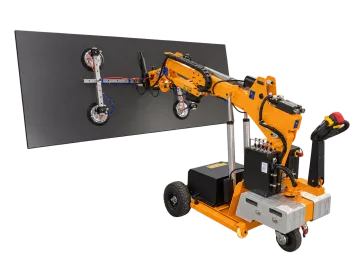
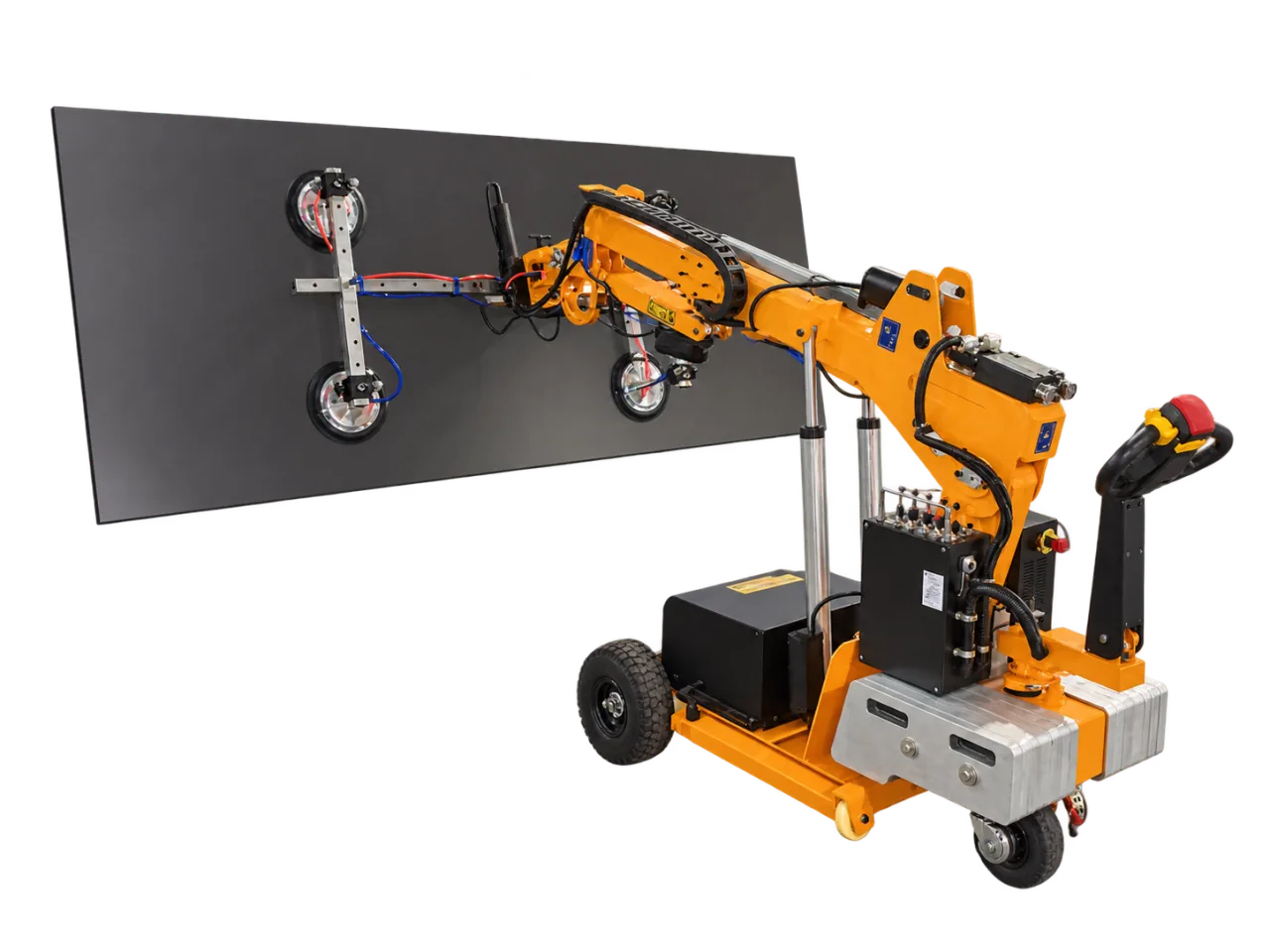
WSR-400MINI — Wheeled Glass Installation Robot — WSR-400MINI lists minimum equipment dimensions of 1,298 × 730 × 1,852 mm, 815 kg equipment weight and 400 kg maximum load.
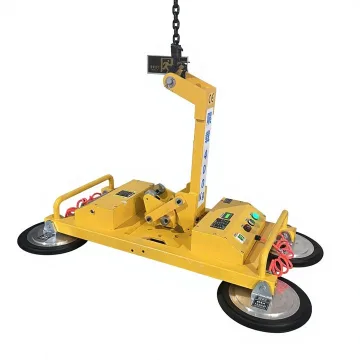
ETJSB-G400B — H-Frame Glass Vacuum Lifter — ETJSB-G400B is a 400 kg suspended H-frame with a 1,230 × 710 mm footprint and 62 kg equipment weight; a supporting lifting machine is still needed.
The shared 400 kg figure hides two different systems. The robot adds chassis and positioning functions; the suspended frame depends on crane/hoist coverage. Compare the complete route and support requirements, not just device weight or the product price. Neither the 730 mm chassis width nor the 710 mm frame width is a guaranteed doorway clearance with glass fitted.
Continue your equipment review
Glass lifting robots · Suspended glass lifters · How to read a glass robot load chart
Questions for this equipment decision
What affects the quoted cost of a glass lifting robot?
Chassis, positioning movements, vacuum equipment, batteries, optional drives and delivery arrangements affect cost.
When should a glazing contractor choose a wheeled, off-road or tracked robot?
Compare the access width, turning space, ground conditions, transport arrangements and required installation position. Wheels, off-road configurations and tracks are chassis choices with different model-specific limits. Include equipment, counterweight and workpiece masses in site planning. A chassis description alone does not establish permission to work on a slope or weak ground.
How should reach charts, floor loading and access width be checked before a glazing job?
Read the load chart for the intended outreach, height and posture of the exact configuration. Separately check doors, turning space, transport position, ramps and ground or floor support. Consider the complete loaded machine, including any counterweights. Maximum rated load and maximum reach are separate limits unless the chart explicitly permits that combination.
What should glazing robot training cover before handover?
Agree a handover covering the actual controls, load chart, travel and positioning tasks, emergency stop, alarms, charging and pre-use checks. Identify working-area controls and the permitted operating conditions. Training and demonstration scope should match the ordered model and be included explicitly in the supply agreement.