
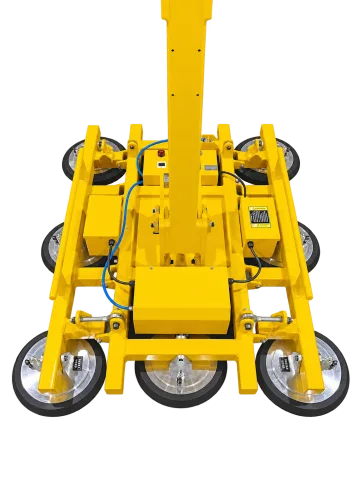
- Load & conditions
- Rated load300 kg
- Workpiece & surface
- Compatible curvature radius≥ 0.5 m
- Movement
- TiltingManual 90°RotationManual 360°
- Suction configuration
- Number of pads4 pcsPad diameter250 mm
Selection & Comparisons
Curved and Heavy Dual-Circuit Glass Vacuum Lifters
At a glance
Curved glazing and multi-tonne facade units break flat-glass shortcuts: pads meet curved glass at different angles, heavy frames double crane hook weight, and overhead lifts require true dual-circuit redundancy.
- Flat-glass load ratings never transfer automatically to curved glass. Radius, convex versus concave contact face, pad articulation and handling orientation all change the safe load—even when the glass is lighter than the nameplate figure.
- Separate single-circuit frames from true dual-circuit redundancy. Dual-circuit heavy lifters isolate two pumps, two vacuum paths and alternating pads, with defined pump start/stop pressure bands and emergency manual release valves.
- Match the heavy frame architecture to both weight and overhang. Choose between light modular manual frames (1.2–2 t), hydraulic tilt-and-rotate frames (0.8–1.5 t), multi-tonne facade frames (2–10 t) and counterbalanced under-overhang lifters (1–2 t).
- Calculate total crane hook load before signing off. A counterbalanced lifter can add 1,700–2,500 kg of self-weight before rigging; verify glass weight plus lifter weight against the crane load chart at actual working radius.
- Load & conditions
- Rated load600 kg
- Workpiece & surface
- Compatible curvature radius≥ 0.5 m
- Movement
- TiltingManual 90°RotationManual 360°
- Suction configuration
- Pad configuration8 pads × Ø250 mm; rated load 600 kgNumber of pads8 pcsPad diameter250 mm
- Load & conditions
- Rated load900 kg
- Workpiece & surface
- Compatible curvature radius≥ 0.5 m
- Movement
- TiltingManual 90°RotationManual 360°
- Suction configuration
- Number of pads12 pcsPad diameter250 mm
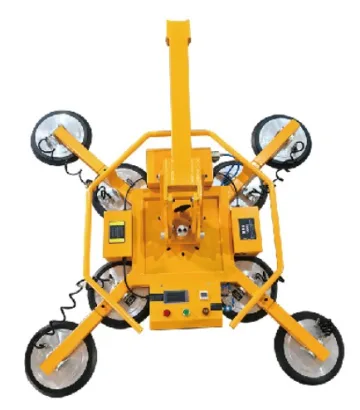
- Load & conditions
- Rated load800 kg
- Workpiece & surface
- MaterialsGlass
- Movement
- TiltingManual 90°RotationManual 360°
- Suction configuration
- Number of pads8 pcsPad diameter300 mm
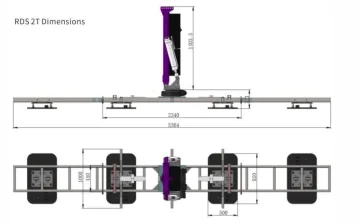
- Load & conditions
- Rated load2000 kg
- Workpiece & surface
- Optional pads for curved glassØ280 mm × 6 pads / group; 4 groups. Permitted load depends on glass curvature, contact positions and handling orientation; the flat-glass rating does not apply automatically.
- Movement
- Tilting0–90°Rotation360° continuous
- Suction configuration
- Standard number of pads4 pcsStandard pad dimensions850 × 550 mm
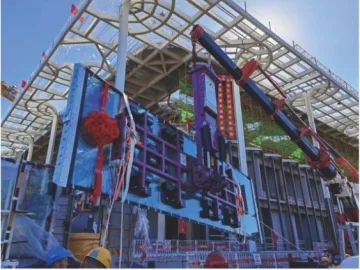
- Load & conditions
- Rated load5000 kg
- Workpiece & surface
- Optional pads for curved glassØ280 mm × 6 pads / group; 10 groups. Permitted load depends on glass curvature, contact positions and handling orientation; the flat-glass rating does not apply automatically.
- Movement
- Tilting0–90°Rotation360° continuous
- Suction configuration
- Standard number of pads10 pcsStandard pad dimensions850 × 550 mm

- Load & conditions
- Rated load10000 kg
- Workpiece & surface
- Optional pads for curved glassØ280 mm × 6 pads / group; 20 groups. Permitted load depends on glass curvature, contact positions and handling orientation; the flat-glass rating does not apply automatically.
- Movement
- Tilting0–90°Rotation360° continuous
- Suction configuration
- Standard number of pads20 pcsStandard pad dimensions850 × 550 mm
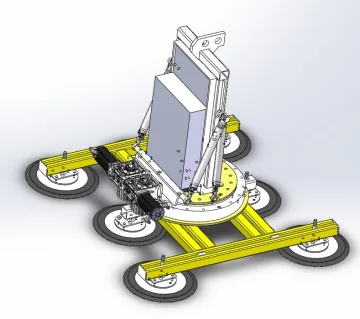
- Load & conditions
- Rated load1500 kg
- Workpiece & surface
- MaterialsGlass
- Movement
- TiltingTwin hydraulic cylinders, 90°RotationHydraulic motor, 360°
- Suction configuration
- Number of pads8 pcsPad diameter400 mmPad arrangement4 pads on main frame, 4 on extension beams
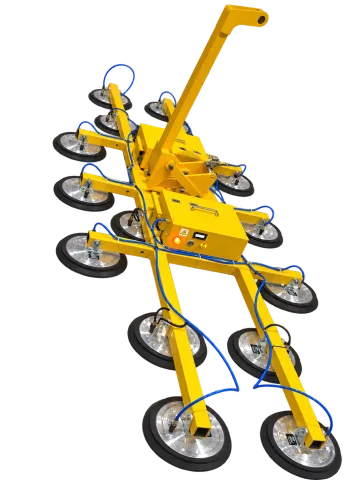
- Load & conditions
- Rated load1200 kg
- Workpiece & surface
- MaterialsGlass
- Movement
- TiltingManual 90°RotationManual 360°
- Suction configuration
- Number of pads12 pcsPad diameter300 mm
- Load & conditions
- Rated load2000 kg
- Workpiece & surface
- MaterialsGlass
- Movement
- TiltingManual 90°RotationManual 360°
- Suction configuration
- Number of pads20 pcsPad diameter300 mm
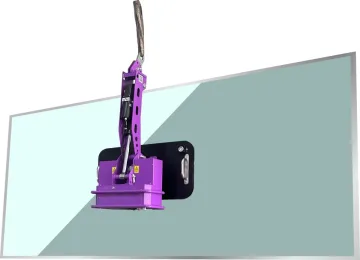
- Load & conditions
- Rated load800 kg
- Workpiece & surface
- MaterialsGlass
- Movement
- Tilting0–90°Rotation360° continuous
- Suction configuration
- Pad configuration500 × 1000 mm
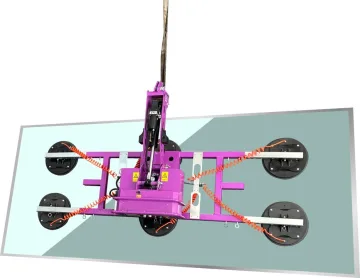
- Load & conditions
- Rated load1000 kg
- Workpiece & surface
- MaterialsGlass
- Movement
- Tilting0–90°Rotation360° continuous
- Suction configuration
- Pad configurationØ400 mm × 6
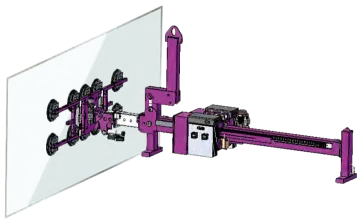
- Load & conditions
- Rated load1000 kg
- Workpiece & surface
- MaterialsGlass
- Movement
- Tilting0–90°Rotation360° continuousSide turning45 °
- Load & conditions
- Rated load1500 kg
- Workpiece & surface
- MaterialsGlass
- Movement
- Tilting0–90°Rotation360° continuousSide turning45 °
- Load & conditions
- Rated load2000 kg maximum; permissible load depends on reach and the load chart.
- Workpiece & surface
- MaterialsGlass
- Movement
- Tilting0–90°Rotation360° continuousSide turning45 °
Prepared by Easytech · Published · Content updated
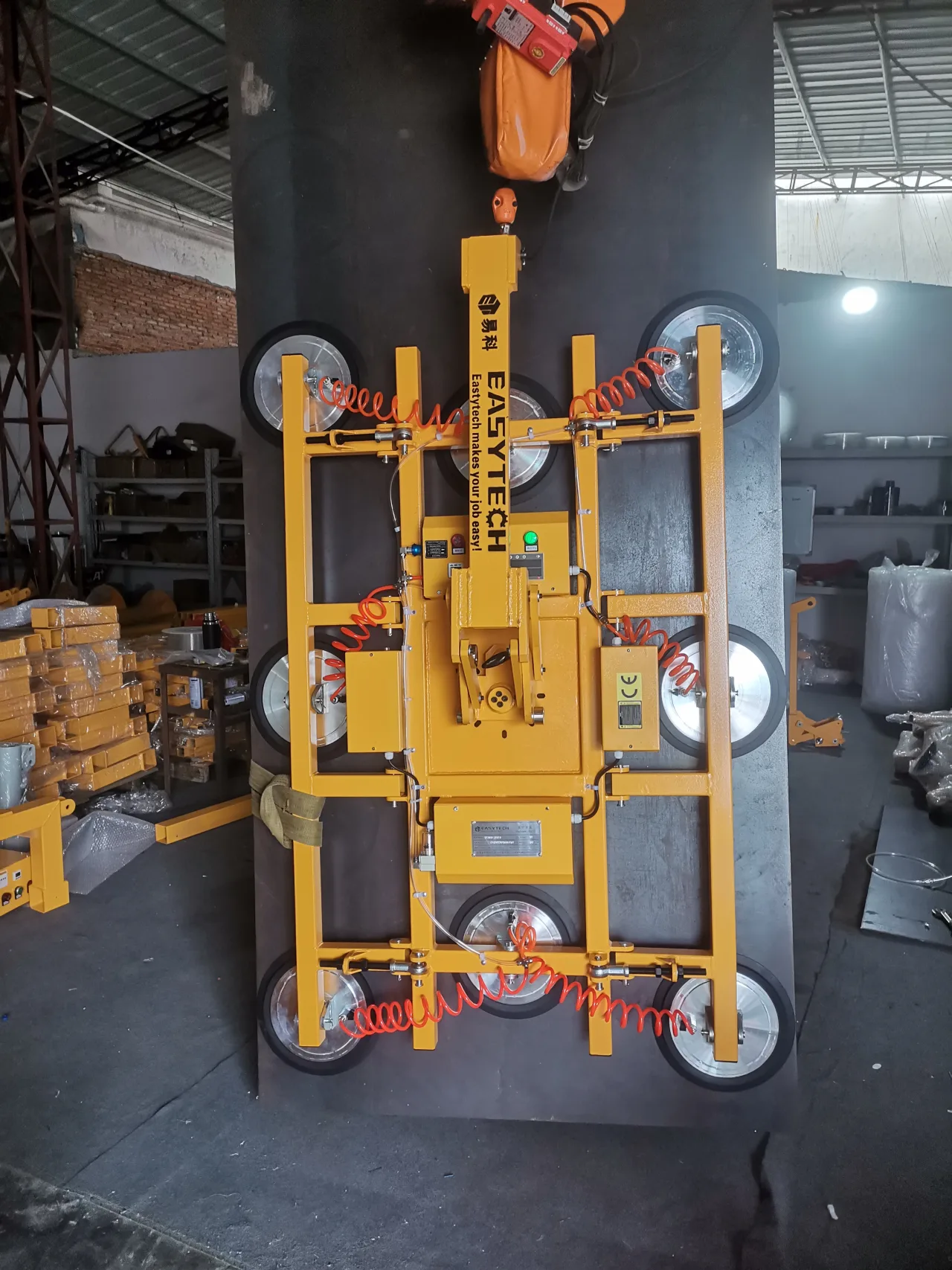
Why curved glass breaks flat-frame assumptions
On a flat pane, every suction cup lies in one geometric plane and pulls parallel to the others. Put that same rigid frame onto cylindrical or bent architectural glass and only the centre or outer edges make square contact. The remaining cups either fold their rubber sealing lips—causing an immediate vacuum leak—or try to bend the pane toward the frame, introducing dangerous localized stress on tempered or laminated units.
Before looking at model numbers, separate three curved-glass requirements:
- Concave versus convex lifting face: Will the pads grip the outer (convex) curve or the inner (concave) curve? That choice determines whether the outer pad arms need to angle inward or outward, and whether any glazing fins, mullions or edge gaskets obstruct the approach.
- Minimum radius across the entire schedule: Easytech’s standard single-circuit curved-glass lifters—ETJS-M312 (300 kg, 4 × Ø250 mm pads), ETJS-M316 (600 kg, 8 × Ø250 mm pads) and ETJS-M624 (900 kg, 12 × Ø250 mm pads)—specify a compatible curvature radius of ≥ 0.5 m, with manual 90° tilting and manual 360° rotation on a 12 V / 12 Ah battery (110–220 V / 1 PH / 50 Hz charger). Tighter radii, compound double curves or heavy multi-tonne curved units require a dedicated pad-cluster layout and drawing review.
- Whether one frame must handle both curved and flat panes: On mixed-facade jobs, a rigid curved frame cannot safely switch back to flat glass unless the pad arms are designed for two documented positions.
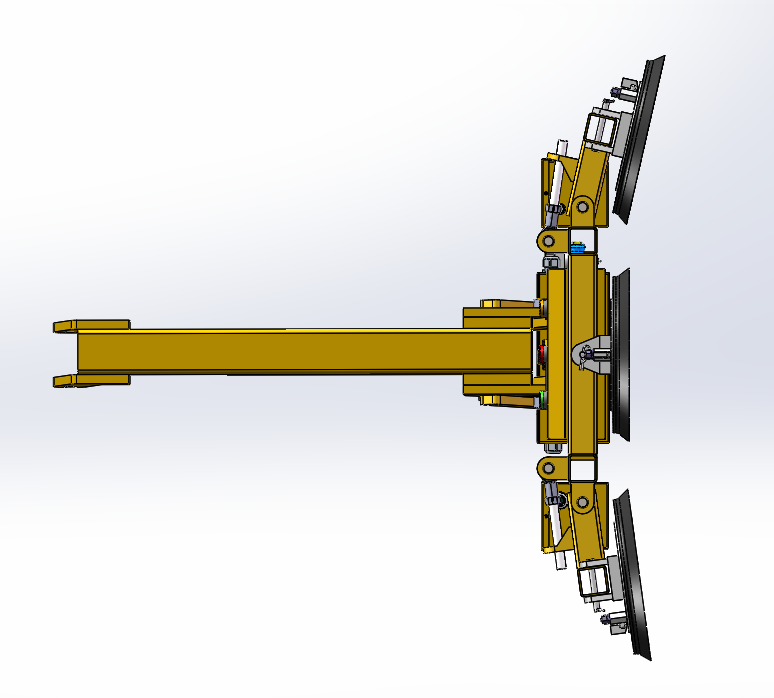
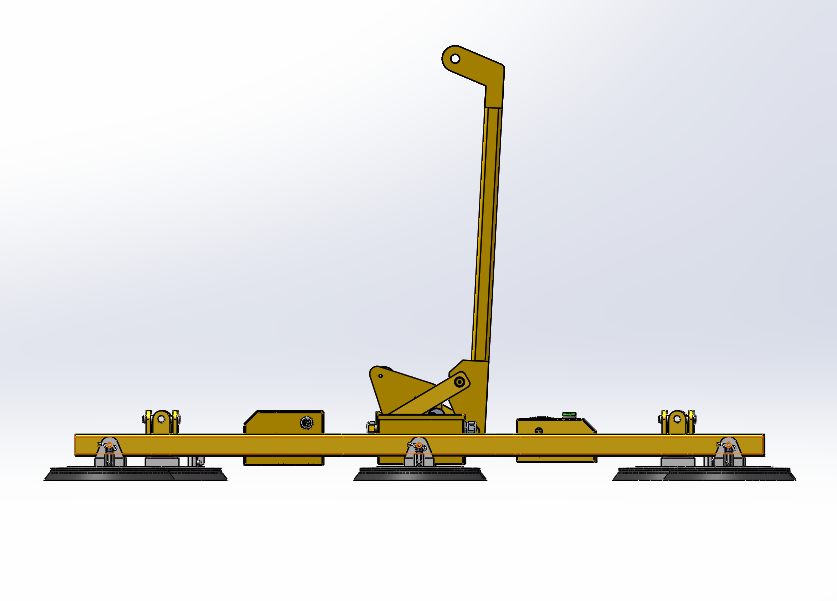
The Singapore 800 kg project documented in the curved-and-flat glass lifter case study shows how adjustable outer pad groups solve mixed-shape projects without forcing a coplanar frame onto a bent pane. Just as important, switching between curved and flat setups is a deliberate unloaded configuration change, followed by checking pad alignment against the next pane’s section drawing—not an automatic fit across every radius.
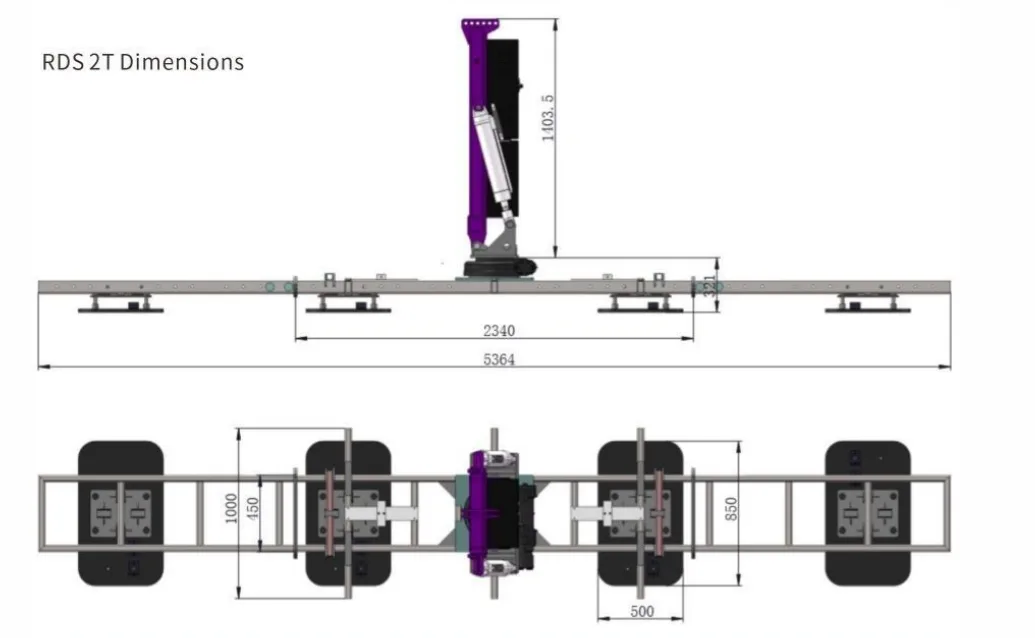
On multi-tonne frames such as RDS-2T, RDS-5T and RDS-10T, standard flat glass uses large 850 × 550 mm pads, whereas curved glass uses optional multi-pad cluster groups (Ø280 mm × 6 pads per group; 4 groups on RDS-2T, 10 groups on RDS-5T, 20 groups on RDS-10T). Every RDS specification carries an explicit engineering boundary: permitted load depends on glass curvature, contact positions and handling orientation; the flat-glass rating does not apply automatically.
Dual-circuit vacuum architecture and real operating pressure windows
For suspended overhead glazing—especially heavy or outdoor facade lifts—buyers frequently ask what separates a single-circuit workshop frame from a true dual-circuit heavy glass lifter.
A single-circuit unit connects all suction pads to one pump and manifold: if one hose splits, a check valve fails or a single pad loses its seal on a chipped edge, the entire pad array loses holding pressure together. A true dual-circuit architecture divides the suction cups into two independent vacuum loops—separate pumps, hoses, non-return protection and pressure monitoring—so a fault in one circuit does not simultaneously vent the second.
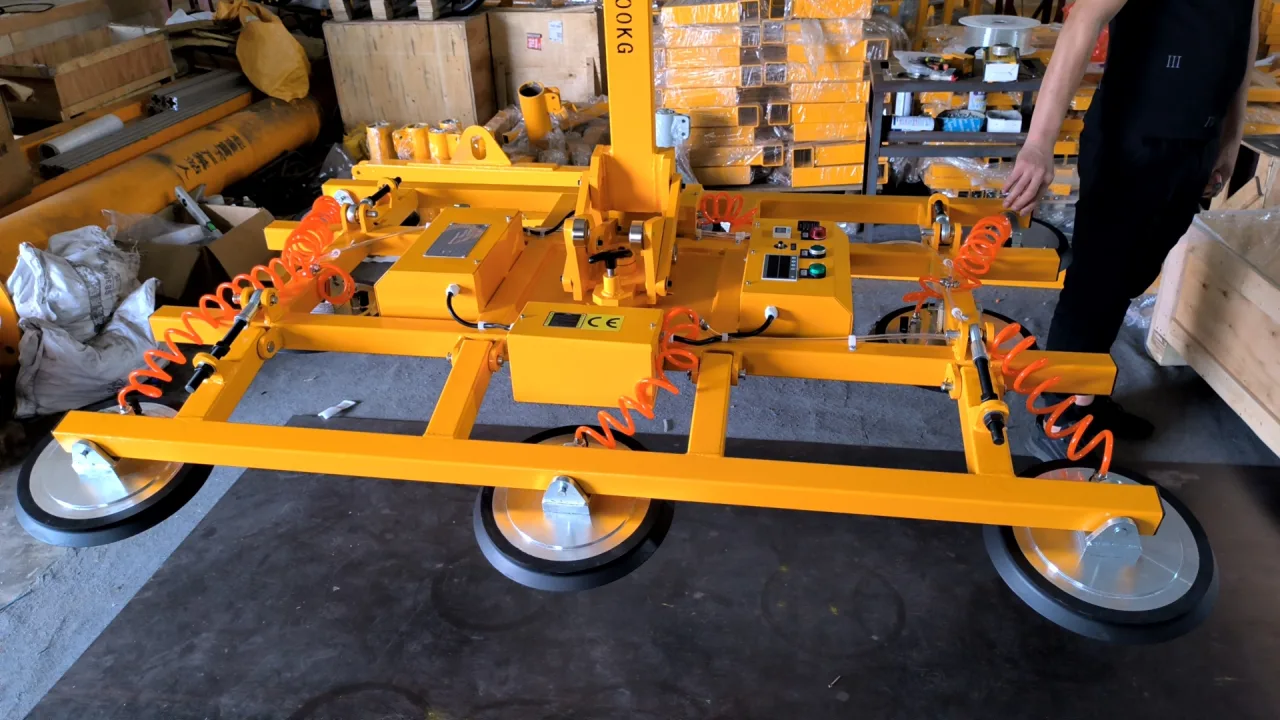
Easytech’s ET-GL-HYD-1500-LEG illustrates the exact hardware details you should inspect on a dual-circuit hydraulic glass lifter specification:
Engineering subsystem | Documented specification on ET-GL-HYD-1500-LEG | Why it matters on site |
|---|---|---|
Rated load & pad array | 1,500 kg; 8 × Ø400 mm aluminum-body NBR pads (4 on main frame + 4 on extension beams) | Extension beams expand frame span from 1,825 × 1,200 mm to 3,600 × 1,200 mm for long panes without overloading pad edges. |
Dual vacuum circuits | 2 independent circuits; 2 × CV-35 DC24V pumps (35 L/min per pump) | Keeps two separate evacuation and holding loops running off dual 12 V / 55 Ah batteries. |
Vacuum operating window | Maximum gauge pressure −85 kPa; automatic pump start/stop −60 / −70 kPa | Tells the operator the exact healthy pressure band: the pump rests at −70 kPa and restarts at −60 kPa. Frequent cycling below −60 kPa signals a leak to diagnose before lifting. |
Powered hydraulic motion | DC24V / 0.75 kW hydraulic power unit; twin cylinders (50 mm bore, 450 mm stroke) for 90° tilting; hydraulic motor for 360° rotation | Moves a 1.5-tonne lite smoothly under remote control instead of relying on crew leverage during manual spin. |
Release & emergency backup | Solenoid valve release plus two manual slide valves for maintenance / emergency use | Allows controlled release or service isolation if an electrical release control faults with the pane safely landed. |
Checking site standards without assuming certification
On European construction sites, buyers commonly check below-the-hook vacuum lifters against EN 13155 principles (redundant vacuum circuits, safety reservoirs, independent low-vacuum optical/acoustic alarms and secondary retention rules); in North America, lifting teams reference ASME B30.20 below-the-hook requirements. Do not assume any standard catalog lifter automatically ships with a specific regional third-party certificate. Confirm your exact site compliance rules—including dual-circuit mandate, secondary safety straps if required by the general contractor, and required inspection documentation—in writing before finalizing the quotation. For what happens during power or vacuum faults, also review vacuum lifter power-failure protection and diagnosing vacuum loss on suspended frames.
Comparing the four heavy-glass lifter architectures (1T to 10T)
Once pane weights pass 800–1,000 kg, buying by headline tonnage alone leads to expensive mismatches—most commonly ordering a heavy frame that cannot tilt under power, or ordering a standard crane frame when the facade sits beneath a projecting soffit.
Heavy-glass architecture | Representative Easytech models | Rated load | Self-weight | Tilt & rotation | Where it fits best |
|---|---|---|---|---|---|
Modular dual-pump manual frame | 1,200–2,000 kg (12–20 × Ø300 mm pads; panes up to 3,600 × 8,000 mm) | 163–211 kg net | Manual 90° tilt / manual 360° rotation | Oversized flat factory or crane lifts where low lifter dead weight and wide pad spread matter most and manual orientation is safe. | |
Dual-circuit hydraulic tilt & rotate | 800–1,500 kg (6–8 × Ø400 mm pads on 1T–1.5T models) | 138–218 kg (RDSE-800/1000) | Powered hydraulic 90° tilt / 360° continuous rotation (wired/wireless remote) | Tall or heavy facade panes where operators should not wrestle manual tilt or spin under a crane hook. | |
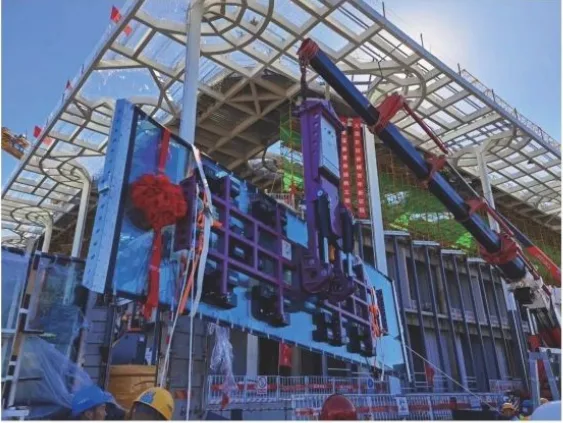
Multi-tonne facade frame (flat or curved clusters) | 2,000–10,000 kg (4–20 flat pads 850 × 550 mm, or optional Ø280 mm × 6 curved clusters) | Project-verified per tonnage | Powered 0–90° tilt / 360° continuous rotation, wireless remote, DC24 V, IP43 | Jumbo commercial curtain-wall lites, multi-ply laminated structural glass and large curved glazing with crane support. | |
Counterbalanced under-overhang lifter | 1,000–2,000 kg max (reach-dependent; use load chart) | 1,700–2,500 kg | Powered 0–90° tilt / 360° rotation / 45° side turn + 897–1,200 mm arm extension | Installing glass beneath canopies, balconies or overhanging floor slabs where a crane wire cannot hang directly over the opening. |
Four checks that prevent site rejections on heavy and curved lifts
Even when the lifter’s rated load exceeds the pane weight, four site constraints routinely halt crane lifts if skipped during planning.
1. Crane hook load = glass + lifter self-weight + rigging
Never compare pane weight alone to crane capacity. Look at the contrast in the table above:
- A 2,000 kg glass unit on a modular ET-GL-DUAL-2000 (211 kg net weight) puts 2,211 kg plus shackles/slings on the hook.
- A 2,000 kg glass unit on a counterbalanced BVL 2000 (2,500 kg equipment weight) puts 4,500 kg plus rigging on the hook—more than double the glass weight—and its own permissible glass load varies with arm extension on the load chart.
Verify total suspended weight at the crane’s farthest required working radius, and check the hook height needed for the rigging plus lifter height plus glass height. See the RDS-5T heavy-glass installation record for the three interfaces (glass-to-frame, frame-to-crane, glass-to-building) that must be coordinated together.
2. Extension-beam configuration and smallest-pane fit
Large heavy-glass frames often span 3.6 m or more with extension beams attached (ET-GL-DUAL-2000 supports panes up to 3,600 × 8,000 mm; ET-GL-HYD-1500-LEG reaches 3,600 × 1,200 mm with extension beams). Always check the smallest lite on the same elevation too: if extension arms cannot be removed or isolated without dropping below the required vacuum circuit balance, a smaller narrow pane may not fit the pad spacing.
3. Coated Low-E glass, IGUs and protective films
- Contact face & markings: Confirm which glass face is permitted for NBR rubber pads (for example, exposed uncoated surface versus sensitive soft-coat Low-E or ceramic frit). Clean pads and dry contact zones prevent debris scratches on expensive coated glass.
- Double- and triple-glazed IGUs: Verify that the seal depth, spacer layout and total unit weight do not place pad edges over unsupported stepped-glass overhangs or weak perimeter seals.
- Protective films: Never lift through loosely adhered shipping film; peel the contact zones clean or verify film bond strength under test.
4. Outdoor weather, IP43 boundaries and battery readiness
Heavy battery-powered facade frames such as the RDS, RDSE and BVL lines carry IP43 ingress protection—suitable for typical dry or light-spray industrial and site handling, not driving rain or wet glass surfaces. Standing rainwater breaks friction on vertical glass lifts far more dangerously than on horizontal factory lifts, and wind load on a 3 × 6 m sail-like pane can quickly overwhelm manual tagline control. Keep dual batteries charged on the documented AC110–240 V input and check vacuum hold stability before every crane pick.
For foundational flat-glass selection steps or deciding whether a wheeled/tracked robot beats a crane-suspended frame altogether, compare how to select a glass vacuum lifter, glass lifting robot vs suspended vacuum lifter, curved-glass equipment range and heavy-glass equipment range.
What to include in a curved or heavy-glass enquiry
Because curved geometry and multi-tonne crane rigging leave zero margin for guesswork, send these details when you request an equipment quotation:
- Glass schedule (heaviest, largest and smallest lites): Length, width, total thickness, glass build-up (monolithic, laminated or IGU) and exact weight in kg.
- Section or 3D drawing for curved glass: Radius in metres (or chord and arc rise), convex versus concave lifting face, and whether the same lifter must also handle flat panes.
- Permitted contact zones and coatings: Mark coatings, frit bands, cutouts, stepped IGU edges or film-covered zones that pads must avoid.
- Required movements and overhang depth: Flat-to-vertical 90° tilt, 360° rotation, manual versus hydraulic/remote control, and any soffit/balcony overhang depth if a counterbalanced frame is needed.
- Crane and site constraints: Crane rated capacity at working radius, available hook height, outdoor exposure, charging voltage (110–240 V / 50–60 Hz) and any local site compliance or secondary-retention rules.
LET’S DEFINE YOUR APPLICATION
The right equipment starts
with your workpiece.
Tell us what you lift, where it moves and how it needs to arrive.