Fixed spans vs 3–5 m telescopic beams: stopping thin-sheet sag and overhang
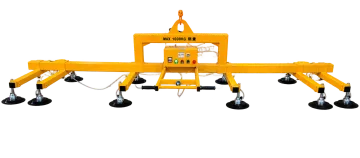
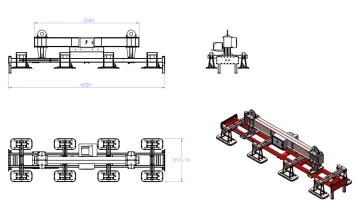
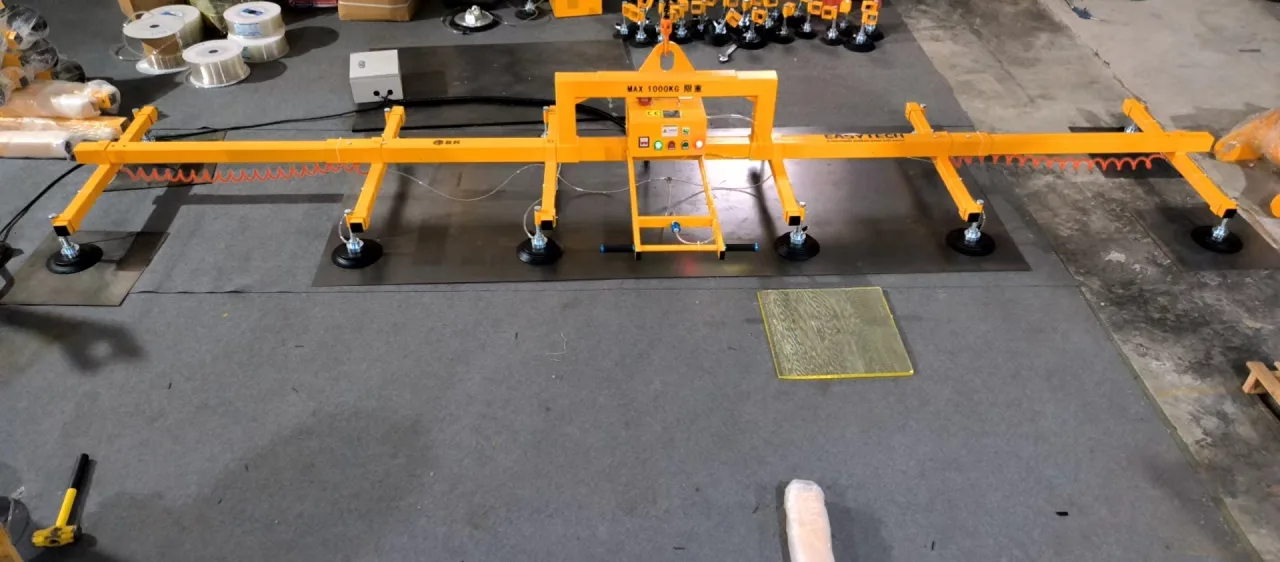
If a fabrication shop only runs one repeatable stock size onto a cutting bed—the scenario covered in our laser-cutting machine loading guide—a fixed-beam horizontal frame keeps cost and equipment weight down. Easytech's horizontal crane frames step cleanly across standard plate envelopes: ETJS-C600-2M and ETJS-C800-2M use a 2,000 × 1,360 × 820 mm frame for sheets up to 3,000 × 1,500 mm, ETJS-C800-3M steps to a 3,000 mm beam for 4,000 × 2,000 mm stock, and ETJS-C1000-5M extends to a 4,900 mm beam with twelve Ø200 mm pads for 6,000 × 2,000 mm plates.
Problems begin the moment one crane bay handles mixed plate lengths—for example, offloading 6 m carbon steel or aluminum sheets in the morning and feeding 2 m remnants after lunch. A fixed 5 m frame puts its outer pads beyond the ends of a 2 m blank, whereas a compact 2 m frame leaves 2 m of unsupported metal hanging off each end of a 6 m sheet. On thin gauges (roughly 0.8 mm to 3 mm carbon steel, stainless steel or aluminum), unsupported overhang bends downward under gravity and turns clean vertical tension into a peeling force at the outer pad lips, breaking the seal well below the lifter's rated weight.
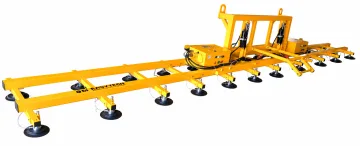
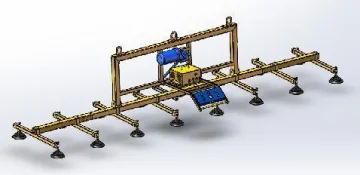
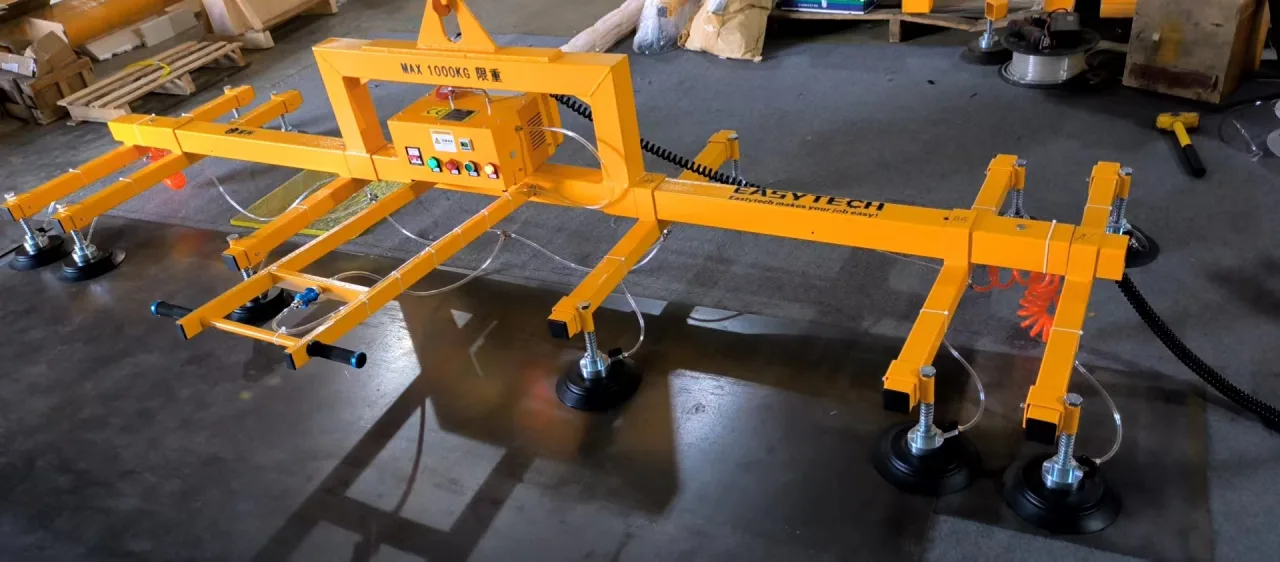
That exact mixed-format problem is why telescopic main beams exist. Both ET-SM-TELE-100 (1,000 kg, horizontal handling only, single mains vacuum pump) and ET-SM-TELE-99 (rated at 2,000 kg across the full 3–5 m main beam adjustment range, mains supply, single pump) pair an extendable main beam with repositionable crossbars. As documented in our 2–6 m telescopic steel-sheet case study, bringing the crossbars inward supports short sheets without hanging pads in mid-air, while extending the beam spreads support across long flexible sheets to control deflection.
Three shop-floor rules separate safe telescopic operation from improvised short-sheet lifting:
- Shut-off valves never preserve full nameplate capacity. Models such as ETJS-C1000-5M, ET-SM-HD-6000 and ET-SM-HD-10000 provide individual pad isolation so operators can close unused pads on narrower or shorter plates. Closing pads immediately reduces available vacuum holding force; the reduced-pad rating must be recalculated before lifting, and shut-off valves must remain balanced symmetrically around the plate's true centre of gravity.
- Beam extension changes cable and hose routing. In the 2–6 m telescopic project, the mains-powered frame used a spring cable whose travel path had to be verified across both the retracted and extended positions. A vacuum hose or control pendant that looks tidy at 3 m can stretch, pinch in a sliding crossbar or snag a sheet edge at 5 m.
- Record approved setups per recurring sheet group. Never let operators guess crossbar spacing by eye. Photograph and log the approved beam extension, crossbar lock marks, active pad count and maximum plate weight for each standard blank size at commissioning.
Easytech Model | Rated Load & Motion | Beam / Plate Envelope | Vacuum & Power Architecture | Net Weight & Key Conditions |
|---|---|---|---|---|
600 kg · Horizontal (manual 360° rotation) | 2,000 × 1,360 × 820 mm frame · max 3,000 × 1,500 mm | 6 × Ø200 mm pads · 220/380/460 V mains · reservoir + check valve | 84 kg net · individual pad shut-off; reduced-pad recalculation required | |
1,000 kg · Horizontal (manual 360° rotation) | 4,900 × 1,360 × 820 mm frame · max 6,000 × 2,000 mm | 12 × Ø200 mm pads · 220/380/460 V mains · optional 2-step release | 175 kg net · reservoir, check valve, vacuum gauge and audible/visual alarm | |
1,000 kg · Horizontal (manual 360° rotation) | 4,900 × 1,360 × 820 mm frame · max 6,000 × 2,000 mm | 12 × Ø200 mm pads · 12 V battery (cable-free) | 181 kg net (+6 kg vs mains) · avoids crane festoon/power-cord snagging | |
1,000 kg / 2,000 kg · Horizontal only (no tilting) | 3–5 m adjustable telescopic main beam | Single vacuum pump · mains supply | Project-verified per build · ET-SM-TELE-99 rated 2,000 kg across 3–5 m range | |
2,500 kg · Horizontal only (no tilting) | Heavy-duty plate frame | EX-94: 4 batteries + twin 160 W pumps · EX-96: mains + single 750 W pump | Project-verified self-weight · cable-free vs continuous mains heavy bay duty | |
3,000 kg / 5,000 kg · Horizontal heavy plate | EX-97: single beam · EX-98: twin beams | Twin vacuum pumps (EX-97: 380 V) | Project-verified self-weight · twin-pump architecture for 3–5 t plates | |
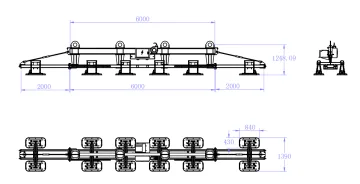
6,000 kg · Horizontal (at 60% vacuum, dry oil-free) | 5,000 mm main × 1,500 mm crossbeam · 6,000 × 2,500 mm plate | 8 × (840 × 430 mm) NBR pads · AC480 V/60 Hz · 2.6 kW / 72 m³/h · −85 kPa max | 750 kg net · ≥10,000 kg crane class · wireless remote ≤50 m + manual valve | |
10,000 kg · Horizontal (at 60% vacuum, dry oil-free) | 6,000 mm main × 2,000 mm crossbeam · 9,000–12,000 × 1,500–3,000 mm plate | 12 × (840 × 430 mm) NBR pads · AC380 V · 2.2 kW / 80 m³/h · −85 kPa max | 1,850 kg net · ≥15,000 kg crane class · ~5 L tank, ≥15 min project retention |
Choosing among four 90° tilting drives for vertical racks and plate turning
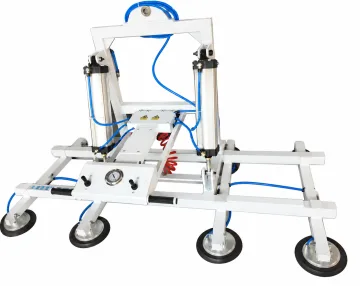
A horizontal sheet lifter is strictly designed for flat-to-flat transfers; trying to pull a plate upright out of a vertical steel rack with a horizontal frame puts shear and peel loads directly onto pads and suspension brackets that were never rated for vertical handling. When plates arrive in vertical A-frames, stand vertically in shot-blast or storage racks, or must tilt 90° for welding, press-brake feeding or truck offloading, specify a dedicated 90° tilting lifter and match the tilting actuator and power architecture to the bay's duty cycle.
Easytech builds four distinct 90° tilting architectures between 300 kg and 2,000 kg. Comparing them side-by-side eliminates the most common mismatch—buying a battery hydraulic unit for a three-shift 380 V line, or buying a compressed-air unit for a bay with weak air pressure or missing vacuum alarms.
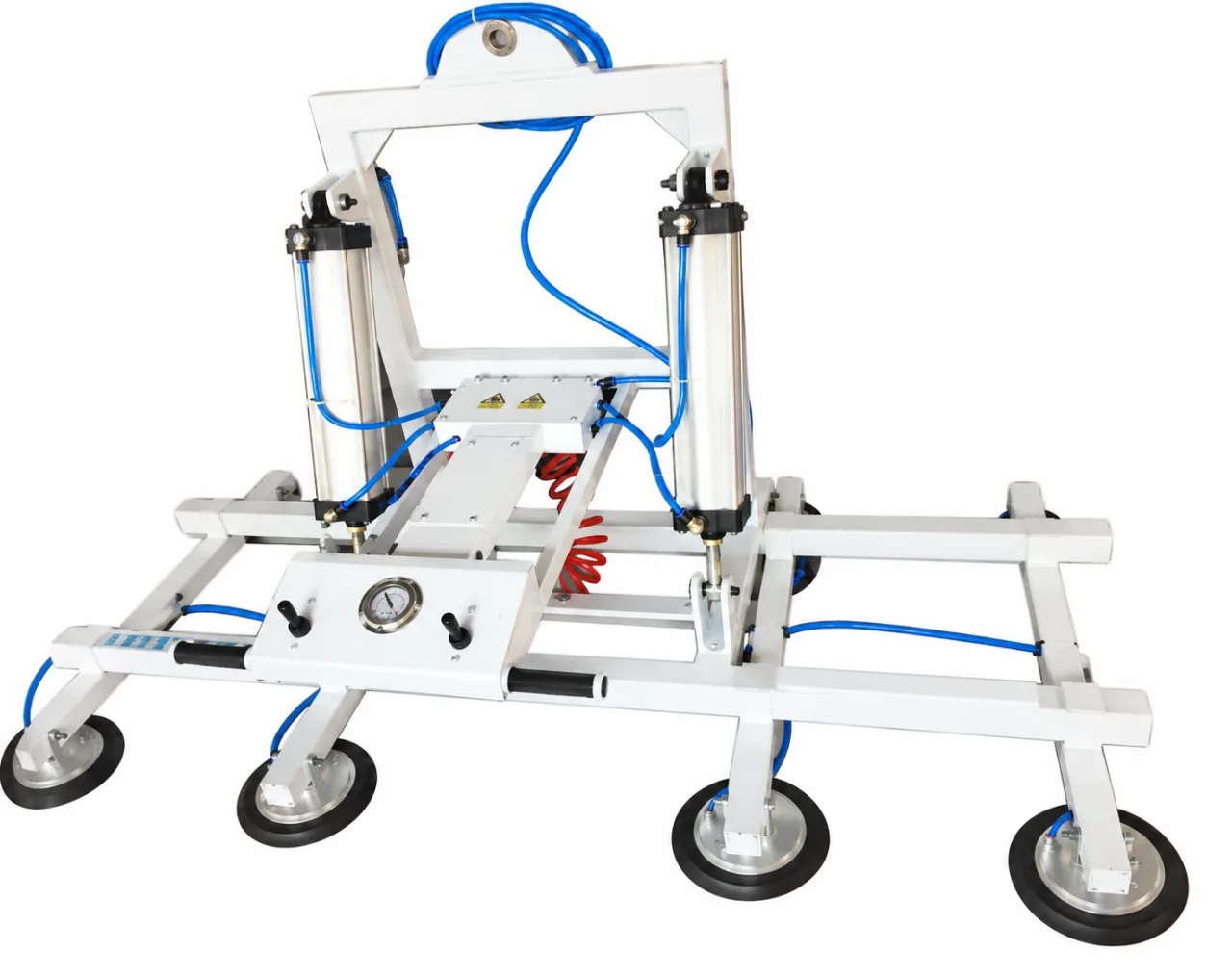
1. Pneumatic 90° tilting lifters (300–500 kg): air-powered simplicity—check the alarm code
The pneumatic tilting series uses plant compressed air both for the 90° tilting cylinder and for a vacuum generator (no electric vacuum pump). That eliminates electric cables and batteries at the crane hook, which suits clean compressed-air bays up to 500 kg—provided air pressure and flow remain stable at the crane point during simultaneous grip and tilt.
Look closely at the exact model codes before ordering, because safety-warning scope splits inside this series: ET-SM-PN-04 (300 kg) and ET-SM-PN-02 (500 kg) include a module alarm, whereas ET-SM-PN-03 (300 kg) and ET-SM-PN-01 (500 kg) list no alarm fitted to that configuration. Never assume every pneumatic tilting frame ships with an audible/visual vacuum alarm by default; confirm the alarm-equipped variant in writing for any overhead shop lift.
2. Battery electrohydraulic 90° tilting lifters (600–2,000 kg): cable-free yard and multi-bay mobility
Where cranes traverse long bays, yards or multiple workstations without a 380 V festoon drop on the hook, battery-powered electrohydraulic tilting frames remove trailing power cords completely. Single-cylinder models scale across ET-SM-HYD-1-03 (600 kg), ET-SM-HYD-1-02 (800 kg) and ET-SM-HYD-1-01 (1,000 kg). At 2,000 kg, ET-SM-HYD-2-01 upgrades to twin electrohydraulic cylinders for 90° tilting paired with twin battery vacuum pumps, keeping torque balanced across wide heavy plates during the 90° transition.
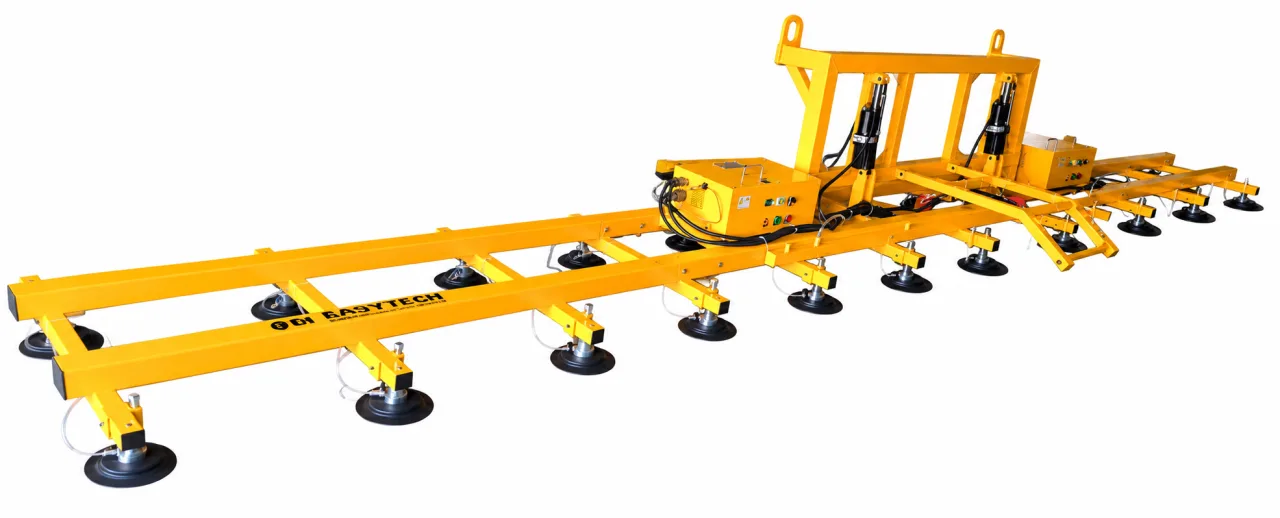
3. Mains 380 V screw-drive 90° tilting lifters (800–2,000 kg): continuous multi-shift precision
For dedicated indoor crane bays with a 380 V supply and high daily cycle counts, the screw-drive series—ET-SM-SCREW-03 (800 kg), ET-SM-SCREW-02 (1,000 kg) and ET-SM-SCREW-01 (2,000 kg)—replaces hydraulic cylinders and batteries with a 380 V motor and mechanical screw drive for 90° tilting. A mechanical screw drive gives controlled, repeatable tilting speed without hydraulic fluid maintenance or end-of-shift battery swaps.
4. Dedicated motor or electrohydraulic flip frames (500–1,000 kg): fixed pad-array turning
Where the priority is pairing a known pad count and diameter with powered tilting, ET-SM-FLIP-500 combines six Ø300 mm pads with a motorized tilting drive (500 kg), while ET-SM-FLIP-1000 steps up to ten Ø250 mm pads with an electrohydraulic cylinder (1,000 kg).
Tilting Architecture | Easytech Models | Rated Load | Tilting Drive & Vacuum Source | Power & Safety Notes |
|---|---|---|---|---|
Pneumatic 90° | 300 kg / 500 kg | Pneumatic 90° · vacuum generator (no electric pump) | Requires stable shop compressed air · module alarm included (PN-01/PN-03 omit alarm) | |
Battery Single-Cylinder Hydraulic 90° | 600 kg / 1,000 kg (also 800 kg HYD-1-02) | Single electrohydraulic cylinder, 90° | Battery-powered · cable-free across multi-bay cranes; plan overnight charging | |
Battery Twin-Cylinder Hydraulic 90° | 2,000 kg | Twin electrohydraulic cylinders, 90° · twin vacuum pumps | Battery-powered · balanced twin-cylinder tilt torque for 2 t vertical-to-flat turns | |
Mains 380 V Screw-Drive 90° | 800 kg / 2,000 kg (also 1,000 kg SCREW-02) | Motor and mechanical screw drive, 90° | 380 V mains · continuous multi-shift duty without hydraulic oil or battery downtime | |
Dedicated Pad-Array Flip | 500 kg / 1,000 kg | 500: motor (6 × Ø300 mm) · 1000: electrohydraulic (10 × Ø250 mm) | Verify final pad layout against plate thickness, vertical shear and centre of gravity |
Heavy multi-tonne steel plates (2.5 t to 10 t): surface limits, pumps and crane class
Moving from 1 t sheet fabrication into 2.5 t–10 t structural plate yards changes both the vacuum physics and the crane engineering. Between 2.5 t and 5 t, Easytech offers battery twin-pump (ET-SM-EX-94, 4 batteries, twin 160 W pumps, 2,500 kg), mains single-pump (ET-SM-EX-96, 750 W, 2,500 kg), 380 V single-beam twin-pump (ET-SM-EX-97, 3,000 kg) and twin-beam twin-pump (ET-SM-EX-98, 5,000 kg) horizontal frames. Above 5 t, the heavy-duty ET-SM-HD-6000 (6,000 kg) and ET-SM-HD-10000 (10,000 kg) document the exact engineering thresholds buyers must verify before ordering.
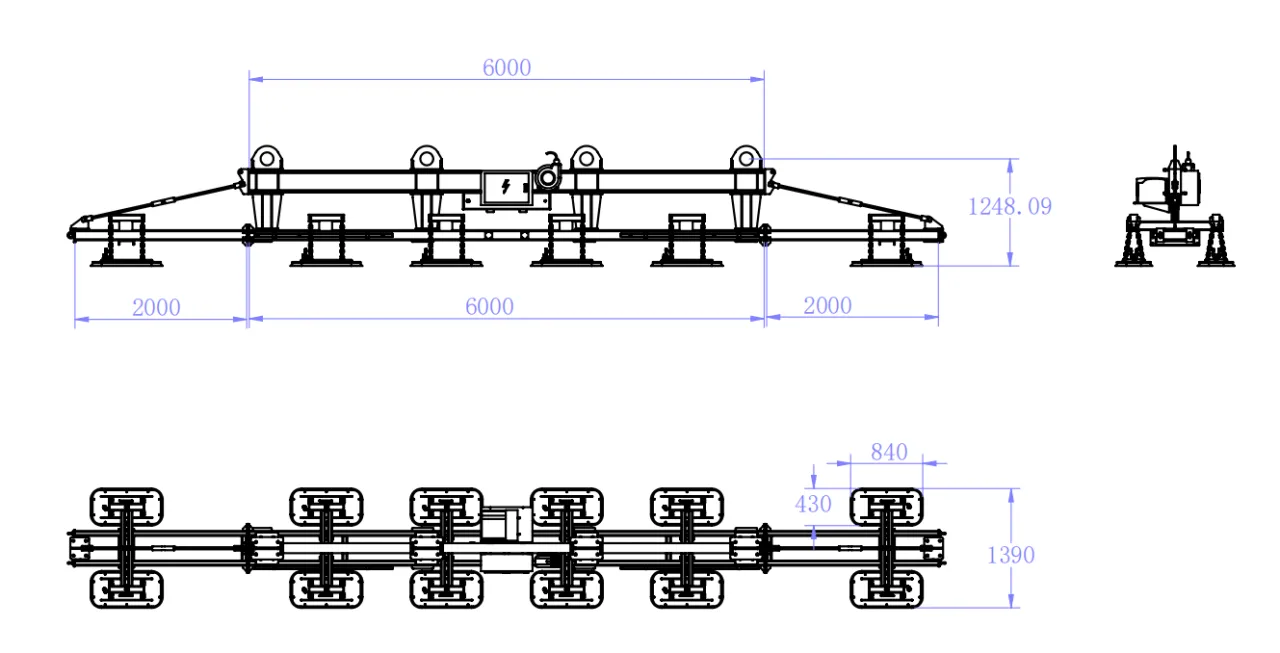
1. Dry, oil-free metal vs real shop surfaces (oily carbon steel, mill scale, brushed stainless)
Both ET-SM-HD-6000 and ET-SM-HD-10000 use large 840 × 430 mm nitrile rubber (NBR) pads and state their horizontal rated load explicitly at 60% vacuum on non-porous, dry, oil-free metal surfaces, with a maximum pump vacuum of 85% (−85 kPa). Their operating limitations explicitly prohibit standing water, oil, sharp particles and corrosive surfaces.
That boundary matters far more in real fabrication yards than most brochures admit:
- Oily or rust-preventive-coated carbon steel: While NBR resists mineral oil degradation better than standard natural rubber, liquid oil films drastically cut pad-to-steel friction—especially during crane acceleration, braking or 90° vertical tilting. Never assume a dry horizontal rating transfers directly to heavily oiled plates or vertical shear lifts; check surface condition and friction factor using our suction cup force calculation guide and test representative stock before production sign-off.
- Heavy mill scale, weld spatter and grit: Loose rust flakes and sharp metal particles score NBR sealing lips and create micro-leak channels that force pumps to cycle continuously. Brush or clean contact zones and protect pad faces when parking the frame on the floor.
- Mirror stainless steel and anodized aluminum: Standard black rubber can scuff decorative surfaces or trap shop grit against the finish. State surface-finish protection requirements (such as protective PE film behaviour or non-marking pad materials) upfront so the pad compound and frame bumpers match the finish; note that weak protective film can itself delaminate under vacuum and let the metal sheet drop while the film stays on the pads.
- Perforated plates, flame-cut skeletons and formed parts: Intact-plate ratings never transfer automatically to sheets with cut-outs, holes or raised flanges. As our formed sheet-metal housing study illustrates—where even small Ø7.3 mm and Ø4.5 mm holes on a 324 × 322 mm face forced a full pad-footprint redesign—every suction seal must sit completely inside continuous, flat metal.
2. Vacuum retention, independent alarm batteries and what they do—and do not—guarantee
On ET-SM-HD-6000 (2.6 kW, 72 m³/h) and ET-SM-HD-10000 (2.2 kW, 80 m³/h), an onboard ~5 L vacuum reservoir, check valve and independent rechargeable alarm battery trigger audible and visual warnings below 60% vacuum or upon mains power loss, with a stated project-specific retention benchmark of ≥15 min from maximum vacuum (−85 kPa) down to 60%.
Treat that figure strictly as an emergency controlled-lowering buffer, never as permission to travel over workers or keep lifting after a power outage—see our power-failure protection guide for exact failure-mode boundaries. Also confirm regional overhead-lifting compliance (such as EN 13155 or ASME B30.20) in writing during project specification rather than assuming any standard catalog unit carries third-party regional certification automatically.
Mains vs battery power and total crane hook load math
Comparing Easytech's identical 2 m, 3 m and 5 m horizontal sheet frames shows how small the weight penalty of 12 V battery power is in the 600–1,000 kg class—and how dramatically crane-class headroom shifts once you step up to 6 t and 10 t plates.
Scenario & Lifter Model | Plate Mass | Lifter Net Weight | Combined Hook Load (Before Rigging) | Minimum Crane / Supply Check |
|---|---|---|---|---|
1 t long sheet · Mains (ETJS-C1000-5M) | 1,000 kg | 175 kg | 1,175 kg | 220/380/460 V mains drop at hook · verify 1.5–2 t hoist margin + pendant reach |
1 t long sheet · Battery (ET-SM-BAT-1000-5M) | 1,000 kg | 181 kg (+6 kg) | 1,181 kg | 12 V onboard battery · cable-free across crane bays; verify shift charging routine |
6 t heavy plate · Mains (ET-SM-HD-6000) | 6,000 kg | 750 kg | 6,750 kg | AC480 V / 60 Hz supply · ≥10,000 kg crane class (project installation verified) |
10 t heavy plate · Mains (ET-SM-HD-10000) | 10,000 kg | 1,850 kg | 11,850 kg | AC380 V supply · ≥15,000 kg crane class (project installation verified) |
Three practical crane-bay checks prevent the most expensive installation surprises:
- Check voltage and frequency before quoting—not at delivery. Notice that standard catalog records list 220/380/460 V on the ETJS-C range, 380 V on ET-SM-SCREW, ET-SM-EX-97 and ET-SM-HD-10000, and AC480 V / 60 Hz on ET-SM-HD-6000. Always specify your exact bay voltage, phase and frequency (50 Hz vs 60 Hz) so the pump motor and transformer match on arrival.
- Account for hook-to-pad headroom and operator standing position. A 5 m frame stands 820 mm tall before adding the crane hook and rigging; on tight jib cranes or low crane runways, review our jib, workstation and gantry crane guide before finalizing lift height. For narrow aisles or side-access racks, a side-mounted handle frame such as ET-SM-SIDE-1000 or a ≤50 m wireless remote (featured alongside the manual valve on ET-SM-HD-6000 and ET-SM-HD-10000) keeps the operator outside the plate's swing envelope.
- Avoid accidental mid-air release. On manual-valve frames such as the ETJS-C series, confirm whether your safety procedure requires the optional two-step release valve to reduce unintended release, and keep every spare pad or valve matched to the approved configuration.
What to send for an accurate steel-plate lifter quotation
To move from catalog shortlisting to a verified configuration on our sheet-metal handling application hub or quotation form, include six concrete inputs:
- Limiting sheet envelope: Smallest, longest, thinnest (critical for deflection) and heaviest plate dimensions (L × W × thickness in mm) and mass (kg).
- Real surface condition: Carbon steel, pickled/oiled, hot-rolled mill scale, brushed/mirror stainless, aluminum, protective PE film, wet outdoor storage, or any cut-outs/holes.
- Required motion: Strictly horizontal transfer, manual 360° rotation, or 90° vertical-to-horizontal tilting (including pickup rack and landing table heights).
- Crane and bay capacity: Existing overhead crane or jib safe working load (remembering lifter self-weight adds 84–181 kg at 0.6–1 t and 750–1,850 kg at 6–10 t), hook height and aisle sweep width.
- Available utilities: Bay voltage/phase/frequency (220 / 380 / 460 / 480 V, 50/60 Hz), compressed-air pressure/flow if evaluating pneumatic tilting, or preference for cable-free battery operation.
- Site compliance and controls: Whether you need wireless remote control, module/audible vacuum alarms, two-step release valves, or specific regional overhead-lifting documentation.