Draw the movement before selecting the structure
Mark every pickup and delivery point on a scaled layout. Add fixed machines, racks, doors, pedestrian routes and the space occupied by the load during turning. Measure the required hook position at both ends of the transfer, not only the height of the building.
Structure | Decision it helps address | What still needs checking |
|---|---|---|
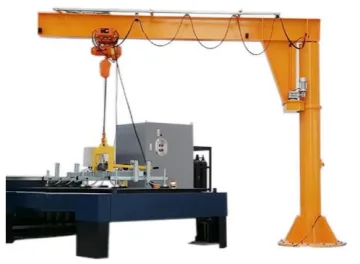
Floor-mounted jib | Coverage around a defined workstation | Foundation, radius, slewing limits, hook height and obstruction zones. |
Wall-mounted jib | Coverage beside a suitable supporting structure | Structural adequacy, mounting reactions and loss of floor-to-wall clearance. |
Articulating jib | Reaching around workstation obstacles | Joint positions, usable reach and clearances throughout movement. |
Workstation rail system | Travel between several positions or along a production area | Span/travel, support arrangement, headroom and trolley movement. |
Gantry | A bridge over a work area with its own supporting legs | Leg positions, clear span, height and whether any mobility is actually specified. |
Account for every suspended component
The workpiece, gripping tool and other below-hook equipment form the suspended load. Review the hoist, trolley, support structure and attachment interfaces as an assembly. A higher-rated hoist does not increase a lower-rated support or lifting tool.
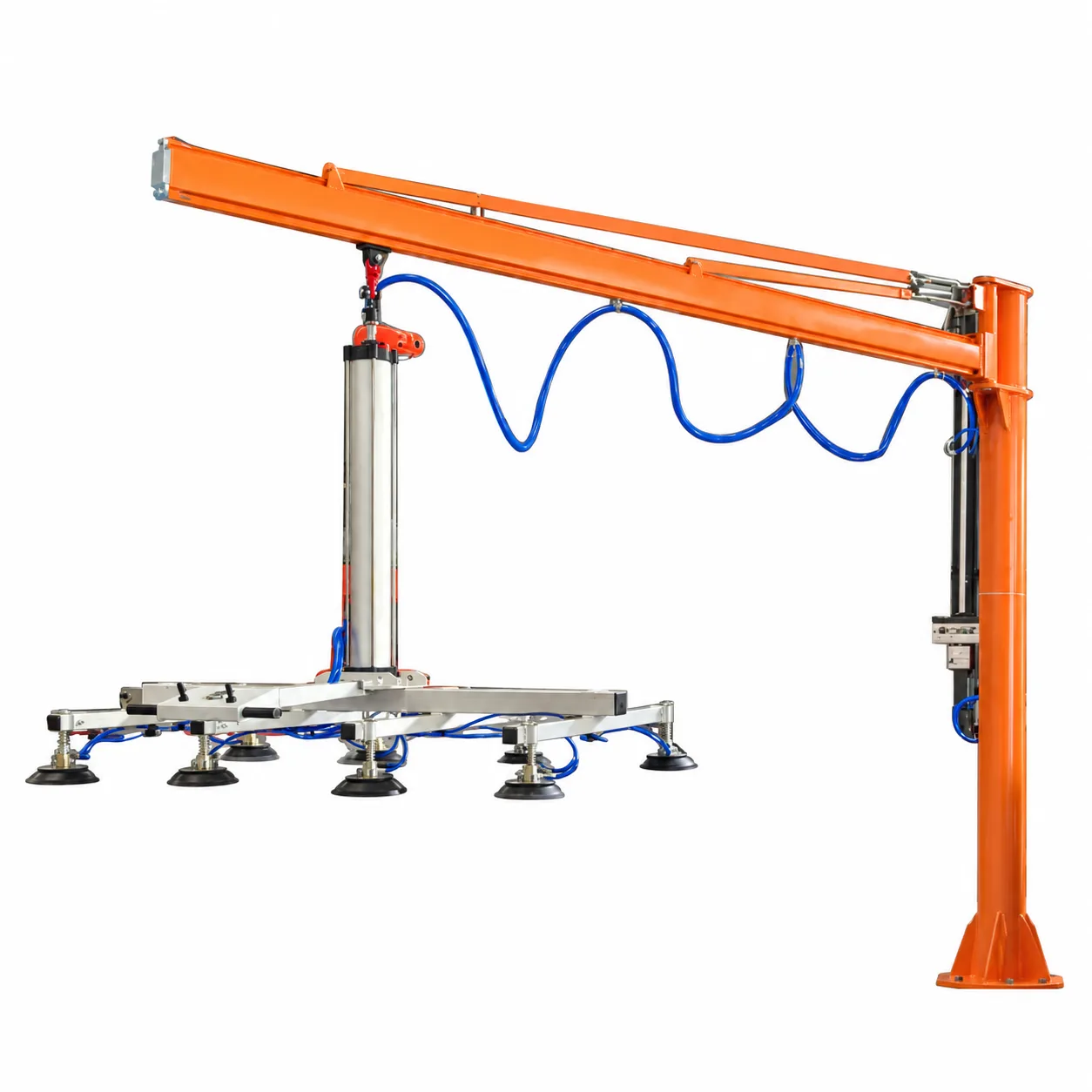
Compare published capacities only when their load definitions and working positions match. For a vacuum lifting station, include the frame and the required pad arrangement in the lifting plan.
Compare two layouts using the same requirement sheet
- Show required pickup, travel and delivery positions, including any turning envelope.
- Record minimum and maximum workpiece dimensions, weight and handling orientation.
- Identify the floor, wall, column or overhead support and available structural drawings.
- Measure headroom after allowing for the hoist, attachment and workpiece.
- Separate the supplied crane structure from the hoist, tool, utilities and installation work.
When the decision needs engineering input
Foundation, anchors and structural reactions depend on the selected equipment and site. Existing concrete thickness by itself is not an installation approval. Have the proposed mounting assessed with the model-specific drawing and site information.
Use this comparison to select the appropriate support format. Detailed structural calculations and installation instructions belong to the approved project design, not a generic selection article.
An example of reach and stroke leading to different choices
Model / configuration | System rated load | Jib length | Lifting stroke | Jib slewing |
|---|---|---|---|---|
ETJSB-D1000-B3M — Electric Jib Crane Vacuum System with Powered Slewing | 1000 kg | 3000 mm | 0–2000 mm | Motor-driven 360° |
ETJSB-D1000-B4M — Electric Jib Crane Vacuum System with Powered Slewing | 1000 kg | 4000 mm | 0–1600 mm | Motor-driven 360° |
These powered-slewing stations both list a 1,000 kg system load. The 4 m jib reaches farther horizontally but lists 0–1,600 mm lifting stroke, compared with 0–2,000 mm for the 3 m arrangement. A job constrained by vertical travel may therefore favor a different layout from one constrained by horizontal coverage. Check the actual pickup and placement points before selecting either.
Draw two envelopes on the layout
Draw the structural coverage first, then the envelope occupied by the tool and workpiece. Include the closest reachable point, obstructions and the sweep during turning. The second envelope often reveals a collision that a simple reach circle misses.
Continue your equipment review
Installation and foundation planning · Compare the complete installed cost · Browse crane systems
Questions for this equipment decision
What affects the cost of a complete crane workstation?
Capacity, span, height, slewing or travel, lifting equipment, structural work and installation affect the total cost.
How should reach, height and coverage determine the choice of a jib or workstation crane?
Plot pickup and placement positions on the workstation layout. Add required hook height, headroom, obstructions, blind areas and the complete suspended load. Compare a jib’s coverage with the travel of a workstation crane or gantry. Confirm the mounting and any mobility requirement for a specific available configuration.
What is included in the price of a jib crane system?
Ask whether the quotation includes the crane structure, hoist, lifting attachment, utilities, installation interfaces, engineering work, transport and handover. Identify the mounting arrangement and any civil or structural work separately. Comparing complete supply scopes is more useful than comparing a bare structure price with a ready-to-use system.