Describe the pane and usable contact area
Send the pane drawing with length, width, thickness, total weight and centre of gravity. Identify curvature, cutouts, coatings, surface films and areas that cannot be contacted. Show which face will be lifted and how the pane is stored.
Selection step | Decision to make |
|---|---|
Contact geometry | Can the approved pad positions fit the pane and avoid restricted areas? |
Pane support | Does the frame/pad layout suit the dimensions and rigidity? |
Required movement | Is the task fixed-orientation transfer, tilting, rotation or installation positioning? |
Vacuum system | Which source, circuits, indication and alarm features are specified? |
Support equipment | Can the crane/hoist or host machine handle the complete assembly in the required position? |
Separate pump power from movement power
A battery-powered vacuum source does not mean that tilt or rotation is powered. Read those movement rows individually. The quoted specification should identify manual, electric or hydraulic actions and any limits for the chosen arrangement.
For an installation that needs both tilt and rotation, specify the start and finish orientation and the clearance available while turning. Do not select a frame by its maximum load and assume the required movement is included.
Compare real configurations
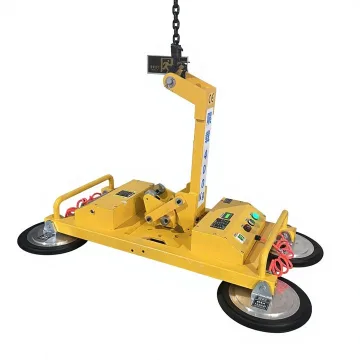
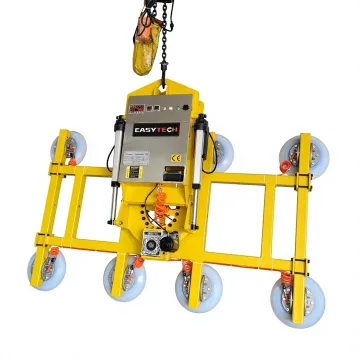
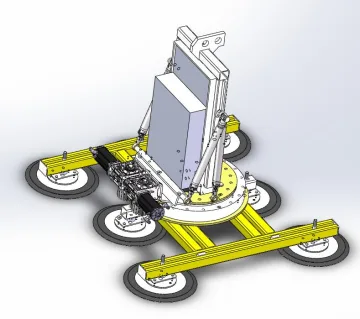
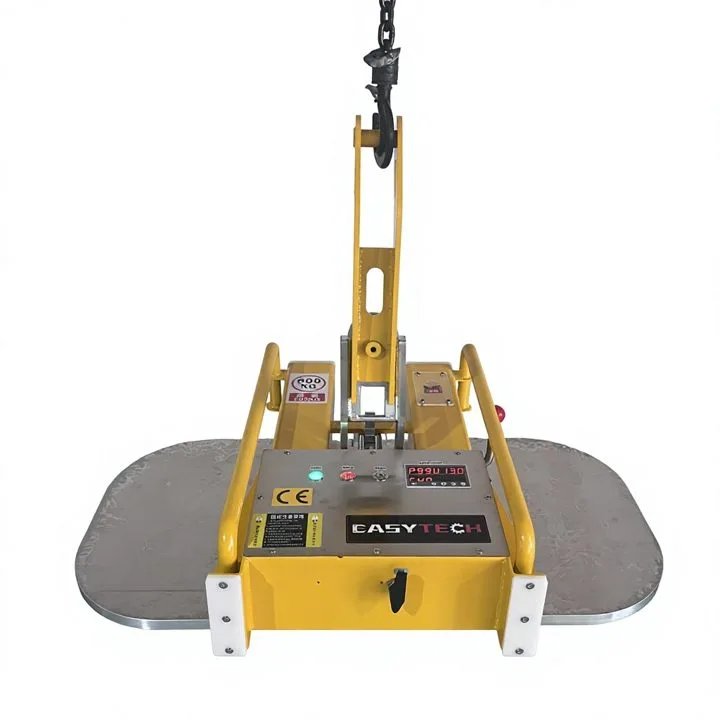
Use the model specification to compare rated load, pad quantity and diameter, frame geometry, equipment weight, vacuum source and movements. Model PDFs retain the documented values and available images. Treat a series reference image as a reference to the format; confirm visible options in the written configuration.
Curved, heavy or unusually shaped glass requires the relevant configuration and a pane-specific contact review. Flat-glass figures cannot be transferred automatically to a curved surface.
Turn the short list into an orderable scope
- Identify the exact model and selected pad/frame configuration.
- State the glass range and approved lifting face/orientation.
- Include required tilt, rotation, controls and vacuum-system features.
- Confirm support equipment, utilities, transport and site access.
- Request matching specifications, drawings and operating documents.
- Agree the representative pane and acceptance sequence.
Manual versus powered: a concrete comparison
Configuration | Rated load / pads | Tilt and rotation |
|---|---|---|
600 kg; six Ø300 mm pads. | Manual 90° tilt and manual 360° rotation. | |
600 kg; six Ø300 mm pads. | Electric 90° tilt and electric 360° rotation; dual vacuum circuits. | |
ET-GL-HYD-1500-LEG — Dual-Circuit Hydraulic Glass Vacuum Lifter | 1,500 kg; eight Ø400 mm pads. | Hydraulic 90° tilt and 360° rotation; two circuits; wireless control available as an option. |
A procurement specification should name each required function, not just “battery glass lifter.” Include whether remote control is standard or optional, whether the pad layout fits the pane and how the operator reaches the controls at the final position. These are concrete differences a quotation can answer.
Continue your equipment review
Glass vacuum lifters · Curved glass handling · Heavy glass handling
Questions for this equipment decision
What affects the price of a glass vacuum lifter?
Frame size, pad arrangement, vacuum circuits, motion drives, remote controls and delivery scope affect the price.
How do glass dimensions and centre of gravity affect suction-pad layout?
Glass length, width, thickness and centre of gravity influence support spacing and load distribution. Coatings, holes and curvature also affect the usable contact areas. Request a pad layout for the workpiece and handling direction. Adding individual cup capacities or calculating suction force does not establish the rated capacity of the complete lifting machine.
When should glass tilting and rotation be manual, electric or hydraulic?
Compare the actual model’s tilt and rotation functions against the workpiece weight, positioning frequency, control needs and available utilities. Manual movement, electric drives and hydraulic drives have different operating arrangements. Select from the specified functions of the quoted machine; a family name or a photograph is insufficient to identify how each movement is powered.
What information is needed to verify performance after a vacuum alarm?
Record the model, installed pad arrangement, workpiece, vacuum readings, alarm and recent maintenance. Alarm monitoring, stored vacuum and independent circuits perform different functions; one feature does not prove the others are present. Follow the equipment instructions and the agreed inspection procedure before returning it to use.
Which drawings and documents should accompany a glass vacuum lifter?
Request the model-specific specification sheet, arrangement drawing, permitted loads and orientations, operating instructions and relevant circuit information. Identify any inspection, test or conformity documents required for your destination and project. Check that each supplied document covers the quoted configuration and revision.