
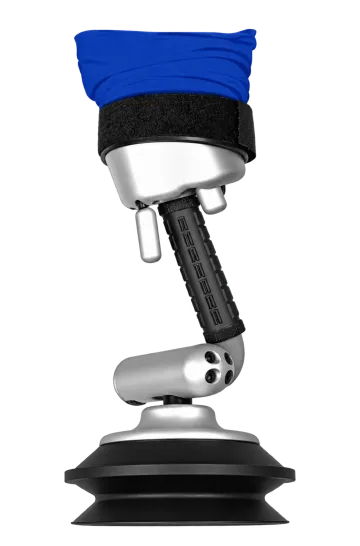
- Load & conditions
- Surface loadSealed 30 kg; porous 25 kg
- Lifting stroke
- Lifting stroke1700 mm
- Installation
- MountingJib crane / rail
- Vacuum supply
- Pump / blower power1750 WElectrical supply standard480 / 380 / 220 V; 3 PH, selected per order
Applications & Workstation Planning
Vacuum Lifters for Wood, MDF and Door Panels
At a glance
Two 50 kg wood panels behave completely differently under vacuum: melamine acts nearly airtight, while raw MDF bleeds air through the face and cut edges.
- Porosity controls both vacuum source and rated load. Sealed laminated panels hold vacuum with little airflow; raw MDF, particleboard and unfinished plywood need high-flow vacuum blowers and lower porous-surface ratings.
- Spread the pads before increasing nominal capacity. Wide, thin sheets bow at the edges and peel off a compact suction head even when the panel weighs half the machine’s rating.
- Match pad geometry to grooves, stiles and dust. Narrow door stiles and routed profiles need oval or compact pad layouts; spring-mounted stems tolerate slight flatness variation, not recessed panels, and MDF dust requires routine filter cleaning.
- Subtract the frame and hoist from ceiling height. Overhead beam height is never the same as usable lifting height at the panel face, and a vacuum lifting tube’s length is always longer than its working stroke.
- Load & conditions
- Surface loadSealed 50 kg; porous 45 kg
- Lifting stroke
- Lifting stroke1700 / 2500 mm
- Installation
- MountingJib crane / rail
- Vacuum supply
- Pump / blower power3000 WElectrical supply standard480 / 380 / 220 V; 3 PH, selected per order
- Load & conditions
- Surface loadSealed 65 kg; porous 60 kg
- Lifting stroke
- Lifting stroke1700 / 2500 mm
- Installation
- MountingJib crane / rail
- Vacuum supply
- Pump / blower power3000 WElectrical supply standard480 / 380 / 220 V; 3 PH, selected per order
- Load & conditions
- Surface loadSealed 110 kg; porous 100 kg
- Lifting stroke
- Lifting stroke1700 / 2500 mm
- Installation
- MountingJib crane / rail
- Vacuum supply
- Pump / blower power3000 WElectrical supply standard480 / 380 / 220 V; 3 PH, selected per order
- Load & conditions
- Surface loadSealed 180 kg; porous 150 kg
- Lifting stroke
- Lifting stroke1650 mm
- Installation
- MountingJib crane / rail
- Vacuum supply
- Pump / blower power3000 WElectrical supply standard480 / 380 / 220 V; 3 PH, selected per order
- Load & conditions
- Surface loadSealed 250 kg; porous 200 kg
- Lifting stroke
- Lifting stroke1650 mm
- Installation
- MountingJib crane / rail
- Vacuum supply
- Pump / blower power3000 / 4000 WElectrical supply standard480 / 380 / 220 V; 3 PH, selected per order
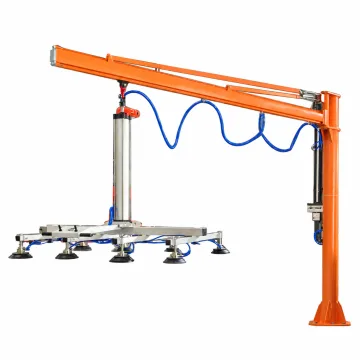
- Load & conditions
- System rated load100 kg
- Jib & structure
- Jib length4000 mm
- Column & lift
- Column dimensions3320 mmLifting stroke100–1100 mm
- Installation
- MountingFloor-mounted column
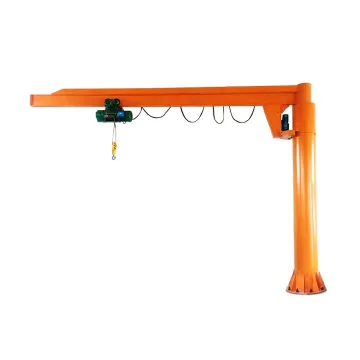
ETJSB-D300-B4M
ETJSB-D300-B4M Electric Jib Crane Vacuum System with Manual Slewing
Jib & workstation cranes- Load & conditions
- System rated load300 kg
- Jib & structure
- Jib length4000 mm
- Column & lift
- Column dimensions3430 mmLifting stroke0–1600 mm
- Installation
- MountingFloor-mounted column
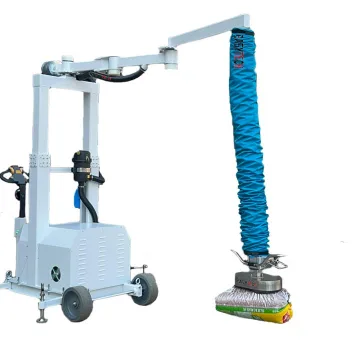
- Load & conditions
- Rated load60 kg
- Installation
- MountingMobile base / forklift
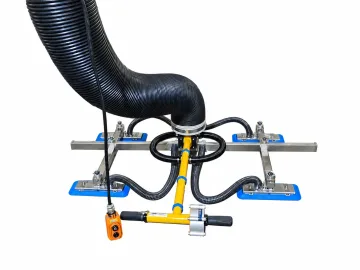
- Dimensions & interface
- Number of pads4 pcsPad dimensions140 × 370 mm
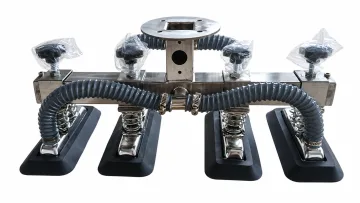
- Dimensions & interface
- Number of pads4 pcsPad dimensions120 × 320 mm
- Application & limits
- ApplicationsNarrow workpieces
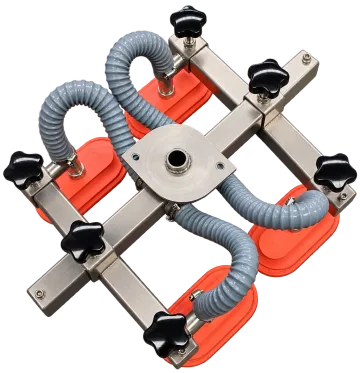
- Dimensions & interface
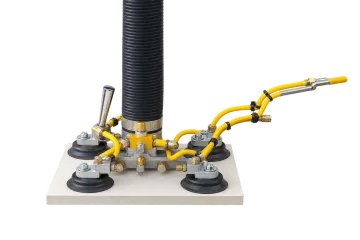
- Number of pads4 pcsPad dimensions140 × 70 mmConnectionQuick-change flange
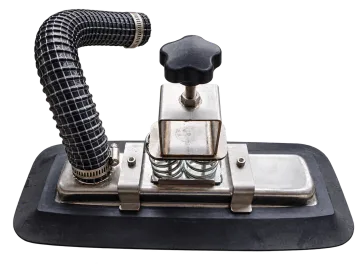
- Application & limits
- Compatible surfaceRough surfaces with small pores; testing on actual workpieces required
- Application & limits
- ApplicationsMDF panels
- Function
- Tilting angle90 °
Prepared by Easytech · Published · Content updated
Why raw MDF, plywood and laminated boards behave differently under vacuum
Buyers often start by sending a board weight—for example, a 45 kg sheet of 18 mm MDF—and asking for a 50 kg lifter. Weight is only half the problem. Wood-based panels span the full range from virtually non-porous to highly air-permeable, and that single difference changes the vacuum generator, the pad seal and the permitted working load.
- Melamine-faced MDF, HPL and sealed veneer boards: The surface resin layer blocks airflow across the face. Leakage happens mostly around surface grain, dust, slight board warp or scratches on the rubber lip.
- Raw MDF, HDF and particleboard (chipboard): Fibres and resin create microscopic air paths through the core and out the sawn edges. Air continuously passes into the suction cup while the load is suspended, so the vacuum source must evacuate air faster than it leaks through the board.
- Unfinished plywood and solid-wood glue-lam panels: Veneer seams, knots, checks, rough sanding and panel bow create localized leak channels that standard flat rubber lips struggle to bridge without either higher flow or compliant foam sealing.
In Easytech’s published vacuum tube lifter catalog, that air-permeability penalty appears directly as two separate ratings on the same machine—one for sealed surfaces and a lower rating for loose or porous surfaces.
Tube lifter model | Sealed-surface load | Loose / porous-surface load | Tube diameter | Lifting tube length | Usable lifting stroke | Blower power |
|---|---|---|---|---|---|---|
30 kg | 25 kg | 100 mm | 2,500 mm | 1,700 mm | 1,750 W | |
50 kg | 45 kg | 140 mm | 2,500 / 4,000 mm | 1,700 / 2,500 mm | 3,000 W | |
65 kg | 60 kg | 160 mm | 2,500 / 4,000 mm | 1,700 / 2,500 mm | 3,000 W | |
110 kg | 100 kg | 200 mm | 2,500 / 4,000 mm | 1,700 / 2,500 mm | 3,000 W | |
180 kg | 150 kg | 250 mm | 2,500 / 4,000 mm | 1,650 mm | 3,000 W | |
250 kg | 200 kg | 300 mm | 2,500 / 4,000 mm | 1,650 mm | 3,000 / 4,000 W |
All models above use three-phase electrical supply (480 / 380 / 220 V, selected per order). Always size the station against the porous-surface rating if raw MDF, chipboard or uncoated plywood will ever cross the machine, even if most shifts run melamine panels.
A side-channel blower on a tube lifter moves high air volume at moderate vacuum, which compensates for continuous bleed through raw board. By contrast, a small dry vacuum pump or compact compressed-air ejector designed for airtight glass or steel reaches deeper static vacuum on sealed laminate, yet can lose holding margin rapidly on raw porous board. For the underlying physics of vacuum level versus airflow, see how to match the vacuum source to the workpiece surface and how vacuum suction force is calculated in practice.
Stopping double-sheet pick-up and thin-board sag on saws and CNC routers
Two practical failures show up repeatedly in panel-saw and CNC nesting cells, and neither is solved by simply buying a higher-capacity pump.
1. Double-sheet pick-up on thin porous boards
When a high-flow suction head pulls hard through a thin raw MDF or chipboard sheet (for instance, 6–12 mm backer boards), air drawn right through the top board creates partial suction against the second sheet underneath. As the operator lifts, the second panel clings for a moment and then slides loose mid-air.
What prevents double-picking in production:
- Spread smaller pads over a wider span rather than concentrating high pull through one oversized central cup.
- Test vacuum-level adjustment or peel-lift technique on the actual thinnest raw sheet in your stock—lifting slightly at one edge or tilting briefly lets air break the seal between sheet one and sheet two before moving across the bed.
- Confirm whether a single board sample test is needed before shipment. If your shop cuts both 3 mm raw hardboard and 25 mm veneered doors on the same station, one static setting rarely handles both cleanly without a quick-change head or pad shut-off valves.
2. Sheet deflection and corner peel on full-size panels
A 2,440 × 1,220 mm or 3,000 × 1,500 mm panel of 9 mm plywood or 12 mm MDF flexes under its own weight when gripped only across a narrow central rectangle. Once the long edges droop, the board pulls away from the outer sealing lip at an angle, breaking the perimeter seal and causing a sudden release.
Match the pad beam spread to the widest and thinnest sheet on the schedule:
- For full-size wood panels on a tube lifter, multi-pad frames such as the four-pad panel head ET-VC-PAD-SHEET-4 (140 × 370 mm × 4 pads) distribute holding force along the board rather than pinching the centre.
- For long narrow strips, rip cuts or cabinet side panels, a narrow four-pad head such as ET-VC-PAD-NAR-4 (120 × 320 mm × 4 pads) or a quick-change compact four-pad head ET-VC-PAD-QC-4 (140 × 70 mm × 4 pads) keeps every seal lip completely inside the cut width.
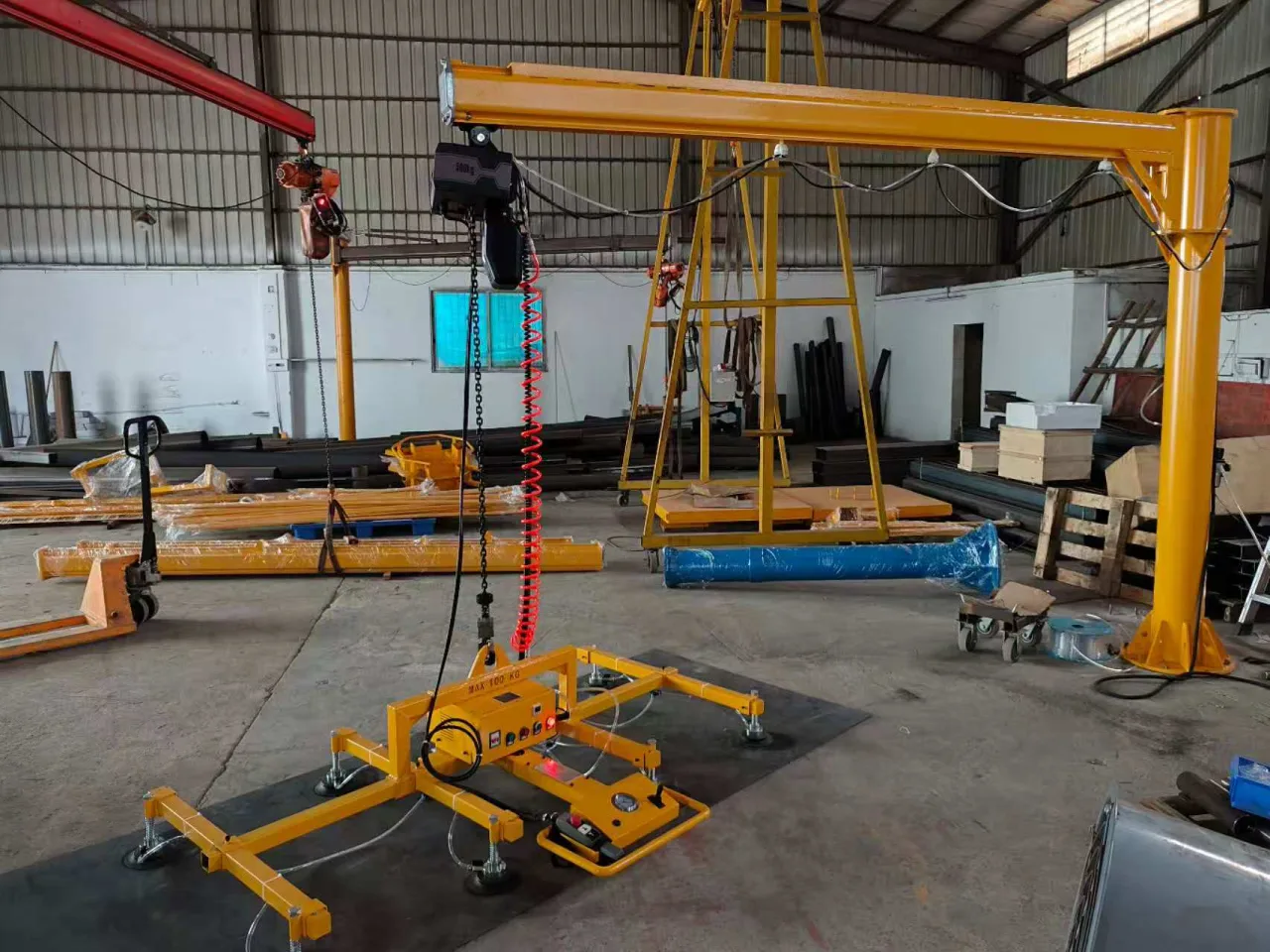
- For large heavy sheets up to 3,000 × 1,500 mm loaded across a wide work zone, an 8-pad jib-mounted frame with Ø200 mm pads—such as ETJSB-Q100-B4M or ETJSB-D300-B4M—supports both the length and width of the sheet across eight contact points.
Choosing pad shapes, foam seals and spring stems for doors and machined panels
Flat stock boards are straightforward compared with interior doors, shaker fronts, routed stair treads or veneered furniture components. Once grooves, lock cutouts, decorative frames or protective films enter the layout, the panel’s overall width no longer tells you where a suction cup can actually sit.
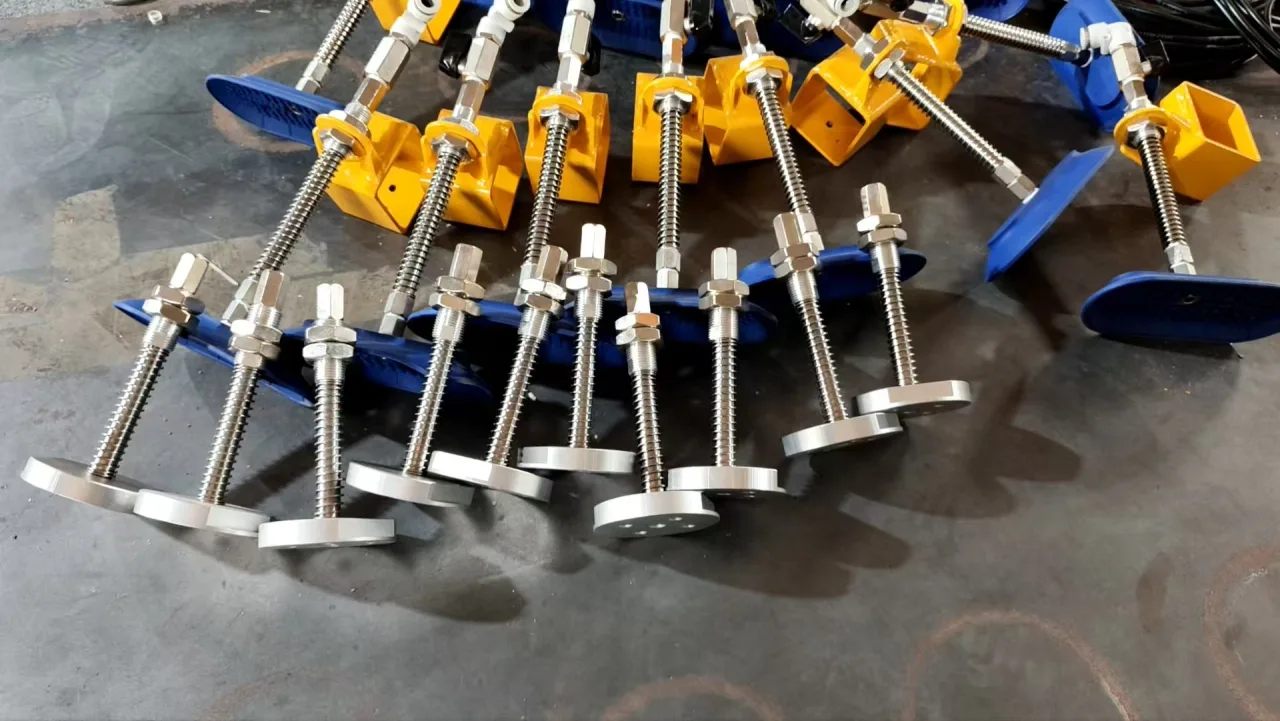
- Round pads give uniform radial sealing and are easy to align on broad flat zones such as flush doors and full raw sheets.
- Oval pads pack usable suction area onto narrow continuous strips—such as door stiles, rails and framed panel borders—where a round pad of equal area would straddle a recess or chamfer.
- Foam vacuum pads such as ET-VC-PAD-FOAM conform to textured grain, saw-marked timber and small surface pores where solid rubber lips bridge and leak. Easytech’s catalog notes an explicit engineering boundary here: testing on the actual workpiece is required, because foam density, surface roughness and dust loading directly affect both seal life and holding safety.
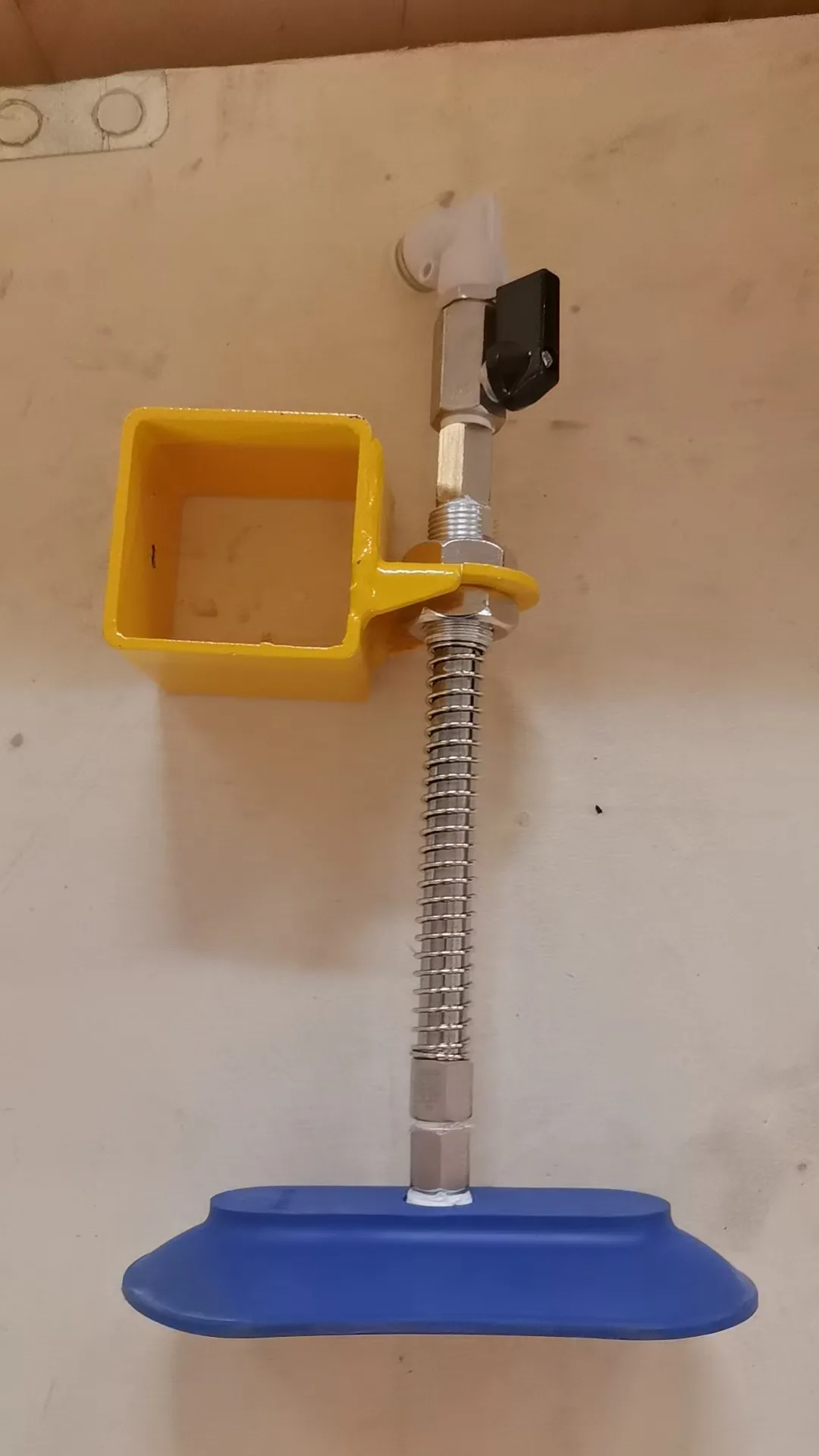
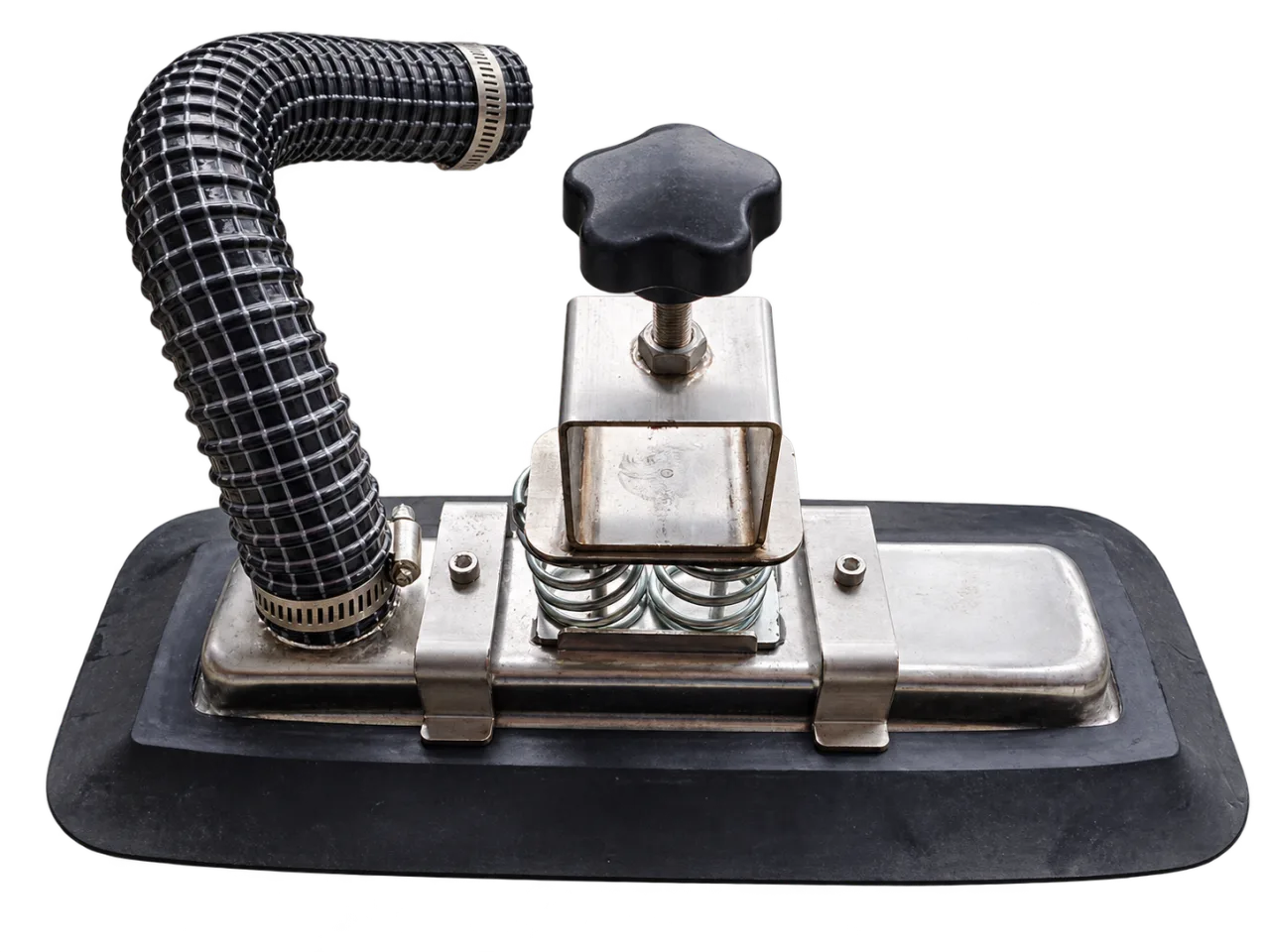
A spring-loaded mounting stem helps each pad settle squarely onto a slightly bowed board or minor height variation without slamming the face. As documented in the door-panel gluing-machine case study, however, a spring mount is not a universal fix for stepped surfaces. If one pad drops into a recessed door panel while neighbouring pads ride on raised stiles, the tilted load path and uneven sealing still require a drawing-based pad-layout review before ordering.
Do not overlook MDF dust and protective films
Woodworking plants generate fine abrasive dust that settles on every board stack. In a vacuum lifter, that dust goes straight into the suction lines:
- Inline vacuum filters clog far faster on MDF than on glass or sheet metal. Restricted airflow makes a tube lifter sluggish, lowers holding force and causes side-channel blowers to run hot. Build filter inspection into every shift and follow the checks in vacuum tube lifter blower overheating and filter maintenance.
- Check peelable protective films on high-gloss acrylic or lacquered furniture boards. If the protective film has weak adhesion, the suction pads can grip the film cleanly while the board itself pulls away from the film. Verify film adhesion or lift the uncoated reverse face when possible.
Comparing the three main architectures for wood shops
Different woodworking stations need different mechanics. Do not choose by rated load alone—compare cycle speed, tilting need, sheet span and whether the shop has overhead support.
Architecture | Representative Easytech models | Typical fit in wood & door plants | Key operating limits to verify |
|---|---|---|---|
Overhead vacuum tube lifter | ETJSQ-V100-30 to ETJSV300-250 (+ optional ET-VC-HEAD-FLIP 90° tilting head) | High-cycle feeding of beam saws, CNC nesting tables and edgebanders; raw MDF, chipboard and plywood stacks (25–200 kg porous rating) | Verify porous load rating, 1,700–2,500 mm usable stroke (not tube length), 3-phase power (220/380/480 V) and dust-filter access. |
Jib-mounted multi-pad vacuum frame | ETJSB-Q100-B4M (100 kg, pneumatic, 0.6–0.8 MPa) · ETJSB-D300-B4M (300 kg, 380 V, electric hoist) | Wide sheets up to 3,000 × 1,500 mm with 8 × Ø200 mm pads and 4,000 mm jib reach; heavier laminated boards, solid-core doors and gluing lines | Confirm compressed-air flow (for pneumatic Q models) or 380 V power (D models), 100–1,100 mm vs 0–1,600 mm stroke, floor slab anchoring and surface porosity if boards are raw. |
Mobile / forklift-repositioned tube lifter | ET-TL-TEL-060 (60 kg, telescopic column, bending tube) | Rental workshops or multi-station cutting bays where floor anchors or overhead runway steel cannot be installed | Rated at 60 kg; lock the jib before forklift relocation; check floor levelness and aisle width around the counterweight base. |
If boards are stored vertically in A-frame or cantilever racks and must land flat on a horizontal CNC router or saw table, confirm the 90° tilting mechanism up front. A horizontal tube lifter with a fixed pad beam cannot safely peel a vertical board out of a rack; you need a documented tilting head such as ET-VC-HEAD-FLIP (90° tilting head listed for MDF panel applications) or a dedicated tilting frame, plus enough floor clearance behind the operator to swing the full board height.
Vertical clearance math: why ceiling height is never usable lift height
One of the costliest installation surprises in panel shops is discovering that a crane fits beneath the roof trusses, yet the suction frame cannot lift a board off the top of a 1,400 mm pallet stack and clear the CNC bed fence.
Always build a vertical stack-up from the finished floor before approving a crane or jib drawing. In Easytech’s door-panel machine-loading layout, a 2,600 mm overall station height breaks down like this:
Height element in the layout example | Dimension | What it consumes |
|---|---|---|
Overall jib / station height | 2,600 mm | Total vertical envelope available from floor |
Minus overhead beam / jib structure | − 250 mm | Steel arm depth above the trolley/hoist hook |
Minus electric chain hoist envelope | − 530 mm | Hoist body and hook headroom |
Minus vacuum lifting attachment | − 550 mm | Frame, suspension linkage and suction pads |
Resulting height at the lifting face | 1,270 mm | Actual maximum panel-face height |
That is a project layout calculation—not a universal constant for every jib—yet it demonstrates the exact check every wood shop must run. Compare the resulting lifting-face height against both the top of a fresh pallet bundle (plus pallet height) and the highest table, fence or conveyor roller on your saw or gluing line.
For vacuum tube lifters, apply a second height check: lifting tube length is not lifting stroke. On ETJSQ-V140-50 through ETJSQ-V200-100, a 2,500 mm lifting tube provides 1,700 mm of lifting stroke, and a 4,000 mm tube provides 2,500 mm of stroke—and on heavier ETJSV250-150 / ETJSV300-250 units, stroke is 1,650 mm. You must confirm that the lowest pickup point (the last board on the pallet near floor level) and the highest drop point (the machine table plus any fence clearance) both sit comfortably inside that working stroke. For crane coverage and floor-slab rules around the saw, see how to compare jib cranes, workstation cranes and gantries and the wood, MDF and plywood handling overview.
What to send for an accurate wood-panel quotation
To avoid an undersized blower, double-sheet pick-up or a headroom clash on delivery day, include these six items when you request an equipment quotation:
- Every board type on the station: State whether surfaces are raw MDF, particleboard, OSB, unfinished plywood, melamine/HPL, painted or wrapped in protective film—and mark the most porous and heaviest board separately.
- Dimension and thickness range: Give both the heaviest panel and the thinnest, widest panel (length × width × thickness in mm) plus any narrow rip cuts or grooved door faces that the same head must pick up.
- Pickup and set-down heights: Measure pallet height (full stack and last sheet), machine bed height, infeed rollers or vertical rack geometry, and the lowest ceiling obstruction above the workstation.
- Required motion and cycle rate: Flat-to-flat only or 90° upright-to-flat tilting? Approximate panels per hour and shift length.
- Workshop utilities and mounting: Available 3-phase voltage/frequency (e.g., 220 V, 380 V or 480 V), compressed-air pressure/flow if considering a pneumatic jib, and whether the concrete floor can take a column anchor or whether overhead steel exists.
- Sample test flag: If you handle ultra-thin raw MDF, deeply textured veneer, open-pore timber or delicate coated doors, tell us up front so a sample-board lifting check can be planned before manufacture.
LET’S DEFINE YOUR APPLICATION
The right equipment starts
with your workpiece.
Tell us what you lift, where it moves and how it needs to arrive.