
If a glass robot grips the pane but will not move, replacing the vacuum pump is unlikely to answer the first question. Travel, braking, hydraulic movement and vacuum gripping perform different jobs. Identify which function stopped, which functions still respond, and whether an indicator or sound changed at the same time.
This guide helps you describe a fault on a battery-powered wheeled glass robot before service work begins. The WSR-600 maintenance and operating instructions distinguish these systems; later machines and optional heads can use different controls. Match the serial number and installed equipment to its instructions before applying a test or repair procedure.
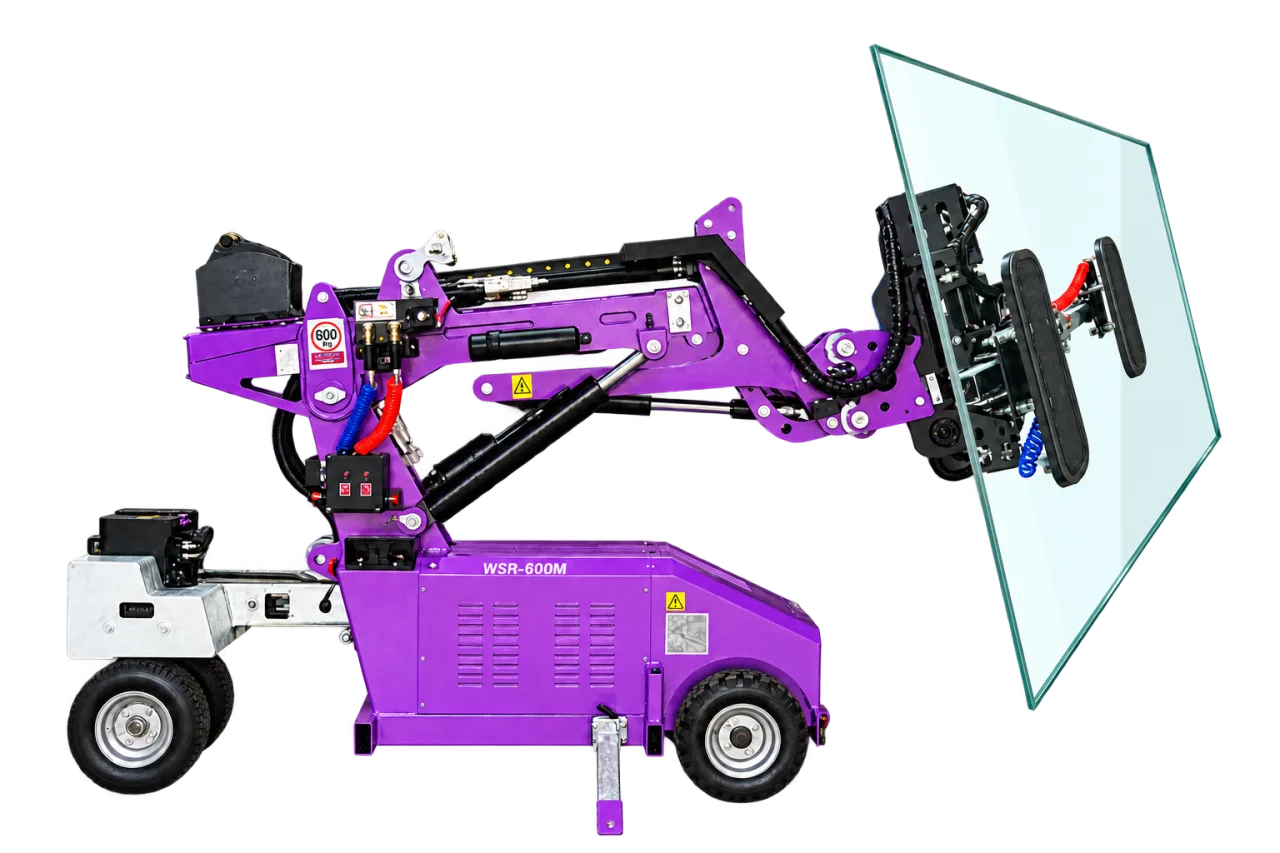
Make the situation safe before investigating
If the machine is carrying glass, follow its emergency procedure to reach a stable supported condition and keep people outside the load and movement area. Do not disconnect power, release vacuum or release a brake simply to see whether the fault clears. A faulty brake, unintended movement, an oil leak or loss of grip is a reason to stop using the machine and obtain service.
The observations below do not require opening electrical covers, loosening hydraulic fittings or repeating a failed lift. Use information already seen during the event. Any subsequent function check must use the machine-specific procedure, a suitable clear area and the specified unloaded condition.
Start with the function that failed
What happened? | What to record | Where the service investigation starts |
|---|---|---|
No power indication and no response | Battery indication, key/main-switch state and whether the problem followed charging, storage or transport. | Supply, connections and indication. A blank display alone does not identify a failed battery. |
Indication is present, but the machine will not travel | Forward, reverse or both; control position; any drive sound; warning text or flashes. | Travel command, controller, drive motor and brake. Vacuum generation is a separate function. |
Travel works, but no hydraulic movement responds | Which controls were used and whether the hydraulic pump made its normal sound. | Common hydraulic supply and its electrical control, before assuming several cylinders failed together. |
One movement fails while others work | The exact movement and direction: lift/lower, extend/retract, tilt or another fitted powered axis. | That function's control and hydraulic branch, including valves, hoses and actuator. |
The frame moves, but vacuum will not build or hold | Gauge units/readings, alarm state, pump cycling, pad contact and hose condition. | Vacuum circuit and contact. Use the separate suction-loss guide. |
The machine does not stop or hold as expected | What happened when the travel control was released, any unintended rolling, and the ground condition. | Brake and travel-control inspection. Remove the machine from use; do not demonstrate the fault again. |
Power is on, but the robot will not drive
The WSR-600 maintenance fault table lists the main supply, speed-control contact, drive controller, motor, fuse and a seized brake among the possible causes. These are different investigation branches, not a list of parts to replace.
Tell service whether all movement stopped or only travel. A vacuum pump that still runs shows that one circuit has power; it does not prove that the drive circuit, battery under demand or brake-release circuit is healthy. Likewise, a lit battery display is not a load test of the battery.
Record the control and brake arrangement before ordering a component. A technician needs the installed controller and brake identity, the correct circuit diagram and the observed symptom. Do not bridge an interlock, fit a larger fuse or mechanically release a brake to make the robot move.
The pump can be heard, but the arm will not move
First distinguish the hydraulic pump from the vacuum pump. The vacuum pump serves the suction system; it is not evidence that hydraulic oil is reaching a lift cylinder. If you are unsure which sound you heard, describe its location or send an existing recording instead of guessing.
The manufacturer fault table separates “oil pump does not work” from “no lifting” and repeats checks for extension, side movement and tilt. For a silent hydraulic pump, the service investigation includes its electrical supply, connections, protection and motor. When the pump runs but an axis does not move, it also includes the oil supply, valve operation, hose damage, internal leakage and actuator condition.
Useful distinctions are whether all powered axes stopped together, only one axis failed, only one direction failed, or movement becomes slow after working. Report visible leaks and the position where movement stopped. Do not reach into the mechanism, loosen a hose to look for flow or adjust a relief valve to overcome the symptom. Pressure adjustment without the approved specification can remove a protection limit without resolving the fault.
Check whether that movement is powered on your machine
On the WSR-600 configuration described in the operating manual, lift, extension, tilt and fine adjustment are electro-hydraulic, while rotation and side shift use a manual spring-lock arrangement. Other configurations can differ. Trying a hydraulic control is not a valid diagnosis of a movement that is manual on the installed machine.
Use the control labels and supplied instructions to identify the axis. In a service request, write “rotation does not release on the manual lock” or “powered tilt responds in one direction only,” rather than “the robot does not work.” Do not force a lock or convert the movement based on another model's photograph.
Vacuum faults need their own observations
If travel and hydraulic positioning work but gripping does not, record the actual vacuum indication, the lifting face, pad positions, isolated pads and whether the warning occurs at rest or during movement. A sound hydraulic system cannot compensate for poor pad contact.
Use the vacuum suction-loss diagnosis for that branch. If the pump repeatedly restarts, the pump-cycling and alarm guide explains how to record the cycle without treating an alarm as permission to continue lifting. Keep the thresholds from your own machine; do not copy them from another robot.
Charging and storage: collect the facts before blaming the battery
Record the battery and charger labels, the charger indication, the previous use/charging pattern and how long the machine was stored. State whether the problem appears before starting, when travel is requested or during hydraulic movement. This helps separate an indication problem, a charging problem and loss of supply under demand.
The WSR-600 instructions require a dry, ventilated charging location, prohibit charging with a damaged cable and call for the battery to cool before charging after use. Follow the isolation and charging sequence supplied with your machine. Never connect a charging plug to a controller connection just because it appears to fit.
Battery construction matters. A maintenance instruction for an electrolyte-level battery must not be applied to a sealed or different battery. Use the fitted battery/charger instructions for storage charging, fluid checks where applicable and replacement. Do not assume a fixed number of working hours or years from the appearance of the battery.
Send a service request that can lead to the right repair
Include | Example of a useful observation |
|---|---|
Machine and fitted head | Model, serial number, full-machine photograph and vacuum head, forks or winch fitted. |
Function and direction | Travel works; extension does not respond in either direction; tilt still responds. |
Indication and sound | Exact display text or flash pattern; which pump was audible and when. |
Conditions before the fault | After storage, after charging, after a head change or during a particular movement. |
Present safe state | Load is independently supported; machine is removed from use; visible leak location noted. |
Existing records | Available photographs, service history and the manual revision. Do not repeat an unsafe operation to create evidence. |
After repair, the technician must verify the affected function and the relevant safety functions under the supplied procedure. A pump starting or one movement returning does not by itself release the machine back to work. Keep the finding, actual repair, parts fitted and verification result together.
Use the fault-report checklist to organize these details, or contact technical support. For selection rather than a fault, start with the glass robot load-chart guide.