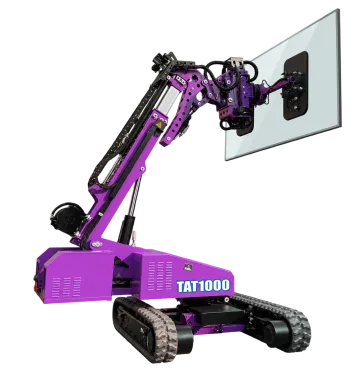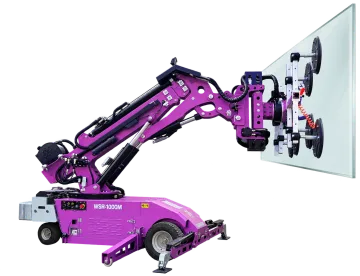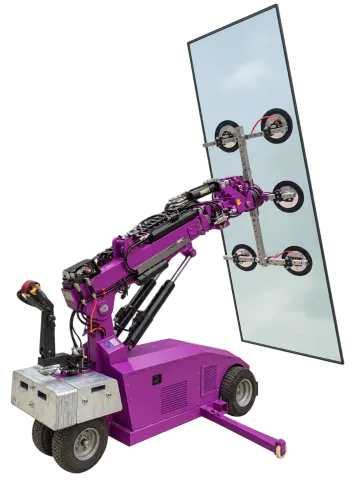
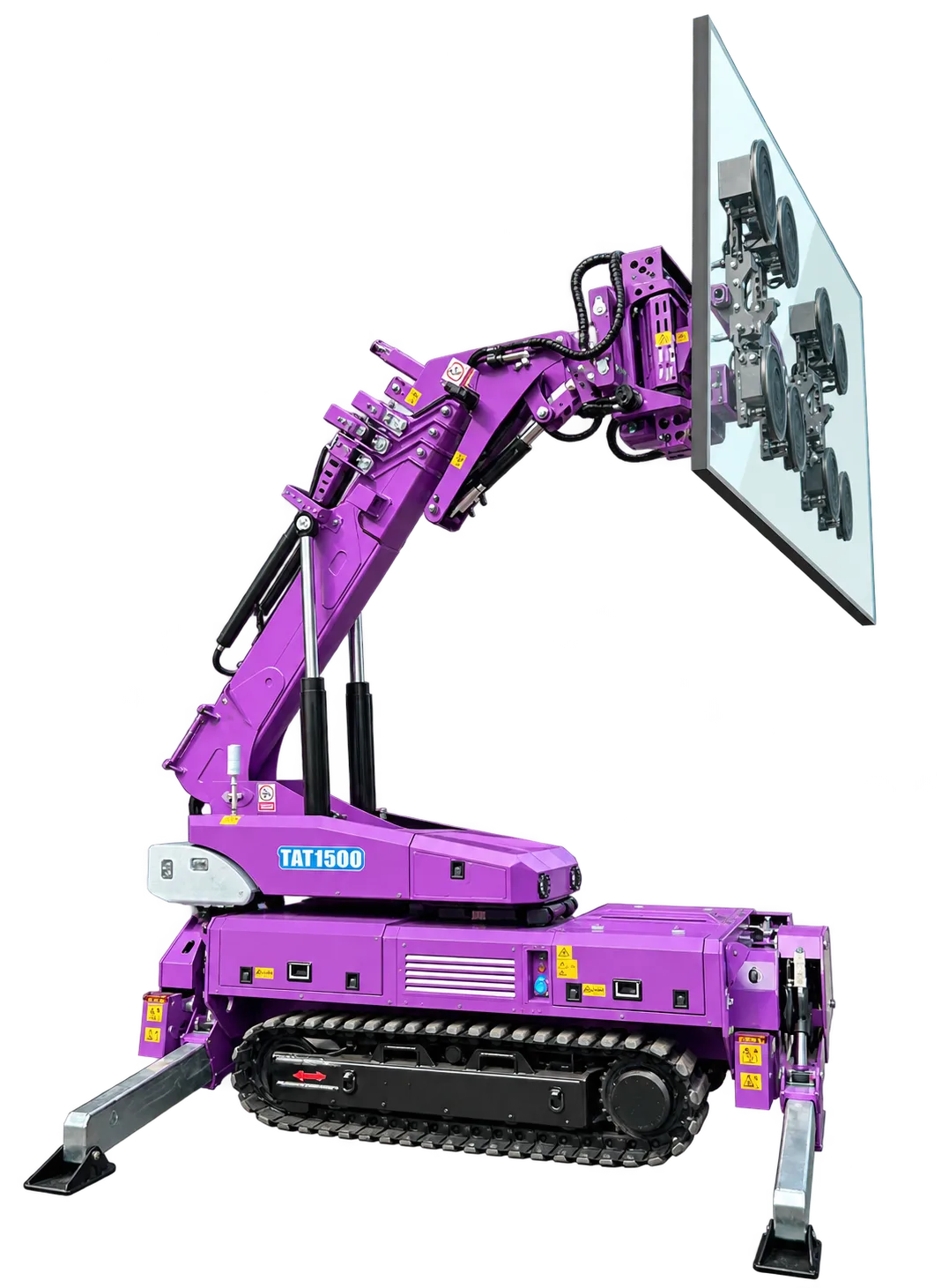
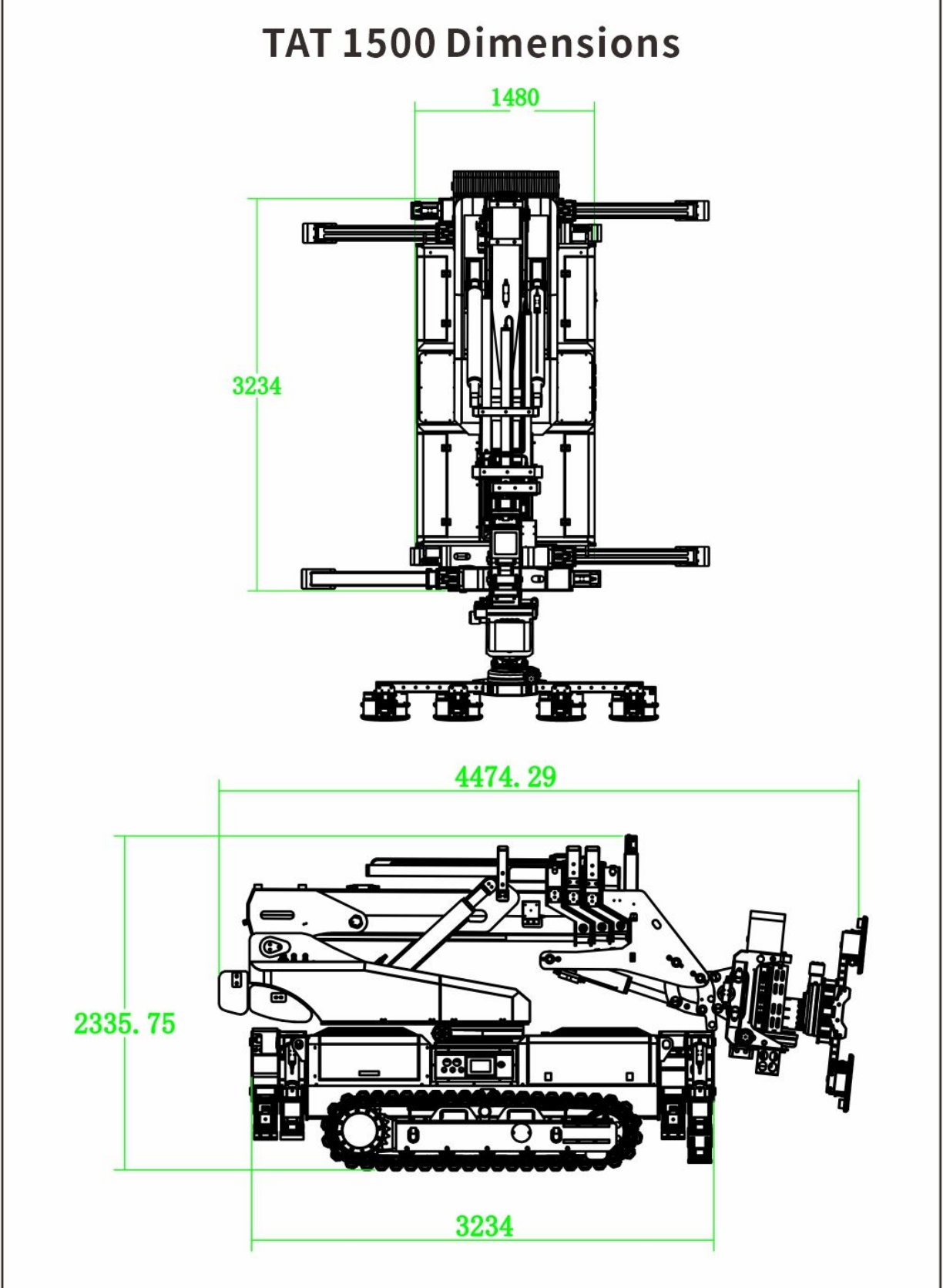
Access route and configuration-specific working position
The maximum load and maximum lifting height are separate limits. First check access and setup with the pane and attachment, then locate the required installation position on the matching load chart. Control type and powered versus manual positioning differ across the range.
Compare similar configurations
Selection point | |||
|---|---|---|---|
Maximum rated load | 1500 kg | 600 kg | 1000 kg |
Maximum lifting height | 8660 mm | 3800 mm (vacuum pad / fork mode only) | 6150 mm |
Minimum overall dimensions | 4475 × 1480 × 2336 mm | — | 2672 × 1377 × 2061 mm |
Equipment weight | 7110 kg | — | 3000 kg |
Pad configuration | Ø400 mm × 8 | — | 500 × 850 mm × 2 |
Winch wire rope length | — | 70 m | — |
Winch mode scope | — | 70 m refers to the wire rope length, not the maximum hook height. Use the attachment-specific working envelope for the actual lifting position. | — |
Equipment and intended application
The mobile chassis carries the lifting arm and vacuum head. Travel positions the machine; arm movement provides reach and height; the head aligns the glass using the listed tilt, rotation and fine-positioning functions. Each movement has its own limit, and the load envelope changes with reach and posture.
Rated-load boundary
Maximum rated capacity is 1,500 kg, with working load varying by reach and height—check the attachment load chart for your exact lift position.
Workpiece compatibility
Topic | Details |
|---|---|
Access to the work area | Check machine transport dimensions against doorways, elevators, corridors and turning radii, and verify floor load limits for the combined weight of the robot and glass. |
Placement geometry | Specify glass weight and size, final installation height, horizontal setback and any overhead obstruction. Maximum height and maximum load are separate values and must not be combined as a single operating point. |
Ground and weather | Check surface strength, slope, obstacles and the support arrangement. Gradeability is a travel specification, not permission to lift on that slope. Outdoor work also requires suitable glass, weather and site conditions. |
Power supply and configuration
Topic | Details |
|---|---|
Chassis and battery | Check the specification table for travel drive, battery setup and compact transport dimensions; real-world battery runtime depends on lift frequency, load weight and travel distance. |
Vacuum head | Pad arrangement and vacuum circuits apply to the stated head. A fork or winch option uses a different load path and requires its own attachment instructions. |
Positioning controls | Side shift translates the head; side turning swivels it; rotation turns the pane in its plane. These functions must not be conflated when checking access around an opening. |
Counterweights and supports | Use the specified counterweight and support arrangement. Removing weights to reduce transport mass changes the working configuration; it does not preserve the same lifting envelope. |
Installation and commissioning
- Survey access and placement before delivery: door and lift dimensions, floor loading, turns, unloading space and the installation setback.
- Prepare a suitable charging point using the supplied charger input. Check battery condition and the planned duty cycle before a shift.
- Inspect the fitted pads, vacuum hoses, hydraulic lines, tyres or tracks, counterweights, support devices and emergency stop. Check both circuits when a dual system is fitted.
- Commission controls and travel without a load, then carry out the prescribed checks for the selected glass and working posture. The operator needs the machine-specific operating instructions and load envelope.
Handling sequence
- Prepare the work area and set the machine to its approved lifting configuration. Keep the pickup and destination accessible for a safe set-down.
- Position the head on intact glass contact areas, apply vacuum and check the circuit indications before taking the glass weight.
- Use the load diagram for the selected reach and height. Make controlled travel and positioning movements; use fine adjustment to align the glass without forcing it against the opening.
- Transfer the pane onto its supports and secure it by the installation procedure before releasing the vacuum. Return the machine to its transport posture before relocating it.
Inspection, maintenance and replacement parts
Topic | Details |
|---|---|
Before use | Inspect pads, hoses, vacuum indications, controls, tyres/tracks and the support arrangement. Investigate any alarm or change in movement. |
Hydraulic system | Check for leaks and damaged hoses without touching pressurised leaks. Support moving parts and isolate energy before maintenance. |
Battery and charging | Keep terminals and charging leads in serviceable condition and follow the fitted battery/charger instructions. Report declining runtime instead of assuming the catalog duration still applies. |
Service identification | Record the model and serial number, attachment type, battery specification and affected component. Pad, hydraulic-seal and controller replacements must match the actual installed version. |
Troubleshooting priorities
Topic | Details |
|---|---|
Arm movement is inhibited | Check overload indication, emergency stop, power and the permitted posture. Do not bypass an interlock to reach the target position. |
One vacuum circuit warns | Set the pane down using the prescribed safe procedure and find the cause. A second circuit does not authorise normal operation with a known fault. |
Travel or positioning becomes irregular | Stop in a supported state and inspect the route, charge level, controls and hydraulic system. Resume only after the cause is resolved. |
Frequently asked questions
What load should I use when selecting TAT 1500?
TAT 1500 lists a maximum rated load of 1500 kg. The permissible load at the required height and outreach comes from the matching configuration load chart. Maximum height is not the full-load height.
Can it lift its maximum rated load to maximum height?
Only if the model load chart explicitly permits that combination. Select the curve for the actual load and check the complete reach/height path, not just the final point.
What is the difference between side shift and rotation?
Side shift moves the pane laterally without changing its angle; rotation turns it within its plane. Side turning changes the head direction relative to the arm.
Can a narrow machine automatically use a passenger lift?
No. Check the whole transport envelope, turning space, total transported mass and lift loading restrictions. The narrowest chassis width is only one of those checks.