
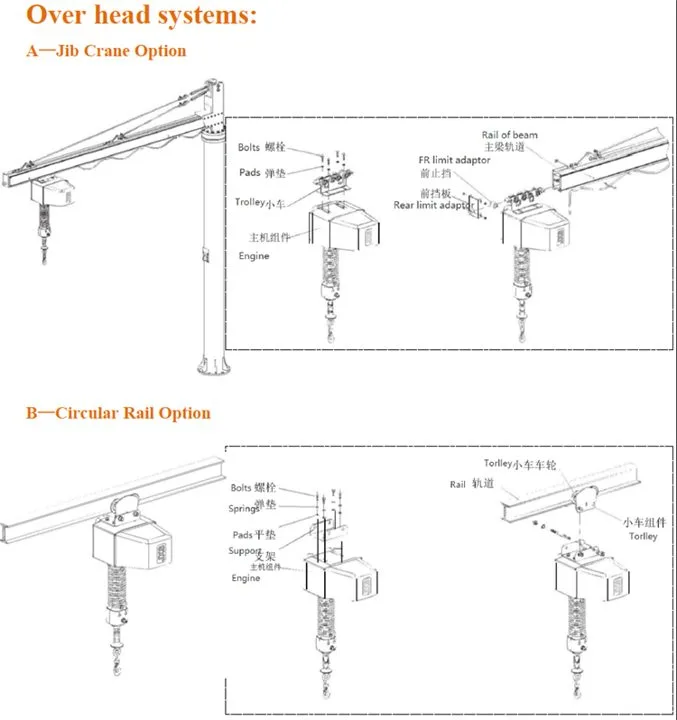
Model configuration and selection
ET-CR-RAIL provides an overhead rail and trolley arrangement for positioning a suspended lifting device. It is specified around workstation coverage, headroom, lifting-device weight, workpiece load and the supporting structure; it has no single standard load or span.
Map the required travel path and the building or independent support points. The rail route determines where the lifting unit can travel; the tube, hoist or balancer determines vertical motion. Define those two scopes separately. The order must identify the support structure, lifting device and end tool individually; an illustrated lifting unit is not an automatically included accessory.
Compare model configurations
Selection point | ||||
|---|---|---|---|---|
Structural arrangement | Gantry-supported bridge | Overhead rail and trolley | Articulated folding jib | Wall or existing-column mounting |
A dash means no value is specified for that comparison field; it does not mean zero or an included feature. Read each model’s complete technical data with its operating conditions.
Equipment and intended application
The crane or workstation structure supports the lifting device and its load over the intended working area. A column-and-arm structure, a complete vacuum-jib system and a cylinder/pad assembly are different supply scopes. The scope specified below determines what must be added to form a working system.
Application and integration requirements
Topic | Details |
|---|---|
Coverage | Plot the pickup and placement positions, arm sweep or rail travel and obstructions. Arm length is not the same as unobstructed usable reach. |
Headroom | Allow for the structure, trolley, hoist or cylinder, attachment and workpiece. Check the highest placement and lowest pickup against the complete installed assembly. |
Foundation or support | Assess the column foundation, wall or overhead structure for the full system loads. Do not infer an anchor size or foundation depth from rated capacity alone. |
Installation, inspection and service checks
Topic | Details |
|---|---|
Installation | Use the approved structural arrangement and foundation/anchor design. Check alignment, fixings, travel stops and routing of utilities. |
Commissioning | Test movement and controls unloaded, verify the lifting attachment and complete the prescribed load checks before production. |
Maintenance | Inspect structural connections, trolley or pivot wear, stops and the lifting assembly. Stop operation when loose fixings, distortion or abnormal travel is found. |
Troubleshooting priorities
Topic | Details |
|---|---|
Unexpected grip, motion or control behaviour | Stop with the workpiece supported. Inspect the affected connection, contact area and power or air supply, then follow the installed equipment instructions before returning to service. |
Replacement does not fit or changes performance | Check the component identity and system configuration. Do not modify interfaces or bypass protective functions to make a substitute fit. |
Frequently asked questions
Does ET-CR-RAIL have a universal load rating?
Specify workstation coverage, headroom, supporting structure, lifting-device mass and workpiece load. These inputs define the crane configuration and its permitted system load.
What determines compatibility?
Plot the pickup and placement positions, arm sweep or rail travel and obstructions. Arm length is not the same as unobstructed usable reach.
What needs checking beyond the listed size or load?
Allow for the structure, trolley, hoist or cylinder, attachment and workpiece. Check the highest placement and lowest pickup against the complete installed assembly.
What defines the supplied configuration?
The specified model, listed technical arrangement and accepted options define the product. Project drawings, utilities, accessories and installation interfaces must describe the same configuration.
Information for application assessment
- Identify the workpiece material, dimensions, mass, contact surface and centre of gravity. Include the least favourable item in a mixed production range.
- Describe pickup and placement positions, required orientation changes, handling frequency and the site layout.
- Identify the available power or air supply and any host machine, crane, support structure or interface that must be retained.
- State the destination market and required documentation, accessories and packing constraints so the proposed configuration can be assessed as a complete system.
Document scope
This product specification supports equipment selection and project definition. It includes the model data and application guidance presented on the product page. The operating instructions supplied for the actual machine govern commissioning, testing, maintenance procedures and safe use; this specification does not replace them.