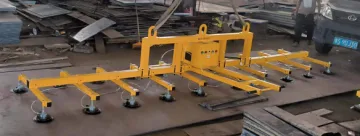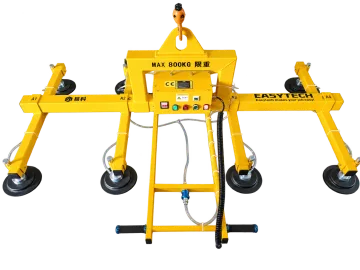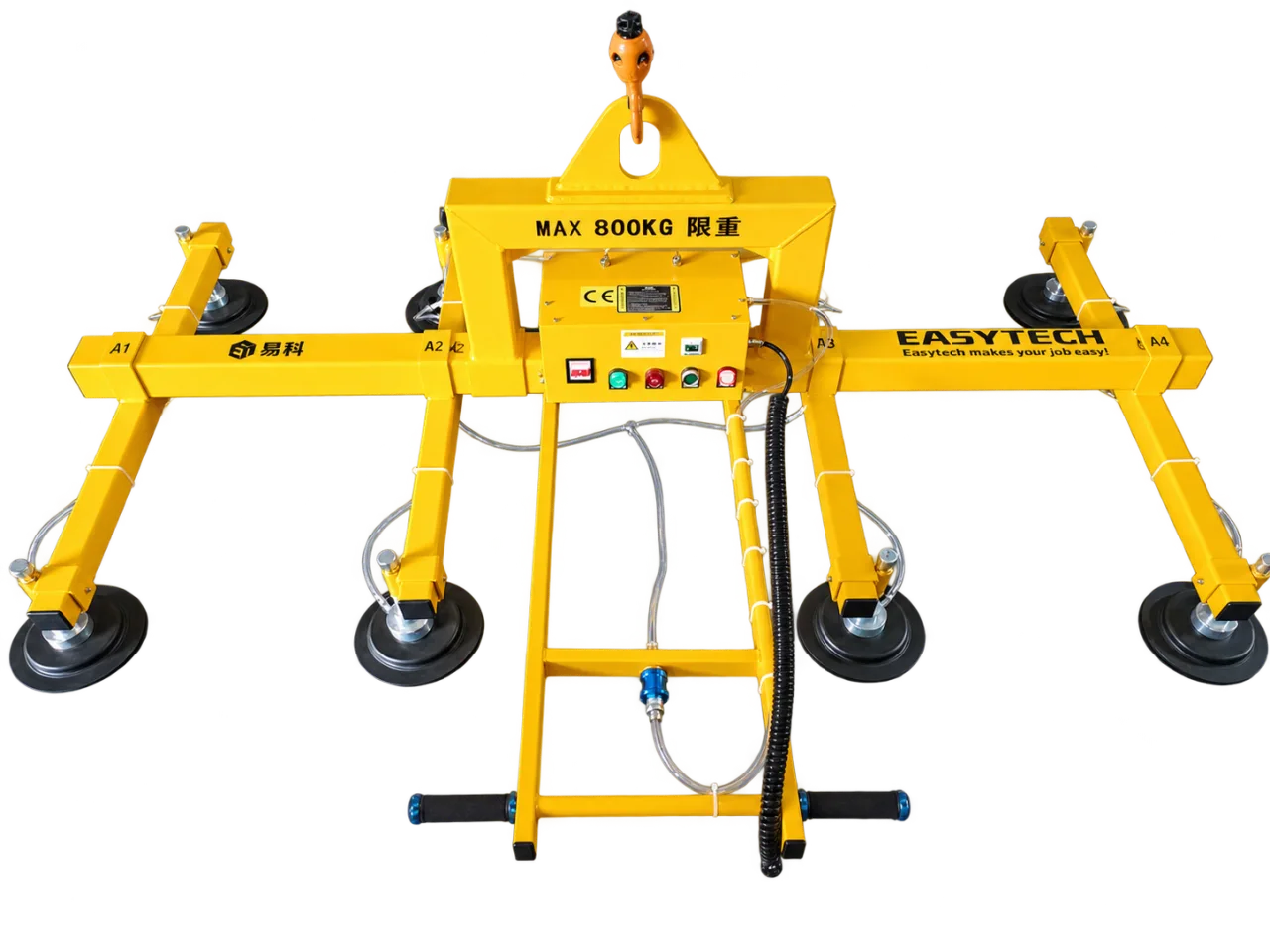
Extended-range sheet frame specification
Use the published pad pattern and supply entry to compare these records. A length-like suffix is not a verified beam dimension or workpiece envelope. Where those values are absent, request the actual arrangement drawing; do not fill them from the model name.
Compare the published configuration
Selection point | |||
|---|---|---|---|
Number of pads | 16 pcs | 20 pcs | 20 pcs |
Pad diameter | 250 mm | 200 mm | 200 mm |
Power supply type | Battery | Mains supply | Battery |
Rated load | 2000 kg | 2000 kg | 2000 kg |
Equipment and intended application
A distributed pad frame grips the sheet using vacuum and transfers its weight to the lifting point. The supporting crane lifts and transports the assembly. Horizontal, tilting and telescopic versions serve different handling sequences: the movement explicitly listed for this model defines its scope.
Workpiece suitability and limits
Topic | Details |
|---|---|
Sheet surface | Assess the actual surface, including protective film, oil, rust, scale and perforations. Every active pad needs a sealing area; a clean flat test plate does not establish capacity on a contaminated production sheet. |
Sheet dimensions and stiffness | Match pad spread and beam length to sheet length, width, thickness and sag. A sheet may be below the mass limit yet too flexible for the proposed support positions. |
Single-sheet handling | Confirm that the intended sheet is free from the stack. Vacuum grip on the top sheet does not establish that only one sheet has separated; the lifting system must not be overloaded by adhered sheets. |
Configuration and supply boundaries
Topic | Details |
|---|---|
Frame layout | The table describes beam, pad and dimensional information for the selected configuration. Adjustable supports must be locked; an extended beam is not permission to exceed the approved sheet size or load. |
Vacuum source | Battery pumps, mains pumps and compressed-air vacuum generators are different versions. A pneumatic vacuum generator needs compressed air; a mains pump requires its specified electrical supply. |
Tilting | Where tilting is listed, identify its drive and angular range separately from the vacuum control. A horizontal-only frame must not be used for vertical lifting based on its horizontal rating. |
Crane interface | The crane, hook and rigging are a separate part of the installation unless explicitly included. Their permissible load must account for the entire suspended assembly. |
Installation and commissioning
- Check the crane capacity, hook height, machine loading opening and travel route using the workpiece plus lifter envelope.
- Place the frame symmetrically about the load centre of gravity. Set and lock crossbeams/pad mounts, and connect all pads required for the stated layout.
- Keep vacuum lines clear of sharp sheet edges and moving machine parts. Provide and verify the specified electrical or compressed-air supply.
- Commission the installed configuration with representative sheets, including the least stiff and most difficult sealing surface in the planned range.
Handling sequence
- Inspect the frame, suspension point, pad seals, hoses and controls; establish the sheet mass and approved layout.
- Position the pads on the sheet and apply vacuum. Check the fitted vacuum indication and warning system before taking the weight.
- Raise in a controlled manner, check that the correct load has separated and guide the sheet clear of obstructions. Use tilt only when the configuration is rated for that orientation.
- Place the sheet on stable supports or the machine table, transfer its weight fully, and then release the vacuum.
Inspection, maintenance and replacement parts
Topic | Details |
|---|---|
Each working period | Inspect pad lips, hoses, beam clamps and the suspension point. Check that the controls return correctly and fitted alarms function. |
Contamination control | Keep coolant, metal chips and oil out of the vacuum path. Service the filter using the instructions for its element; investigate recurring contamination at the workpiece. |
Wear parts | Identify pads by diameter/profile/material and connection, and hoses by size and service. Keep replacement parts appropriate to the actual machine and sheet finish. |
After reconfiguration | Check locked beam positions, connected pad count and vacuum tightness. Reassess permissible loading before lifting with a reduced pad arrangement. |
Troubleshooting priorities
Topic | Details |
|---|---|
Sheet bends excessively | Set it down and reassess thickness, overhang and support positions. Adding vacuum does not correct an unsuitable mechanical support pattern. |
Grip weakens during transfer | Set down safely and check surface condition, leaks, power and pad contact. Do not continue because the load was secure at initial pickup. |
Pump runs unusually often | Inspect the seals, hoses and valves for leakage and check the filter. A pressure-switch adjustment should not be used to conceal a leak. |
Frequently asked questions
What load should I use when selecting ET-SM-J2000-3M?
The stated rated load for ET-SM-J2000-3M is 2000 kg. Apply it only to the specified configuration and operating conditions. Include the workpiece geometry, orientation and any tooling in the application assessment; do not combine separate maximum reach, height and capacity values.
Can the same machine lift different sheet sizes?
An adjustable frame can cover the configurations approved for it. Pad spread, overhang, sheet stiffness and connected pad count must be checked for each size.
Can I turn off unused pads?
Only within an assessed reduced-capacity arrangement. Do not divide or multiply the headline load to invent a new safe working load.
Can it handle an oily sheet?
That is not established by the standard load figure. Oil affects pad friction and can enter the vacuum circuit; evaluate the actual finish and use an approved contact arrangement.
Information for application assessment
- Identify the workpiece material, dimensions, mass, contact surface and centre of gravity. Include the least favourable item in a mixed production range.
- Describe pickup and placement positions, required orientation changes, handling frequency and the site layout.
- Identify the available power or air supply and any host machine, crane, support structure or interface that must be retained.
- State the destination market and required documentation, accessories and packing constraints so the proposed configuration can be assessed as a complete system.
Document scope
This product specification supports equipment selection and project definition. It includes the model data and application guidance presented on the product page. The operating instructions supplied for the actual machine govern commissioning, testing, maintenance procedures and safe use; this specification does not replace them.