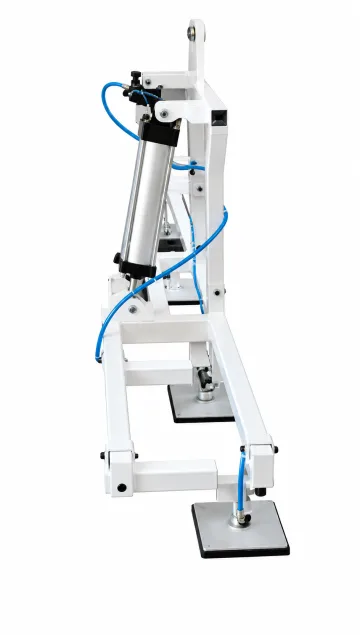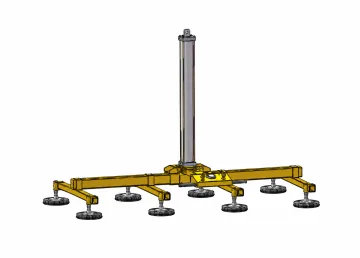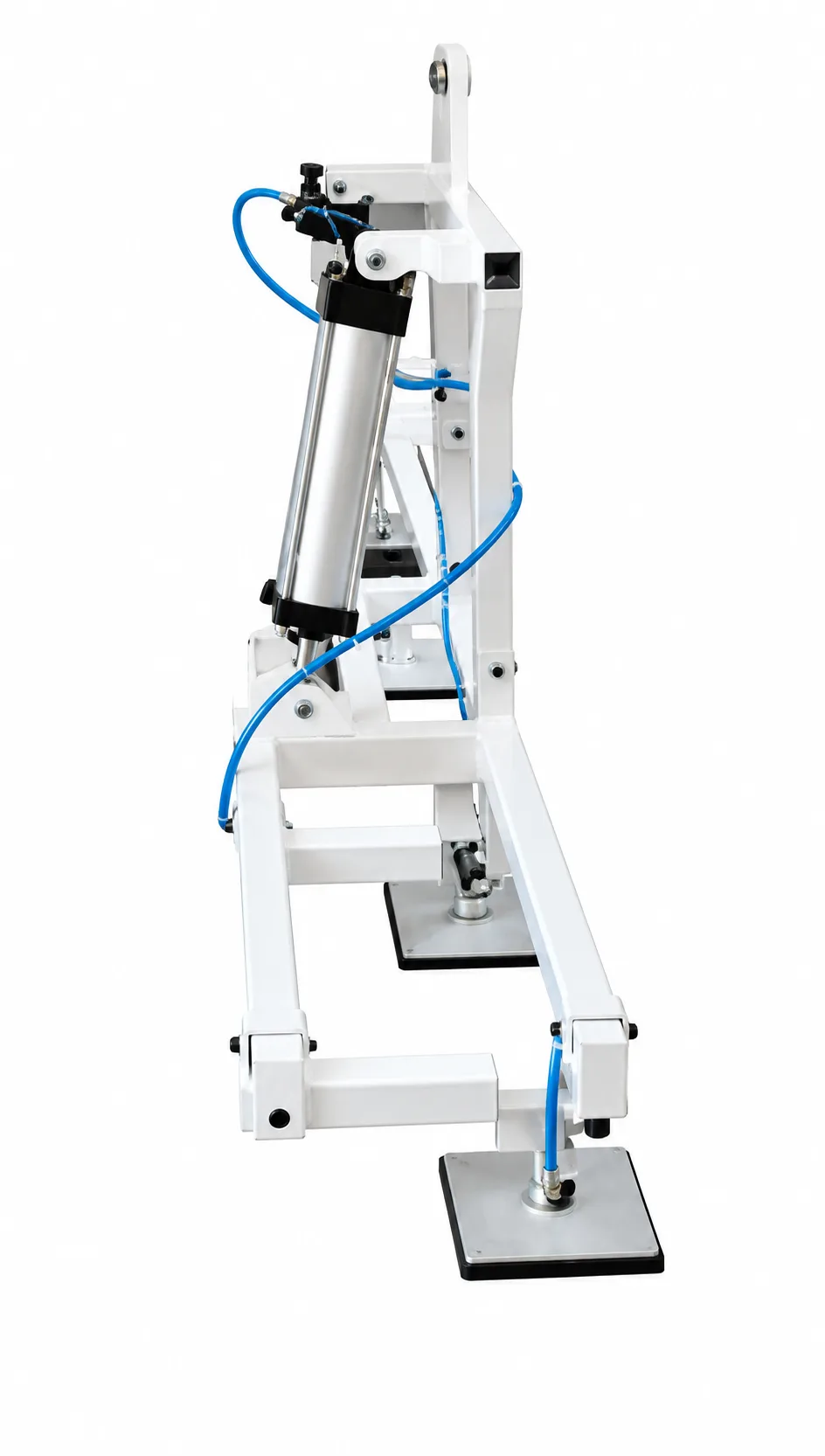
Stone handling orientation and pad layout
Pneumatic tilting provides a 90° orientation change. Match the rack and receiving position to that movement, with room for the slab and frame to sweep without obstruction.
Compare the published configuration
Selection point | |||
|---|---|---|---|
Rated load | 500 kg | 300 kg | 400 kg |
Number of pads | 8 pcs | 6 pcs | 6 pcs |
Pad diameter | — | 200 mm | — |
Pad dimensions | 200 × 400 mm | — | 200 × 400 mm |
Working orientation | — | Horizontal gripping | — |
Tilting | Pneumatic 90° | — | Pneumatic 90° |
Equipment and intended application
Stone and paving products range from suspended pad frames to rough-surface foam heads and a powered paving manipulator. Selection depends on stone mass, rigidity, surface leakage and the required placement method. The exact product configuration below determines whether it lifts horizontally, tilts or positions a paving element.
Application and integration requirements
Topic | Details |
|---|---|
Surface and porosity | Polished stone, textured stone and porous blocks behave differently under vacuum. Test the actual surface, including dust, moisture and any coating, rather than relying on material name. |
Slab integrity | Check thickness, unsupported span, cracks and cut-outs. A grip that holds securely can still damage a weak slab if support positions are unsuitable. |
Placement task | Record the pickup height, destination height, required tilt and access width. For the paving manipulator, keep the end-effector rating separate from pallet-fork mode. |
Installation, inspection and service checks
Topic | Details |
|---|---|
Before a lift | Check the seal or foam condition, contact cleanliness, pad coverage and the integrity of the stone. |
During handling | Maintain the approved orientation and keep the load clear of personnel and obstacles; do not pull a slab free by side-loading a pad. |
Service focus | Dust loading, seal wear and leaks require attention. Isolate the equipment before opening filters or replacing seals. |
Troubleshooting priorities
Topic | Details |
|---|---|
Unexpected grip, motion or control behaviour | Stop with the workpiece supported. Inspect the affected connection, contact area and power or air supply, then follow the installed equipment instructions before returning to service. |
Replacement does not fit or changes performance | Check the component identity and system configuration. Do not modify interfaces or bypass protective functions to make a substitute fit. |
Frequently asked questions
What configuration detail should I check before ordering?
Pneumatic tilting provides a 90° orientation change. Match the rack and receiving position to that movement, with room for the slab and frame to sweep without obstruction.
What load should I use when selecting ET-ST-TILT-500?
The stated rated load for ET-ST-TILT-500 is 500 kg. Apply it only to the specified configuration and operating conditions. Include the workpiece geometry, orientation and any tooling in the application assessment; do not combine separate maximum reach, height and capacity values.
What determines compatibility?
Polished stone, textured stone and porous blocks behave differently under vacuum. Test the actual surface, including dust, moisture and any coating, rather than relying on material name.
What needs checking beyond the listed size or load?
Check thickness, unsupported span, cracks and cut-outs. A grip that holds securely can still damage a weak slab if support positions are unsuitable.
What defines the supplied configuration?
The specified model, listed technical arrangement and accepted options define the product. Project drawings, utilities, accessories and installation interfaces must describe the same configuration.
Information for application assessment
- Identify the workpiece material, dimensions, mass, contact surface and centre of gravity. Include the least favourable item in a mixed production range.
- Describe pickup and placement positions, required orientation changes, handling frequency and the site layout.
- Identify the available power or air supply and any host machine, crane, support structure or interface that must be retained.
- State the destination market and required documentation, accessories and packing constraints so the proposed configuration can be assessed as a complete system.
Document scope
This product specification supports equipment selection and project definition. It includes the model data and application guidance presented on the product page. The operating instructions supplied for the actual machine govern commissioning, testing, maintenance procedures and safe use; this specification does not replace them.