Plan sheet and plate transfer around size, thickness, surface condition and machine access. Compare documented frame and power configurations and request an application quotation.
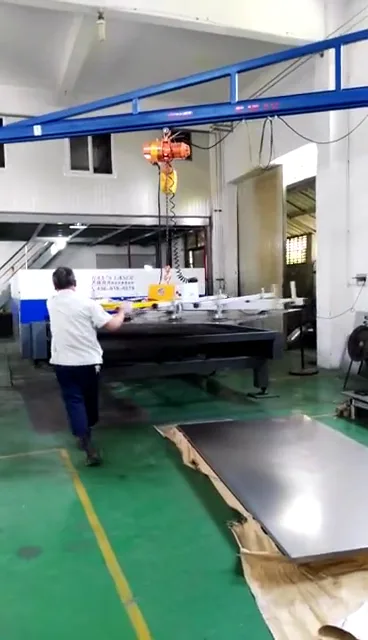
Frame from the sheet-loading demonstration. The workpiece, crane and lifting frame shown are an application reference.
START WITH THE HANDLING METHOD
Equipment options to discuss
Compare the documented 3 m and 5 m arrangements and mains-powered versus battery-powered configurations. Frame span, pad layout and workpiece support matter as well as the load rating. The model PDFs retain the published dimensions and operating conditions.
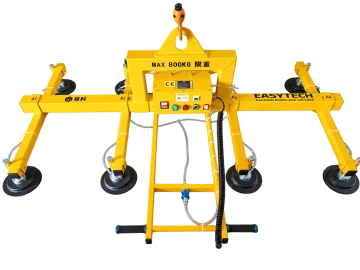
Some images illustrate the equipment series; the supplied configuration may differ.
Thin sheet, heavy plate and large format need different checks
A thin sheet can deflect between pickup points even when it is below the lifter’s nominal capacity. A larger plate may need a different frame span and pad layout. Describe the largest, smallest and thinnest workpieces so that the arrangement can be assessed across the actual range.
Plan the route into the machine
For loading a cutting machine or moving sheets between racks and tables, provide the pickup and placement heights, clear opening and hook position. Include the frame’s own dimensions and the workpiece overhang in the movement envelope. A lifting frame does not provide the crane’s travel or lifting capacity.
Review the surface and the stack
State whether the surface is clean, oily, coated, textured, perforated or covered with film.
Identify cutouts, welds, ribs and regions where a pad cannot form a suitable seal.
Explain how individual sheets are separated from the stack; vacuum gripping alone is not evidence of reliable single-sheet separation.
State whether the task requires horizontal transfer, tilting or rotation. Do not assume all sheet lifters can turn the load.
See a sheet-loading application
Sheet-loading reference footage with a crane system. Machine access and the workpiece must be reviewed for the selected configuration.
Mains or battery power?
Mains-powered frames require a suitable electrical connection and cable arrangement throughout the movement. Battery configurations have charging and operating requirements of their own. Confirm any external compressed-air requirement for the ordered vacuum configuration; do not infer it from the headline power label.
Can I close unused pads and retain the full rated load?
Do not assume that. Reducing the number of active pads changes the lifting arrangement. Pad loading, workpiece support and the permitted configuration need reassessment. Supply the actual sheet size and proposed pad layout.
What information makes a quotation useful?
Provide a simple drawing of the sheet and transfer path, including the machine table, racks and crane. Ask the quotation to state the frame, pad arrangement, vacuum source, controls, supplied accessories and installation responsibilities. Use the complete model PDFs to circulate the proposed configuration internally.
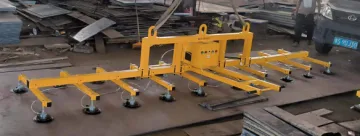
Hello! We received the lifter and I am sending you a picture. Thank you for everything. You are a very good partner! with a wish for a successful day and greetings from me!
The customer confirmed receipt and shared a photograph of the multi-pad lifting frame. The message describes their delivery experience.
Lifter is very good. My only problem is the cable😭😭😭
The customer requested a replacement cable for an Easytech machine with a 2022 nameplate. Their positive comment and the cable problem are both retained. This correspondence does not establish a maintenance-free service life.