Plan repetitive bag and carton transfer around the real package, pickup height and workstation. Compare tube-lifter arrangements and send your application for a configuration quotation.
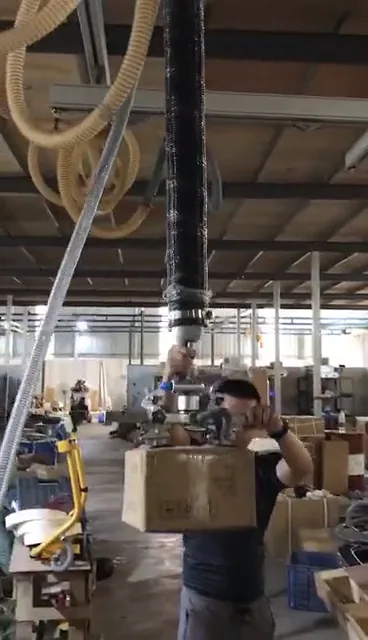
Carton-handling demonstration from the Easytech application footage. Bag handling requires a suitable suction head and a trial on the actual packaging.
START WITH THE HANDLING METHOD
Equipment options to discuss
A fixed workstation and a repositionable system solve different layout problems. The models below provide starting points. For the ETJSQ series, sealed-surface and porous-surface loads differ; keep both conditions with the model specifications.
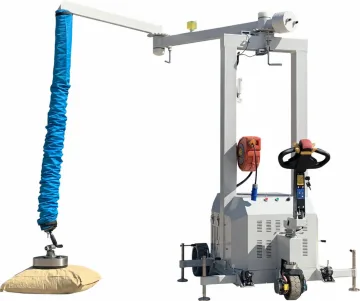
Some images illustrate the equipment series; the supplied configuration may differ.
Paper sacks, woven bags, plastic bags and cartons do not seal in the same way. Seams, folds, labels, damage and loosely filled packaging can affect contact. Send photos of the top, sides and filled package, together with the heaviest and smallest items you expect to handle. A representative sample helps assess a suction head before finalising the configuration.
Choose the workstation arrangement
A jib or rail arrangement suits a defined transfer area. It still needs an agreed support structure, reach and clear path between pickup and placement. A mobile-base arrangement can support a different layout, but relocation, clearance and operating conditions must be reviewed separately. A mobile base does not mean every floor, slope or travel-under-load operation is permitted.
Low pallet pickup: state the lowest package position and the reach into the pallet.
High stacking: state the final stacking height, including the package itself.
Machine feeding: show guards, doors, obstacles and how the load must be released.
Frequent transfers: describe the cycle and operator position; do not choose on maximum capacity alone.
See a carton-handling arrangement
Carton handling with a vacuum tube lifter. Select the head for the package’s contact face and test representative filled packages.
What is included in the system discussion?
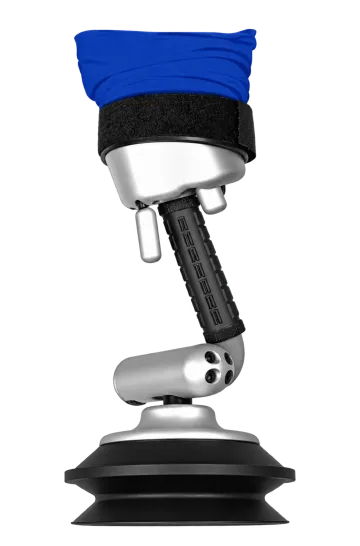
Define the suction head, lift tube, vacuum source, control handle and supporting crane or rail as one handling system. Confirm the electrical supply and installation scope. Quoted equipment should identify what is supplied and what must already exist at your site.
Will one suction head handle all of our packaging?
Possibly, but that cannot be decided from nominal weight. Compare the smallest contact area, seams, porosity and condition across the full package range. If these differ substantially, separate heads or configurations may be necessary.
How do I choose between the stated load values?
Use the value for the relevant surface condition in the selected model’s specifications. A sealed-surface maximum is not a porous-bag rating. Describe the actual packaging and include a sample or clear images in the application review.
The customer shared a video of handling a metal enclosure while discussing the setup. This is a tube-lifter application example; it does not establish performance on bags or cartons.